Beyond the EV Hype: Why E-Bikes Are the Overlooked Economic Solution to Rising Transportation Costs
While electric vehicles dominate the green transportation conversation, the economic logic of personal mobility is quietly shifting. This analysis moves beyond simple fuel cost comparisons to explore how e-bikes challenge the fundamental economics of car ownership. We examine the 'total cost of mobility'—encompassing purchase price, financing, insurance, maintenance, and infrastructure—to reveal why e-bikes represent not just a cheaper alternative, but a disruptive force in urban transportation economics. The article investigates the long-term implications for auto-centric supply chains, urban planning, and household budgets, arguing that the rise of micro-mobility signals a deeper market correction in how we value and pay for personal transit.
Beyond the EV Hype: Why E-Bikes Are the Overlooked Economic Solution to Rising Transportation Costs
While public and policy discourse on sustainable transport remains dominated by electric vehicles (EVs), a more fundamental economic recalculation is occurring at the level of personal mobility. The conversation, often narrowly framed as a transition from internal combustion to electric propulsion, overlooks a more disruptive shift: the challenge to the automobile's economic model itself. This analysis applies a "Total Cost of Mobility" framework to electric cars and e-bikes, examining purchase, financing, insurance, maintenance, and infrastructure. The findings suggest e-bikes are not merely a cheaper alternative but represent a distinct economic category with the potential to fragment traditional automotive demand and reshape urban transportation economics.
The False Dichotomy: It's Not Gas vs. Electric, It's Car vs. Everything Else
The prevailing comparison between gasoline and electricity as fuel sources obscures the primary cost drivers of personal transportation. The "Total Cost of Mobility" framework moves beyond fuel to include depreciation, financing, insurance, maintenance, parking, and registration. Within this model, the fuel cost differential, while significant, is often secondary.
For an electric car, the largest expense remains the vehicle's initial purchase price and its subsequent depreciation. Financing this capital outlay over several years constitutes a fixed, substantial monthly cost. Insurance premiums for vehicles valued at tens of thousands of dollars, alongside scheduled maintenance and tire replacement for a two-ton machine, add recurring financial burdens. Parking, whether through permits, leased spaces, or home garage infrastructure, represents another often-overlooked line item.
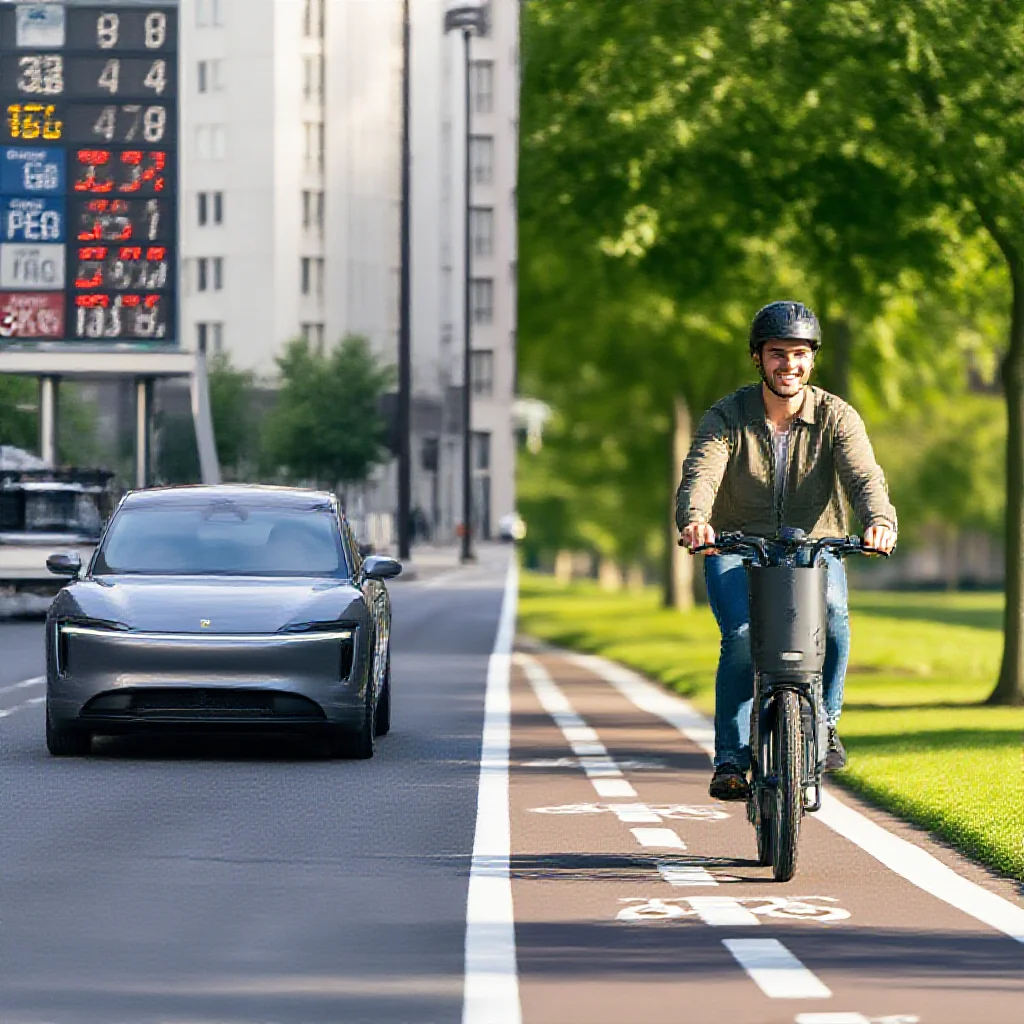
An e-bike operates on a fundamentally different economic principle. Its purchase price is typically an order of magnitude lower, often eliminating the need for financing. Insurance is minimal or non-existent in most jurisdictions. Maintenance costs are fractional, involving simpler components like tires, chains, and brake pads. Parking is virtually free, requiring only a secure rack. By bypassing the traditional automotive cost structure, the e-bike creates a category of mobility where the marginal cost per trip approaches zero, a stark contrast to the high fixed-cost model of car ownership.
The Infrastructure Dividend: How Society Subsidizes Cars and Penalizes Alternatives
The private cost of vehicle ownership is underpinned by a vast, publicly funded infrastructure system. The economic burden of constructing, maintaining, and policing road networks, alongside providing public parking and managing traffic congestion, is distributed across all taxpayers. Studies from urban planning institutes quantify this subsidy. Analysis often shows that public infrastructure and services required to support automobile travel incur a higher public cost per passenger mile compared to investments in cycling and pedestrian infrastructure (Source 1: [Urban Mobility Systems Cost Analysis, ITDP]).
E-bikes are "infrastructure-lite." They require significantly narrower rights-of-way, reducing construction and maintenance costs for dedicated lanes. They impose minimal wear on road surfaces. The space required for secure parking for dozens of e-bikes can be equivalent to a single car parking stall. The economic verification is clear: the public investment needed to facilitate a trip via e-bike is substantially lower than for a car trip, whether electric or gasoline-powered. This represents an "infrastructure dividend" – a potential reduction in public expenditure or a reallocation of funds toward more spatially and economically efficient modes.
Supply Chain Shockwaves: What Happens When Demand Shifts from 2-Ton Vehicles to 50-Pound Bikes?
A sustained shift in consumer preference from cars to e-bikes would send shockwaves through global industrial supply chains. The automotive industry is built on the economies of scale for producing millions of multi-ton vehicles annually, involving complex, capital-intensive supply chains for steel, aluminum, advanced electronics, and lithium-ion battery packs measured in tens of kilowatt-hours.
E-bike manufacturing represents a parallel but distinct ecosystem. While it also uses lithium-ion batteries, the scale is measured in hundreds of watt-hours. The supply chain for frames, motors, and components is less centralized, with a mix of global and regional sourcing. The retail and service model is also different, favoring local bike shops and direct-to-consumer sales over expansive dealership networks. Market analysis indicates that automotive original equipment manufacturers (OEMs) are vulnerable to demand fragmentation, where a small percentage decrease in car sales, displaced by micro-mobility options, can disproportionately impact profitability due to high fixed costs (Source 2: [Automotive Sector Vulnerability Assessment, Industry Analyst Report]).
The Behavioral Economics of Adoption: Cost Savings vs. Perceived Status and Convenience
The rational economic argument for e-bikes confronts deeply ingrained behavioral and cultural norms. The private automobile remains a potent symbol of status, freedom, and convenience. The "sunk cost fallacy" can also impede switching; households with existing car payments and insurance may perceive the vehicle's high fixed costs as unavoidable, delaying the adoption of a cheaper alternative for suitable trips.
However, empirical data from high-adoption regions demonstrates a behavioral shift when infrastructure and culture align. In cities like Copenhagen and Utrecht, where cycling is deeply integrated, household transportation expenditure as a percentage of income is markedly lower than in auto-centric cities of similar wealth. The e-bike, particularly cargo and higher-speed models, expands the practical radius of cycling, making it a viable replacement for a significant portion of urban and suburban car trips. The adoption driver becomes a combination of direct financial benefit, time savings in congested areas, and the health co-benefit, gradually recalibrating the perceived utility equation.
Conclusion: A Market Correction in Personal Mobility
The economic analysis of e-bikes versus electric cars reveals a story beyond environmental sustainability. It signals a potential market correction in the economics of personal transit. The 20th-century model, centered on the private automobile as a universal solution, is being challenged by a mode that offers radically lower capital and operational costs for a defined set of travel needs.
The long-term implication is not the complete disappearance of the car, but a fragmentation of the mobility market. Electric vehicles will likely continue to dominate longer-distance and intercity travel. For dense urban and suburban environments, however, the economic logic increasingly favors lightweight, electric-assisted micro-mobility. This bifurcation will pressure automotive manufacturers to adapt, encourage urban planners to reallocate space more efficiently, and ultimately alter household budget allocations, transferring expenditure from transportation to other sectors of the economy. The rise of the e-bike is, therefore, foremost an economic phenomenon, one that redefines value in personal transportation.