Beyond the Curb: How San Francisco''s EV Charger Plan Exposes the Urban Equity and Grid Strain Crisis
San Francisco''s approval of a curbside EV charger program for residents without off-street parking is more than a simple infrastructure upgrade. This analysis reveals the plan as a critical stress test for urban energy grids and a case study in transportation equity. While addressing a key barrier to EV adoption in dense cities, the initiative uncovers deeper challenges: the hidden economics of public-right-of-way infrastructure, the looming strain on aging local electricity networks, and the potential to reshape real estate values in parking-scarce neighborhoods. We examine the long-term implications for city planning, utility partnerships, and the true cost of democratizing electric mobility.
Beyond the Curb: How San Francisco's EV Charger Plan Exposes the Urban Equity and Grid Strain Crisis

**The Surface Approval: A Nod to Equity and Access**
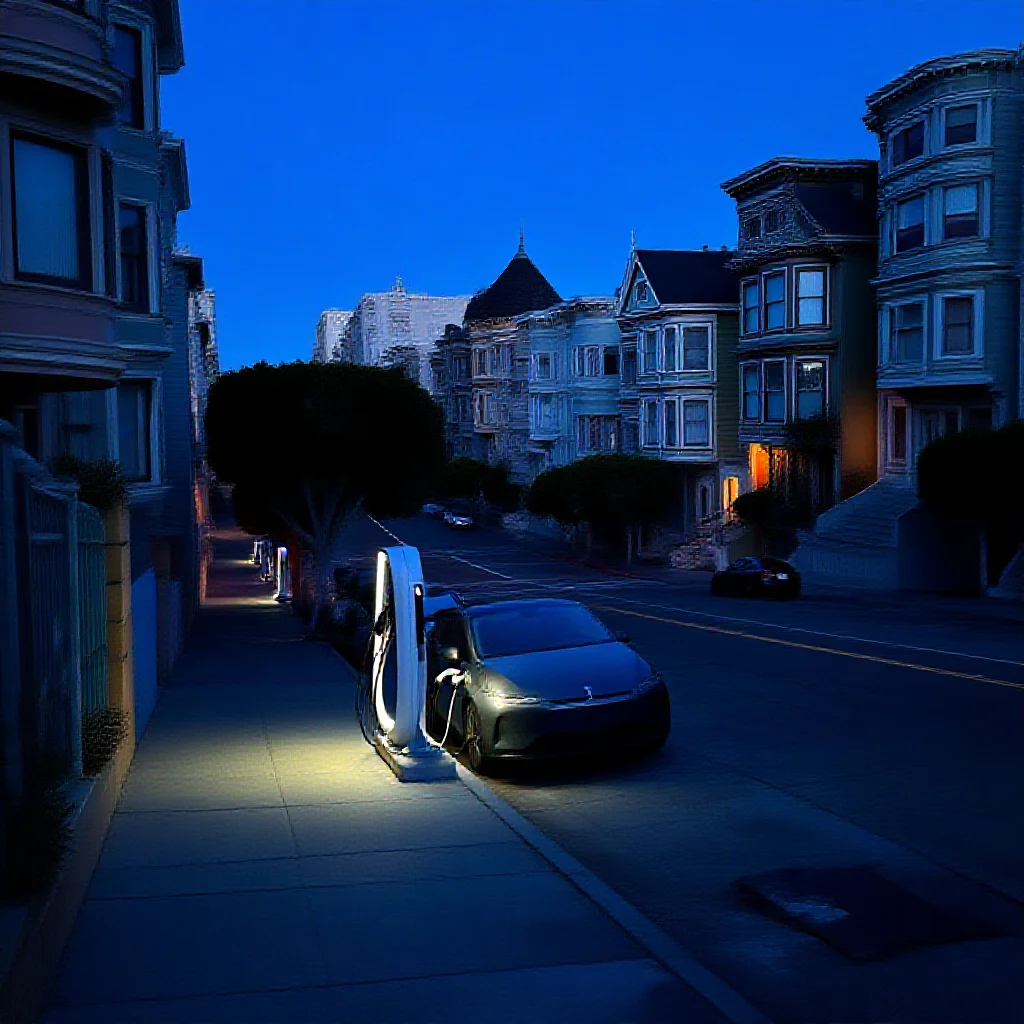
On March 11, 2026, the San Francisco Municipal Transportation Agency (SFMTA) Board of Directors approved a plan to install electric vehicle chargers on city streets (Source 1: [Primary Data]). This initiative authorizes the installation of up to 200 charging ports in its initial phase, directly targeting a significant barrier to EV adoption: residents who lack access to off-street parking such as driveways or private garages.
The decision represents a formal acknowledgment of the "garage gap," a structural inequity in dense urban environments where vehicle ownership is often decoupled from dedicated parking infrastructure. By converting public curbside space from passive storage to active energy delivery, the SFMTA is conducting a controlled pilot. The scale—200 ports—is a strategic choice, designed to test public acceptance, gather critical data on usage patterns, and identify logistical hurdles before considering a city-wide rollout. The program’s management under the municipal transportation authority, rather than a purely private entity, underscores its framing as a public utility and equity project.

**The Hidden Economic Logic: The Curb as a Monetized Public Asset**
Beneath the policy objective lies a fundamental economic redefinition of urban street space. The curb is transitioning from a zone valued primarily for long-term storage (parking) to one valued for on-demand energy delivery (charging). This shift necessitates a new calculus for municipal asset management.
The funding model for this infrastructure remains a pivotal, unanswered question. Analysis indicates three probable pathways: direct user fees creating a new municipal revenue stream; significant upfront capital investment from the city’s budget; or public-private partnerships with utility companies or charging network operators. Each model distributes costs, risks, and operational control differently. The long-term economic implications may extend beyond the curb itself. Reliable, ubiquitous curbside charging could potentially diminish the real estate premium currently commanded by properties with private garages, subtly reshaping property values in parking-scarce neighborhoods.

**The Deep Audit: Grid Strain and the Infrastructure Debt**
The installation of 200 charging ports is a visible symptom of a much deeper, systemic challenge. The true bottleneck for scaling this pilot is not the street-level hardware but the aging electrical infrastructure behind the walls and beneath the streets. Local distribution transformers and secondary lines, many decades old, were not designed for the simultaneous, high-demand load of multiple Level 2 chargers operating overnight in a single city block.
A successful pilot that demonstrates high demand will inevitably stress these localized grid assets. Consequently, the program’s viability is inextricably linked to parallel, unglamorous, and capital-intensive investments in underground electrical infrastructure. The cost of a curbside charger unit is merely the entry fee; the significant "infrastructure debt" of upgrading century-old neighborhood grids constitutes the larger, often unstated financial liability. This creates a direct interdependency between municipal transportation policy and utility capital planning cycles.

**The Unseen Blueprint: A Model for Dense Cities Worldwide**
San Francisco’s pilot program functions as a critical petri dish for global megacities facing similar constraints—from New York and London to Tokyo and Hong Kong. The lessons extracted will extend far beyond installation techniques. The integrated collection and analysis of usage data is paramount. This data must inform dynamic pricing models to manage demand, intelligent load management protocols to protect grid integrity, and evidence-based algorithms for future charger siting to optimize equity and efficiency.
The ultimate strategic goal for any city is not merely the deployment of chargers, but the creation of a flexible, data-driven mobility energy ecosystem. This system must balance equitable access with physical grid constraints, using price signals and smart technology to shape charging behavior. The success or failure of this integration will determine whether curbside charging becomes a sustainable pillar of urban electrification or a source of new inequities and grid instability.
**Neutral Market and Industry Predictions**
The approval of this plan will accelerate competitive responses from charging network operators seeking municipal partnerships. Utility companies will increasingly develop specialized rate tariffs and grid-modernization proposals tailored to dense urban corridors. The hardware market will see intensified R&D into compact, vandal-resistant, and grid-communicative curbside charger designs.
In the longer term, if such programs prove technically and economically viable, a secondary market for "charging rights" or managed charging services may emerge for residents in multi-unit dwellings. Furthermore, city planning departments will be compelled to formally incorporate electrical capacity mapping into their zoning and transportation frameworks, treating ampacity as a foundational resource akin to water or broadband. The San Francisco pilot, therefore, marks a transition from conceptual discussion to operational reality, placing hard engineering and economic questions at the forefront of the urban EV transition.