Beyond the Partnership: How Zoox-Uber''s Geofenced Launch Reveals the Real Strategy of Autonomous Ride-Hailing
The partnership between Zoox and Uber to launch a driverless service in two geofenced metropolitan areas is more than a simple technology deployment. This analysis argues that the move represents a critical strategic pivot for both companies, shifting from a 'scale-first' to a 'profitability-first' model for autonomy. By leveraging Zoox's purpose-built, bidirectional vehicles within tightly controlled zones, the alliance is testing a capital-efficient pathway to commercialization. This article explores the hidden economic logic behind geofencing, the long-term implications for urban mobility infrastructure, and why this controlled launch may be the blueprint that finally makes autonomous ride-hailing a viable business, not just a technological marvel.
Beyond the Partnership: How Zoox-Uber's Geofenced Launch Reveals the Real Strategy of Autonomous Ride-Hailing

Introduction: The Announcement and the Hidden Blueprint
On March 11, 2026, Zoox and Uber announced a partnership to launch a driverless ride-hailing service within specific geofenced zones of two metropolitan areas (Source 1: [Primary Data]). The service will utilize Zoox’s purpose-built, bidirectional, electric autonomous vehicles to transport Uber users. This move is not merely an incremental deployment of autonomous vehicle (AV) technology. It represents a fundamental strategic pivot for the industry, shifting from a "scale-first" to a "profitability-first" model. The deliberate choice of a geofenced launch with specialized hardware is a blueprint for confronting the core economic challenges of autonomous ride-hailing, prioritizing controlled unit economics over uncontrolled geographic ambition.

Deconstructing the Strategy: Why Geofencing is the New Scaling
The operational constraint of geofencing is, in this context, a strategic tool for mastering complexity. The primary economic logic is the containment of the Operational Design Domain (ODD). By limiting the service to meticulously mapped areas, Zoox and Uber can drastically reduce the occurrence of costly and computationally intensive "edge cases"—rare and unpredictable driving scenarios. This containment allows for accelerated software iteration within a known environment, higher predictability of vehicle performance, and more efficient fleet management. The approach contrasts sharply with earlier industry paradigms that prioritized expansive geographic coverage, often leading to unsustainable burn rates as companies attempted to solve for near-infinite variability.
Analysis from firms like Guidehouse Insights and McKinsey & Company has previously highlighted that a significant portion of AV development cost is dedicated to handling low-probability, high-consequence scenarios. The geofenced model explicitly minimizes exposure to these scenarios, thereby controlling the primary cost driver in AV operations. This is not a retreat from scaling but a redefinition: scaling depth of operational mastery within a zone precedes scaling breadth of territory.
The Vehicle as a Strategic Asset: Zoox's Bidirectional Design
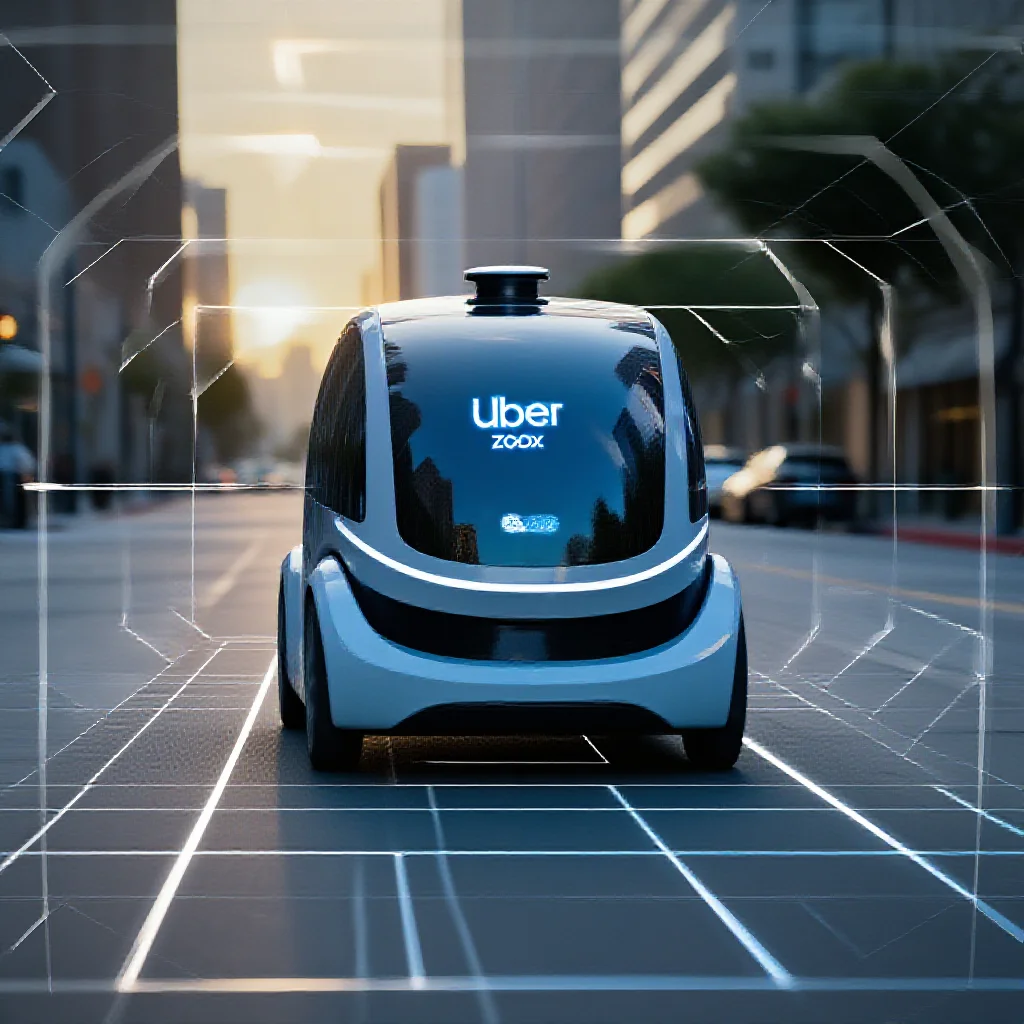
The partnership’s use of Zoox’s purpose-built vehicle is a critical differentiator with profound strategic implications. Unlike retrofitted consumer vehicles, Zoox’s bidirectional, symmetrical, sensor-native design is engineered for a dense, urban, point-to-point mobility service. The vehicle’s ability to move in any direction without traditional U-turns maximizes operational efficiency within a confined geofence, reducing trip time and energy consumption. It is optimized for frequent stops, passenger ingress/egress, and docking in tight spaces.
This hardware choice signals a long-term commitment to a specific service model: high-utilization, autonomous taxis in dense urban cores. It is not a platform designed for suburban highway commuting or long-distance travel. The vehicle is the physical manifestation of a strategy that abandons the goal of a universal autonomous driver in favor of a specialized autonomous mobility service. Technical specifications from Zoox emphasize a design philosophy centered on the passenger experience and fleet operational efficiency, a stark contrast to platforms adapting existing vehicle architectures to autonomy.
The Partnership Calculus: What Uber Gains and Zoox Secures
The symbiosis of this partnership reveals calculated strategic hedging and resource optimization for both entities.
For Uber, the partnership provides access to a differentiated, potentially higher-margin service layer without the catastrophic capital expenditure associated with in-house AV development. It represents a continuation of Uber’s multi-pronged autonomy strategy, previously evidenced by partnerships with Waymo and Aurora, ensuring it is not dependent on a single technology provider. Uber contributes its massive, established demand funnel, consumer brand, and payment infrastructure, effectively acting as the retailer and dispatcher for Zoox’s robotic fleet.
For Zoox, a subsidiary of Amazon, the partnership secures a guaranteed, high-volume deployment channel. The real-world operational data gathered at scale through Uber’s network is invaluable for accelerating the refinement of its autonomous systems. This aligns with Amazon’s overarching strategic focus on logistics and transportation efficiency. The model emerging is akin to an OEM-fleet operator relationship, where Zoox manufactures and maintains the specialized "product" (the vehicle and its driving AI), and Uber manages the customer relationship and demand aggregation.
The Long-Game Impact: Ripples for Urban Mobility Infrastructure
The controlled launch of the Zoox-Uber service establishes a potential template for the phased commercialization of autonomous mobility. Its success or failure will be measured not in miles driven, but in cost per ride, vehicle utilization rates, and safety metrics within the ODD. A successful model would likely catalyze further investment in geofenced, purpose-built AV services for other high-demand corridors, such as airport circuits, university campuses, and central business districts.
This approach also implies a future where urban mobility infrastructure may evolve to accommodate such services, with dedicated pick-up/drop-off zones optimized for bidirectional vehicles. The competition may shift from who has the most expansive map coverage to who has the most efficient and profitable operations within key, high-value zones. The partnership underscores a maturation in the industry, where the formidable challenge of unit economics is being addressed not with more capital alone, but with strategic constraints and symbiotic partnerships. The geofence, therefore, is less a boundary and more a foundation for a viable business model.