The AI Power Paradox: How a Pennsylvania Town''s 1.5-Gigawatt Data Center Exposes the Hidden Costs of the AI Boom
The approval of a massive 2.5 million square foot AI data center campus in West Whiteland Township, Pennsylvania, reveals a critical tension at the heart of the artificial intelligence revolution. While promising economic development, the project's staggering demand for 1.5 gigawatts of power—more than San Francisco—and its reliance on Susquehanna River water for cooling have ignited local controversy and a lawsuit. This case study serves as a microcosm of the broader, often overlooked, infrastructural and environmental burdens placed on small communities by the global race for AI supremacy, questioning the sustainability of current development models.
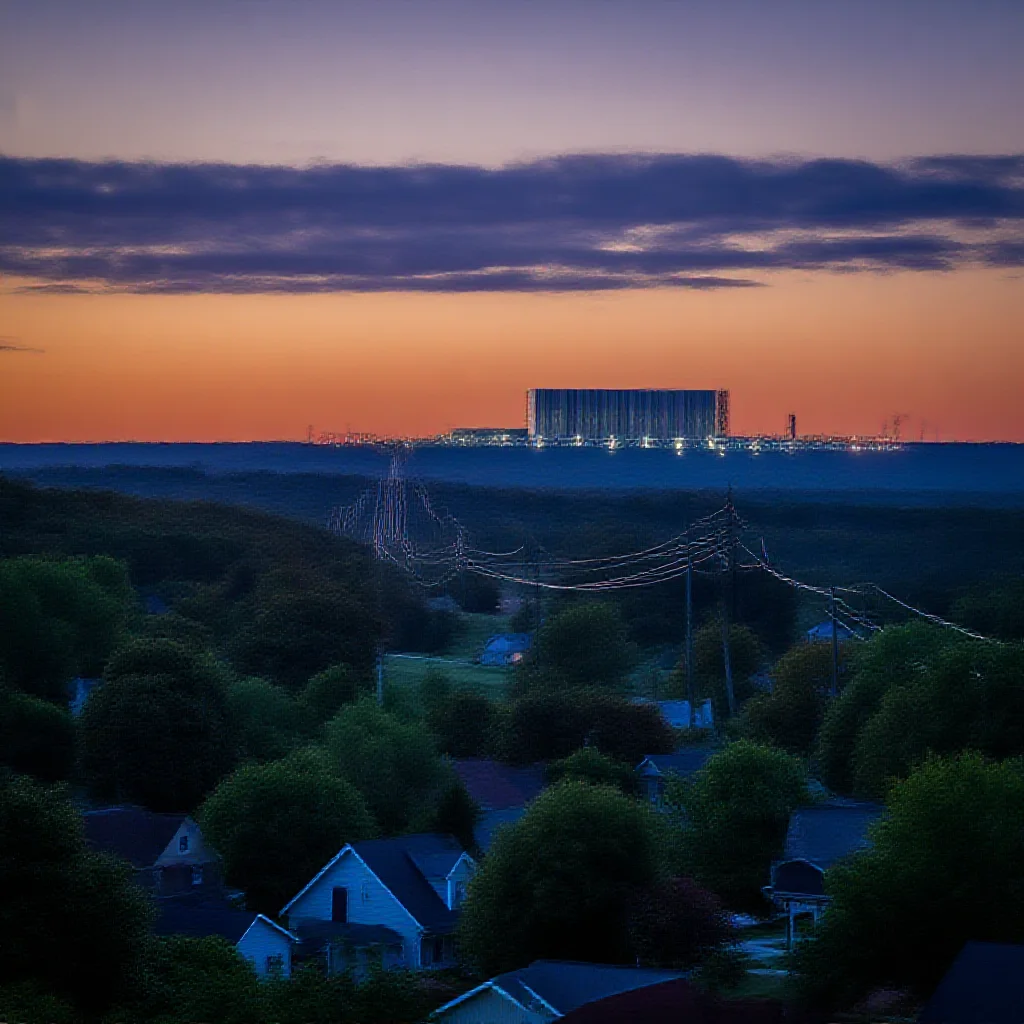
The AI Power Paradox: How a Pennsylvania Town's 1.5-Gigawatt Data Center Exposes the Hidden Costs of the AI Boom

**Introduction: West Whiteland's Unlikely Role in the AI Arms Race**
West Whiteland Township, a community in Chester County, Pennsylvania, has become an unexpected frontline in the global competition to build artificial intelligence infrastructure. In April 2024, the township's Board of Supervisors approved the development of a 2.5 million square foot data center campus on a 414-acre site (Source 1: [Primary Data]). The project, proposed by developer QTS Data Centers, is designed specifically for power-intensive AI computing workloads. This approval has ignited significant local controversy, culminating in a lawsuit filed by residents in May 2024 (Source 2: [Primary Data]). The case presents a core paradox: a locally sanctioned project whose scale introduces monumental infrastructural and environmental demands, challenging the township's character and resources. This project serves as a focused lens through which to examine the often-overlooked physical and community costs of the rapidly expanding digital AI economy.
*[Image Suggestion: A map highlighting West Whiteland Township within Chester County, Pennsylvania, with an inset showing the 414-acre project site.]*
**Deconstructing the Scale: More Than Just a Data Center**
The operational requirements of the proposed campus quantify the material footprint of advanced AI.
**Power Demand:** The facility is projected to require up to 1.5 gigawatts of electrical power (Source 3: [Primary Data]). For contextualization, this demand exceeds the average power consumption of the city of San Francisco, which has a population of over 800,000. A single industrial campus in a township of approximately 20,000 residents would command a comparable load, highlighting a disproportionate draw on regional grid capacity.
**Water Calculus:** The cooling systems for the servers will source water from the Susquehanna River basin (Source 4: [Primary Data]). This reliance on a shared regional water resource introduces a variable cost, particularly under conditions of climate volatility where drought or low-flow periods could create tension between data center operations, municipal needs, and ecological health. The permanent withdrawal of significant volumes for industrial cooling represents a long-term hydrological commitment.
**Land Use Transformation:** The project entails the conversion of 414 acres of local landscape into a 2.5 million square foot industrial-tech campus (Source 5: [Primary Data]). This represents a permanent physical and visual alteration of the township, shifting its economic base and environmental profile from its previous state.
*[Image Suggestion: An infographic comparing the 1.5 GW power demand to the usage of well-known cities or landmarks.]*
**The Approval Paradox: Local Governance Meets Macro-Economic Forces**
The decision-making process in West Whiteland reveals the tension between localized governance and macro-economic imperatives.
The township board's approval balanced projected benefits—primarily significant new tax revenue and the creation of technical and construction jobs—against resident concerns regarding noise, environmental impact, and strain on local infrastructure (Source 6: [Primary Data]). The subsequent lawsuit filed by residents challenges the procedural and substantive adequacy of the project's impact assessments. This legal action can be framed not merely as opposition to change, but as a procedural test of whether existing municipal review frameworks are equipped to evaluate projects of a novel scale and technological character.
The location within Chester County is likely not incidental. The region may be positioning itself as a strategic corridor for data infrastructure, leveraging its proximity to major population centers on the Eastern Seaboard, existing power transmission networks, and fiber optic backbones. The West Whiteland case may therefore represent a leading indicator of a broader regional development strategy.
**The Hidden Economic Logic: Why Here, Why Now?**
The site selection and development model follow a distinct economic logic that extends beyond low land costs.
The primary drivers are infrastructural: proximity to high-capacity power transmission corridors and robust fiber optic networks. These are non-negotiable inputs for AI data centers, making locations with such access disproportionately valuable. The developer, QTS Data Centers, employs a recognizable playbook, targeting ex-urban and semi-rural areas where large parcels are available and zoning may be more amenable to rapid, large-scale industrial development than in dense urban cores. This model can exploit gaps between local regulatory experience and the unprecedented scale of modern data center projects.
The long-term fiscal bargain for the township remains an open variable. While short-term tax gains are quantifiable, the long-term municipal costs—including accelerated wear on roadways from construction and service vehicles, demands on emergency services, and potential needs for upstream grid or water infrastructure upgrades—may be partially externalized to residents or regional utilities. The net fiscal benefit depends on the contractual structure and the allocation of these future liabilities.
*[Image Suggestion: A diagram showing the convergence of key infrastructure—high-voltage power lines, fiber optic trunks, and water access—at the project site.]*
**Conclusion: A Microcosm of Macro Trends**
The West Whiteland project is a microcosm of a global pattern. The AI boom necessitates physical infrastructure of a historically large scale, and this infrastructure must be located somewhere. The analysis indicates a trend where the "somewhere" is increasingly communities at the periphery of major metropolitan areas, selected for infrastructural adjacency rather than population centers.
The resident lawsuit and ongoing controversy are predictable outcomes of this model, representing a market and social friction point. The logical deduction is that for the AI infrastructure build-out to continue at its projected pace, one of two adaptations must occur: either development models will evolve to incorporate more substantial impact mitigation and community integration from the outset, or development will progressively shift to regions with even fewer regulatory and political constraints, potentially exporting these tensions. The resolution in West Whiteland will provide a consequential case study for other municipalities, developers, and policymakers navigating the same convergence of technological ambition and local reality.