Beyond the Panels: How California''s Westlands Water District is Betting Its Future on a 21 GW Solar-Battery ''Crop''
The Valley Clean Infrastructure Plan (VCIP) proposes a radical transformation of California's Westlands Water District, converting 136,000 fallowed acres into a 21-gigawatt solar and battery storage facility. More than a clean energy project, it's a strategic pivot for a region crippled by decades of water scarcity, aiming to replace lost agricultural revenue with a new, sun-harvested 'crop.' This analysis explores the hidden economic logic of repurposing water rights and land assets, the project's role as a massive grid-stabilizing battery, and the complex socio-economic trade-offs of turning the nation's fruit basket into a power plant. The plan represents a landmark case study in climate adaptation, energy infrastructure, and the future of resource-scarce agricultural economies.
Beyond the Panels: How California's Westlands Water District is Betting Its Future on a 21 GW Solar-Battery 'Crop'

Introduction: A Sinking Ship and a Solar Lifeline
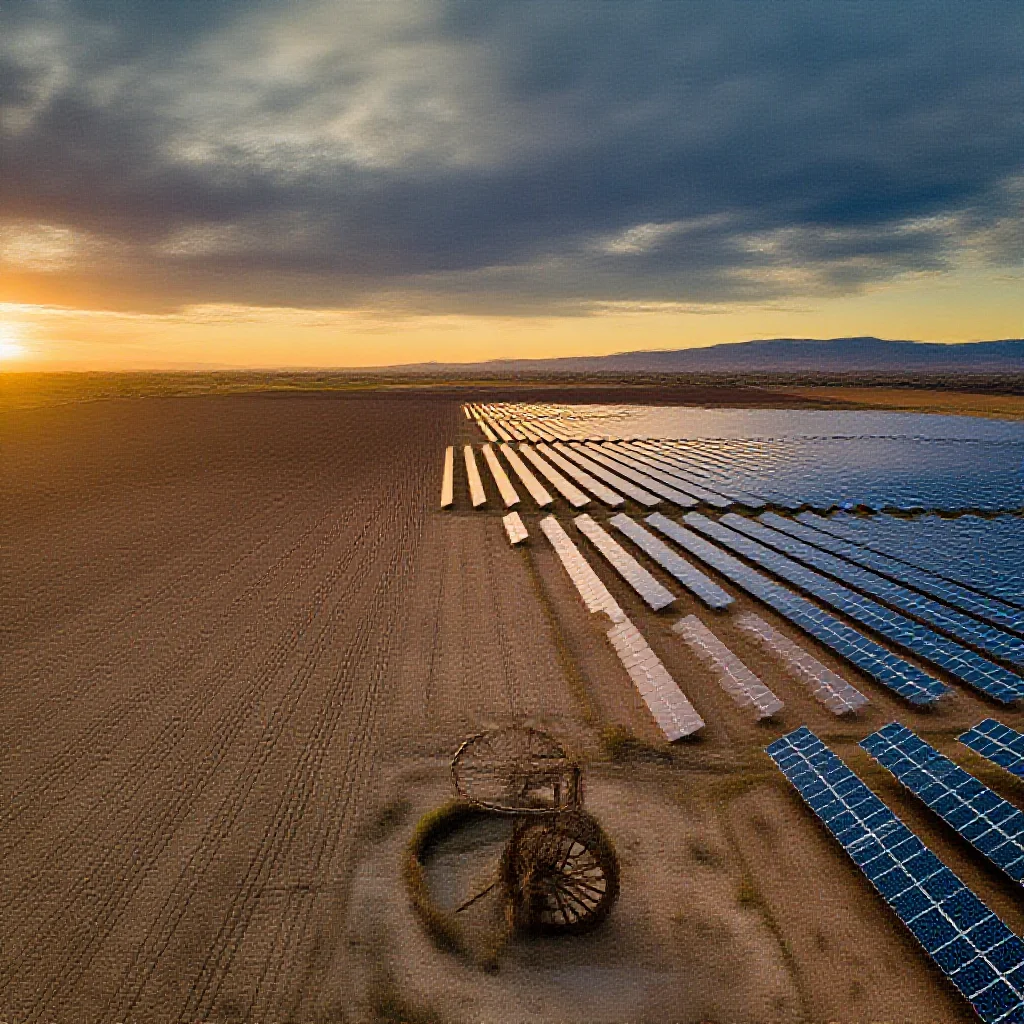
"Our hand is forced. Everyone’s in the same sinking ship together," stated Jeff Fortune, a representative for the project developer Golden State Clean Energy (Source 1: [Primary Quote]). This sentiment encapsulates the strategic calculus behind the Valley Clean Infrastructure Plan (VCIP), a proposal to convert 136,000 acres of fallowed agricultural land within California's Westlands Water District into a 21-gigawatt battery-backed solar power facility (Source 2: [Primary Data]).
The Westlands Water District, a 1,000-square-mile territory containing 614,000 acres of farmland, is a cornerstone of U.S. agricultural production, responsible for roughly a quarter of the nation's food crops, including 40% of its fruits and nuts (Source 3: [Primary Data]). However, since the 1990s, surface-water cutbacks have led to the fallowing of hundreds of thousands of acres, stranding both land and water rights (Source 4: [Primary Data]). The VCIP, a collaboration between the district and Golden State Clean Energy, is not merely an energy project. It is a systemic survival strategy, proposing to replace lost agricultural revenue with a new, sun-harvested commodity.

The Hidden Economic Logic: Water Rights as Energy Capital
The financial architecture of the VCIP is predicated on the conversion of stranded assets into productive capital. The core mechanism involves repurposing perpetual water allocations—rendered valueless on fallowed land—into a guaranteed revenue stream for solar development. This transforms a liability into an engine for infrastructure investment.
A rational analysis reveals the shift in resource optimization. The economic yield per unit of water, historically measured in crop output, is being recalibrated. The "new crop" metaphor, as articulated by Jeremy Hughes of Woolf Farming & Processing, involves comparing the net revenue from almond or fruit farming per acre-foot of water against the projected revenue from solar electricity generation funded by the sale or lease of associated water rights (Source 5: [Primary Quote]). Early contractual evidence suggests landowners find this trade-off viable; approximately 150 contracts have been signed by growers to make land available, including about 800 acres from a single family (Source 6: [Primary Data]).
The landowner lease model further alters the region's fundamental risk profile. By retaining land ownership and leasing to developers, farmers can secure long-term, drought-proof annuities. This creates a financial buffer against hydrological volatility, decoupling community and individual economic stability from the increasingly unreliable water supply that has defined the district's recent history.

The Grid Architecture Play: 21 GW of Power and its Panacea Potential
The scale of the VCIP proposal—21 GW of solar paired with storage—demands analysis beyond generation capacity addition. It represents a potential foundational asset for California's grid stability. For context, the state's entire operational generating capacity from all sources was approximately 80 GW in 2023. The integration of a resource of this magnitude, concentrated in a single, sun-rich zone, is a grid architecture decision with systemic implications.
A critical component is the proposed new transmission network. Its strategic value lies in its potential to relieve chronic congestion on existing pathways and establish a high-capacity conduit from the Central Valley to coastal load centers. This infrastructure would not only serve the VCIP but could unlock further renewable development in the region.
The "battery-backed" specification is the linchpin of the project's claim to provide firm, dispatchable power. The technical details of storage duration and capacity will determine whether the facility acts as a daytime peaker or a true reliability resource capable of addressing the critical evening net peak. Analysis of California Independent System Operator (CAISO) reliability reports indicates a pressing need for long-duration storage and generation that can ramp after sunset. The VCIP’s storage component, if sufficiently scaled, is designed to meet this precise market signal, transforming intermittent solar into a schedulable product.
The Socio-Economic Calculus: Trade-offs in the Nation's Fruit Basket
The conversion of agricultural land to industrial energy production entails complex socio-economic trade-offs. The district's board approved the programmatic environmental impact report for VCIP in December 2025, initiating a multi-year process with an estimated completion timeline of a decade or more (Source 7: [Timeline Data]).
State law mandates the inclusion of a community benefits plan, a requirement that acknowledges the potential for disruptive local effects (Source 8: [Primary Data]). The economic proposition for local governments involves replacing potentially declining property tax bases from fallowed land with new revenue from solar installations. For farmworkers, the transition from seasonal agricultural labor to potentially fewer, more technical operations and maintenance jobs represents a structural shift in the local labor market. Proponents argue, as Jeff Fortune noted, that making the district more sustainable "helps the grower, it helps the communities, it helps the farmworkers — everybody" (Source 9: [Primary Quote]). The validity of this claim will be determined by the specific implementation of the community benefits agreement and the project's ability to generate ancillary local economic activity.
Conclusion: A Landmark Case in Climate Adaptation
The Valley Clean Infrastructure Plan is a landmark case study in the adaptation of resource-scarce agricultural economies. It demonstrates a logical, asset-repurposing response to intersecting crises of water scarcity and grid decarbonization needs.
The future trajectory of the VCIP will be dictated by several factors: the finalization of power purchase agreements with major offtakers like Pacific Gas & Electric and Southern California Edison, the timely permitting and financing of the new transmission lines, and the evolving economics of both battery storage and agricultural commodities. Its progression will be closely monitored as a precedent. Similar regions facing hydrological stress may find the Westlands model—leveraging water rights for energy capital and leasing land for long-term income—a replicable template for economic transition. The project signifies a pragmatic, if profound, redefinition of land use and wealth generation in the American West, where the most valuable harvest may no longer be measured in bushels, but in megawatt-hours.