Beyond IPCC Projections: Why New Climate Sensitivity Data Signals a Faster, More Disruptive Warming Era
A landmark 2023 study published in Nature Reviews Earth & Environment reveals a critical recalibration of Earth''s climate sensitivity, suggesting it is significantly higher than the IPCC''s established range. This analysis, led by institutions like the University of Leeds and the Met Office Hadley Centre, indicates a ''likely'' warming range of 3.1°C to 4.1°C per doubling of CO2, up from 2.5°C to 4°C. The practical consequence is stark: a 50% probability of breaching the 1.5°C threshold by 2029, years ahead of previous IPCC estimates. This article explores the hidden economic and systemic implications of this accelerated timeline, arguing it represents not just a scientific update but a fundamental shift in risk assessment for global infrastructure, finance, and adaptation planning.
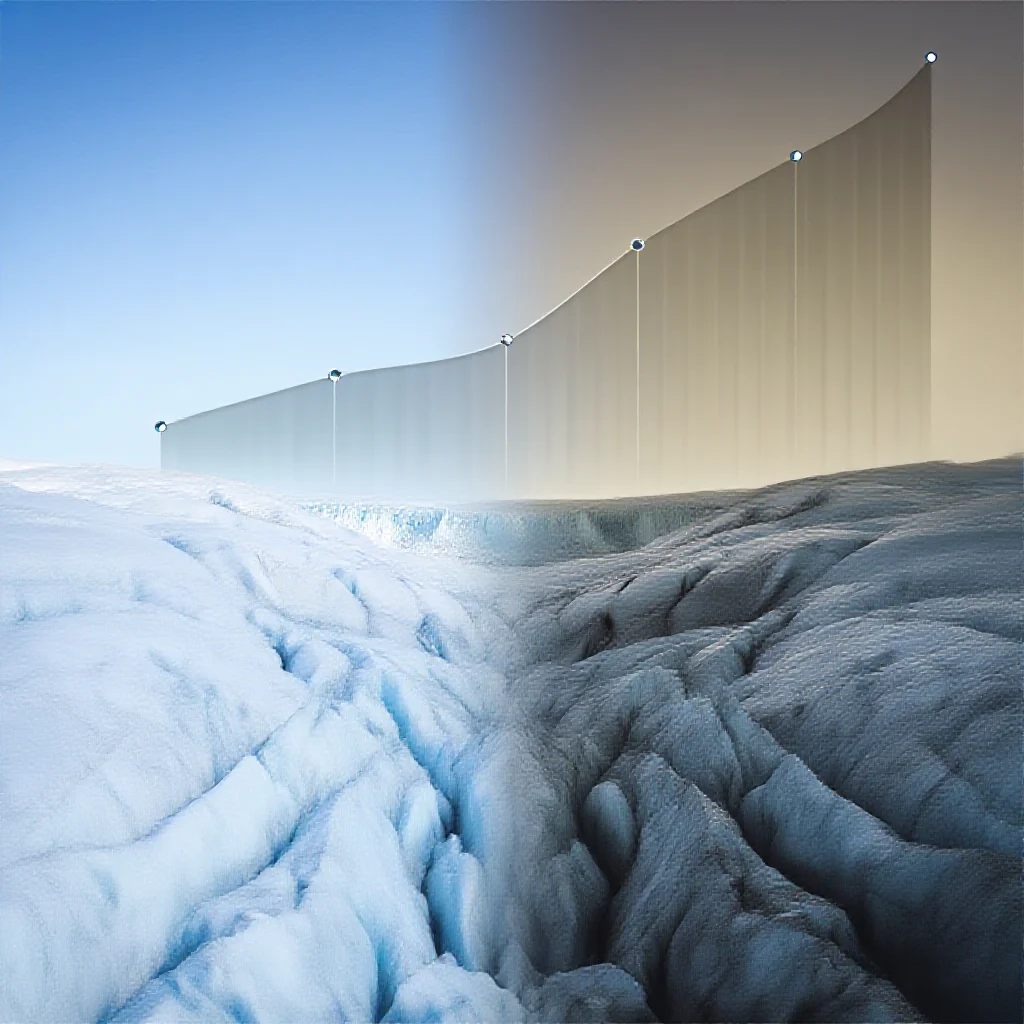
Beyond IPCC Projections: Why New Climate Sensitivity Data Signals a Faster, More Disruptive Warming Era
A 2023 study published in *Nature Reviews Earth & Environment* has recalibrated a core metric of climate science, indicating that the planet’s climate system is more reactive to greenhouse gases than previously established. The analysis, conducted by researchers from institutions including the University of Leeds and the Met Office Hadley Centre, revises the "likely" range for Equilibrium Climate Sensitivity (ECS) upward (Source 1: [Primary Data]). This shift, from the Intergovernmental Panel on Climate Change’s (IPCC) 2.5°C to 4°C range to a new span of 3.1°C to 4.1°C per doubling of atmospheric CO₂, carries profound implications for the projected timeline of warming and the associated systemic risks to global economic and infrastructural stability.
The Tipping Point in the Data: Recalibrating Earth's Climate Thermostat
The central finding of the study is a statistically significant narrowing and upward shift of the ECS range. Equilibrium Climate Sensitivity represents the long-term global surface warming following a sustained doubling of atmospheric carbon dioxide concentrations. The IPCC’s Sixth Assessment Report, a synthesis of thousands of studies, established a "likely" range of 2.5°C to 4°C (Source 1: [Primary Data]). The 2023 analysis refines this to 3.1°C to 4.1°C (Source 1: [Primary Data]).
The scientific significance lies not in the extremes of the range but in the shift of the probability distribution. A higher central estimate increases the probability of more severe warming outcomes for any given emissions pathway. This recalibration suggests that previous climate model ensembles may have underrepresented the frequency of higher-warming scenarios. The revision is attributed to improved understanding of climate feedback mechanisms, particularly cloud adjustments and the interplay between atmospheric warming and surface albedo changes.
The Accelerated Timeline: From Distant Threat to Imminent Reality
The practical consequence of a higher climate sensitivity is an accelerated timeline for crossing critical warming thresholds. The study calculates a 50% probability that global warming will reach 1.5°C above pre-industrial levels by 2029 (Source 1: [Primary Data]). This contrasts with the IPCC’s estimate of a 50% chance of reaching that threshold between 2030 and 2035 (Source 1: [Primary Data]).
This temporal compression has immediate economic logic. Long-duration capital investments—in coastal infrastructure, agricultural development, energy systems, and urban planning—are predicated on risk assessments with defined time horizons. An earlier breach of the 1.5°C threshold invalidates the cost-benefit calculations underpinning projects designed for a slower warming curve. The policy implication is a widening "implementation gap." Nationally Determined Contributions (NDCs) and net-zero pledges calibrated to older IPCC timelines are rendered potentially insufficient, requiring urgent and substantive revision to meet the same temperature goals.
Beyond Temperature: The Cascade of Systemic Risks
The revised sensitivity data necessitates an audit of second and third-order impacts on systems with high inertial momentum.
**Supply Chain Deep Audit:** Global trade and production networks are optimized for historical climate stability. An accelerated warming timeline brings forward the disruption of climatic "chokepoints." Increased frequency of extreme heat in agricultural breadbaskets threatens yield stability sooner. Intensified storm surges and sea-level rise compromise port operations and coastal logistics hubs. Drought conditions could impair inland waterways and hydropower-dependent industrial regions more frequently. Adaptation plans for these nodes, often based on prior IPCC timelines, face obsolescence.
**Financial & Insurance Reckoning:** Financial risk models and actuarial tables are built on historical data and forward projections that may now be outdated. The higher probability of earlier, more intense physical climate events increases the likelihood of a abrupt repricing of climate-vulnerable assets. This could trigger a "climate Minsky moment," where the sudden recognition of stranded assets and uninsurable properties leads to cascading market corrections. The insurance industry’s capacity to underwrite risk in increasingly volatile zones will be tested sooner, potentially leading to widespread withdrawal of coverage and transferring untenable costs to public balance sheets and private entities.
Neutral Market and Industry Predictions
Based on the logical implications of the revised climate sensitivity data, several predictions can be formulated.
1. **Accelerated Capital Reallocation:** Investment flows will shift more rapidly toward climate resilience engineering and adaptive technologies. Sectors involved in water management, grid hardening, and climate-resilient construction will see accelerated demand. 2. **Repricing of Long-Dated Assets:** Valuation models for infrastructure, real estate, and sovereign bonds will increasingly incorporate forward-looking climate stress tests based on the new sensitivity range, leading to a premium for "low-exposure" assets and a discount for vulnerable ones. 3. **Contraction in Traditional Insurance Markets:** The geographic scope of insurable risk at conventional premiums will contract faster than previously anticipated, spurring growth in parametric insurance products and increasing calls for public-private risk pooling mechanisms. 4. **Increased Scrutiny of Corporate Transition Plans:** Investors and regulators will apply greater pressure on corporations to demonstrate that their decarbonization and adaptation strategies are aligned with the accelerated warming timeline implied by the latest climate sensitivity research.
The 2023 study in *Nature Reviews Earth & Environment* represents more than a scientific update; it is a fundamental recalibration of the baseline for physical climate risk. The upward revision of Equilibrium Climate Sensitivity and the consequent forward shift in the 1.5°C threshold timeline demand a commensurate acceleration in financial, industrial, and policy responses. The data indicates that the period for orderly adaptation is shorter than previously understood.