Beyond the Pivot: How Fiber Optic Soil Sensing Exposes the Hidden Inefficiency of Uniform Irrigation
A University of Nebraska-Lincoln study, published in The Leading Edge, reveals a critical flaw in modern agriculture's reliance on uniform irrigation. By burying fiber optic cables to measure soil temperature at high resolution, researchers documented soil moisture varying by up to a factor of two within a single 60-acre, center-pivot irrigated field. This granular data, collected every meter and 20 minutes, challenges the economic and environmental logic of one-size-fits-all water application. The findings point toward a future of precision irrigation, where real-time, distributed soil data could dynamically guide water systems to optimize resource use, crop yield, and farm profitability, signaling a potential shift in the underlying value proposition of agricultural technology.
Beyond the Pivot: How Fiber Optic Soil Sensing Exposes the Hidden Inefficiency of Uniform Irrigation
The Illusion of Uniformity: A High-Resolution Reality Check
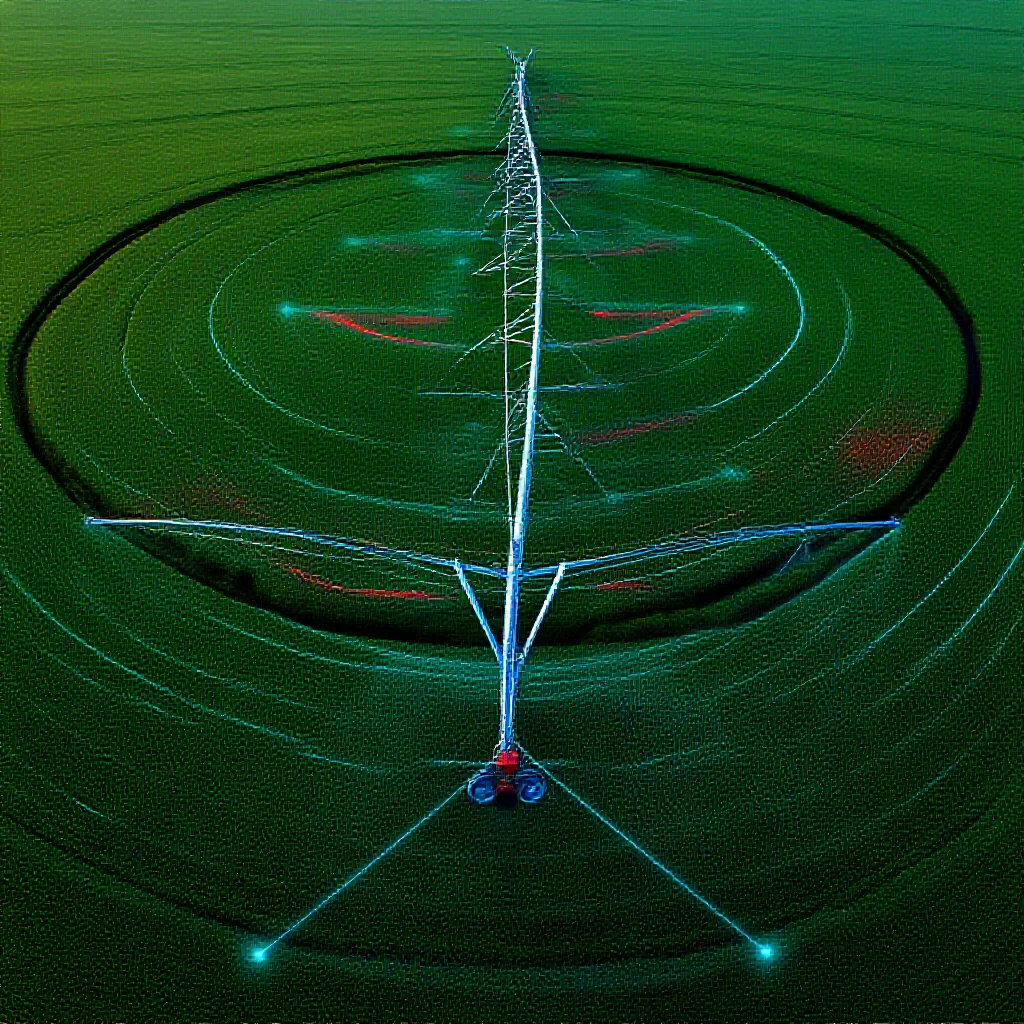
Modern agriculture operates on a foundational paradox. While fields are managed as uniform blocks, the soil beneath is inherently variable. A study from the University of Nebraska-Lincoln, published in *The Leading Edge*, provides a high-resolution reality check on this disconnect. Researchers buried fiber optic cables four inches deep in a 60-acre, center-pivot irrigated field in Nebraska (Source 1: [Primary Data]). By measuring soil temperature—a proxy for water content—every meter along the cable at 20-minute intervals over seven days in July 2023, they documented soil moisture varying by up to a factor of two within the single, managed field (Source 2: [Primary Data]).
This granularity represents a technological leap. As study author Jie Tian noted, "We can measure temperature every meter along the cable... That’s a big advantage" (Source 3: [Primary Quote]). This continuous, distributed sensing contrasts sharply with traditional point-sampling methods, which can miss critical micro-variations. The resulting data transforms the abstract concept of "field variability" into a quantifiable, mappable fact, directly challenging the operational logic of applying water uniformly across such a heterogeneous substrate.
The Hidden Economic Logic: Water as a Precision Input, Not a Bulk Commodity
The economic implication of the documented variability is a direct inefficiency in resource allocation. Uniform irrigation in such a field results in the simultaneous over-application of water to already-wet zones and under-application to dry zones. This represents a dual financial loss: wasted expenditure on pumped water and energy, and forfeited potential crop yield in moisture-starved areas. The input cost is incurred without achieving the optimal output.
The study’s data points toward a recalibration of water’s role in agronomic management—from a bulk commodity to a precision input. This shift in perception alters the underlying value proposition of agricultural technology. The focus moves from the sale of water application hardware, like center pivots, toward integrated systems offering data-as-a-service and variable-rate control. The research objective, as articulated by Tian, aligns with this economic optimization: "We’re hoping that this technology would be able to see the distribution of soil moisture... and then adjust the irrigation" (Source 4: [Primary Quote]). The transition from seeing to adjusting encapsulates the move from diagnostic monitoring to prescriptive, profit-maximizing action.
From Lab to Landscape: The Scalability and Verification Challenge
The Nebraska study, while compelling, defines the scope of the current challenge. The data represents a seven-day snapshot from July 2023 on a single field (Source 5: [Primary Data]). Verifying patterns and building robust predictive models for irrigation scheduling requires longitudinal, multi-season data across diverse soil types, crops, and climates. The involvement of USDA researcher Michael H. Cosh in the study lends credibility to its agricultural applicability beyond an academic proof-of-concept, signaling recognition of the technique’s potential at the institutional level.
Scalability presents practical hurdles. The capital cost of fiber optic deployment, the complexity of data management, and the integration of real-time soil maps with existing farm machinery and decision-support systems are significant barriers to widespread adoption. The technology must prove not only its diagnostic accuracy but also its operational reliability and return on investment under commercial farming conditions. The timeline from the July 2023 data collection to the 2024 publication marks an initial phase of scientific validation; the subsequent phase will be defined by commercial piloting and cost-benefit analyses.
Neutral Market/Industry Predictions
Based on the cause-and-effect relationship established by the research, several industry trajectories can be logically deduced. The demand for higher-resolution soil data will intensify, accelerating development in both fiber optic and competing sensing technologies (e.g., electromagnetic, cosmic-ray neutron sensing). Agricultural technology providers will increasingly bundle sensing hardware with analytics software and control systems, moving toward closed-loop, automated irrigation platforms.
The market for traditional irrigation equipment will not disappear but will evolve. Center-pivot manufacturers will likely integrate variable-rate irrigation (VRI) capabilities as a standard or premium feature, transforming the pivot from a uniform water distributor into a precision application tool. The primary competition will center on data interoperability and the ability to translate subsurface conditions into actionable, profitable agronomic prescriptions. The ultimate adoption curve will be determined by the convergence of declining technology costs, compelling field-scale ROI data, and regulatory or resource pressures on water use.