Eco Visuals

The Melting Business: How Iceland''s Glacier Tourism Industry Is Adapting to Climate Change

Iceland's iconic glaciers, covering 10% of the country, are receding at an alarming rate, losing 250 cubic kilometers of ice in 25 years. Yet, glacier tourism is booming, with over 2.3 million visitors to Vatnajökull National Park in 2023. This article explores the paradoxical relationship between a climate-threatened natural resource and a growing industry. We analyze how operators are forced to adapt—constantly moving tour starting points, deploying crevasse radar for safety, and following new government guidelines—while the very attraction they sell disappears. The piece uncovers the hidden economic logic of a tourism sector built on a vanishing foundation and its long-term viability.

4 min read
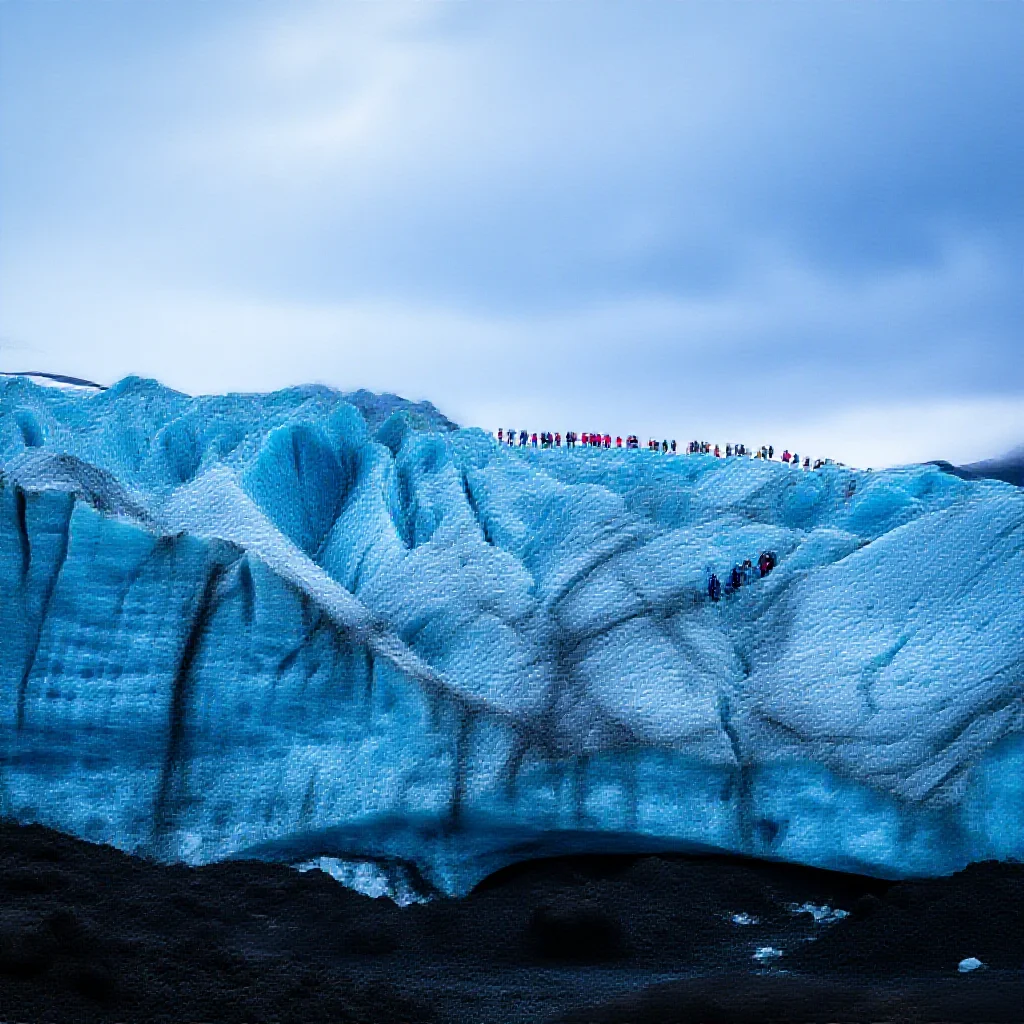
The Melting Business: How Iceland''s Glacier Tourism Industry Is Adapting to Climate Change

The Melting Business: How Iceland's Glacier Tourism Industry Is Adapting to Climate Change

Introduction: The Paradox of Vanishing Ice and Booming Business Iceland’s glaciers, which cover approximately 10% of the nation’s landmass, are receding at a quantifiable rate. Over the past 25 years, these ice masses have lost an estimated 250 cubic kilometers of volume (Source 1: [Primary Data]). Concurrently, the tourism industry built upon them is experiencing significant growth. In 2023, over 2.3 million people visited the Vatnajökull National Park region, and a 2022 report documented a 6% year-on-year increase in glacier tour participants (Source 2: [Icelandic Tourist Board Report]). This establishes a fundamental paradox: a major economic sector is expanding its operations on a core natural resource that is actively diminishing due to the same global systems that facilitate international travel.

The Shrinking Stage: Quantifying the Glacial Retreat The physical transformation of the landscape is not a future projection but a present operational variable. The Sólheimajökull glacier, a popular destination for guided walks, has retreated more than one kilometer since 2010 according to monitoring by the Icelandic Meteorological Office (Source 3: [Icelandic Meteorological Office monitoring]). This retreat is not an abstract environmental metric; it directly dictates logistical and financial decisions for tour companies. Operators are compelled to repeatedly relocate tour starting points and access routes to maintain contact with the receding ice front. This constant geographical shift represents a direct, recurring capital and labor cost attributable to climate change, embedded in the operational budget of glacier tourism.

The Adaptation Economy: Safety and Logistics in a Dynamic Landscape The industry’s response has evolved from simple guiding to a technology-augmented risk management model. The dynamic formation of new crevasses and the instability of ice margins necessitate advanced safety protocols. The deployment of crevasse detection radar by some operators exemplifies this shift, representing a tangible capital investment in adaptation. This operational adaptation has been formalized at an institutional level. The Icelandic Tourism Association has published updated safety guidelines for glacier visits, codifying reactive measures into standardized industry practice (Source 4: [Icelandic Tourism Association Guidelines]). This institutionalization indicates the transition of climate adaptation from an ad-hoc concern to a core component of business compliance and insurance liability frameworks.

The Long-Term Calculus: Tourism on a Borrowed Landscape A technical audit of this sector reveals an underlying economic structure predicated on a non-renewable raw material. The glacier functions as the essential "inventory" for the experience product. The long-term viability of the industry hinges on the rate of inventory depletion versus the capacity for product substitution or market transformation. Two divergent economic pathways emerge. First, as glaciers recede into higher, less accessible terrain, the cost of delivering the experience will rise, potentially compressing profit margins. Second, the narrative surrounding the tours may shift, marketing the experience as a "last-chance" opportunity. This could alter visitor demographics and spending patterns, potentially increasing short-term revenue per customer while simultaneously shortening the overall lifespan of the business model. The break-even point between accessibility and practical dissolution remains an unresolved variable in the sector’s financial projections.

Conclusion: Navigating an Uncertain Future The Icelandic glacier tourism sector is engaged in a dual-track process. The "fast analysis" track monitors annual visitor statistics and immediate operational adaptations. The more critical "slow analysis" track involves a deep structural assessment of an industry whose foundational asset has a finite and contracting lifespan. Current adaptations in safety and logistics manage proximate risks and costs but do not address the terminal trajectory of the resource. The central question for stakeholders is whether the current model represents a framework for resilient adaptation or a systematic management of core asset decline. The future valuation of this sector will be determined by its success in either decoupling its value proposition from the physical ice or in accurately timing its market exit. The outcome will serve as a case study in the economics of tourism built upon ephemeral natural capital.