California''s EV Charging Mandate Clash: Equity, Infrastructure, and the Future of Urban Electrification
California''s pioneering mandate requiring EV charging access in new multifamily buildings is facing a legislative challenge. A newly introduced bill seeks to limit this requirement for affordable housing, creating a pivotal conflict at the intersection of climate policy, housing equity, and infrastructure economics. This article analyzes the underlying tensions: the high cost of retrofitting for developers versus the risk of creating an EV charging ''desert'' for lower-income residents. We explore the long-term implications for California''s 2035 zero-emission vehicle goals, the hidden economic logic of who bears the upfront infrastructure cost, and whether this policy clash signals a broader reckoning for the equitable rollout of the electric transition in dense urban environments.
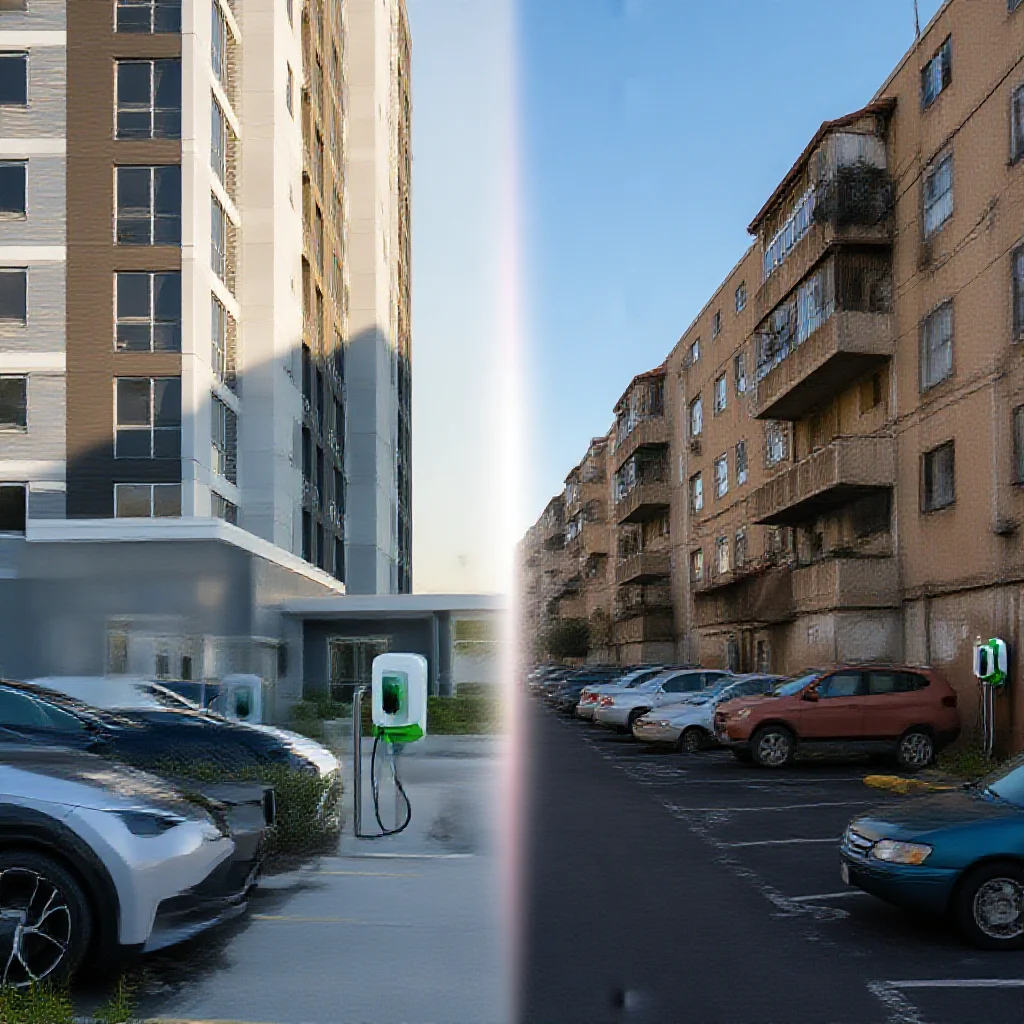
California's EV Charging Mandate Clash: Equity, Infrastructure, and the Future of Urban Electrification
**Opening Summary** As of January 2026, California state building code requires developers of new multifamily buildings to ensure residents with dedicated parking have access to electric vehicle (EV) charging infrastructure. This mandate is a foundational component of the state’s strategy to achieve its goal of 100% zero-emission vehicle (ZEV) sales by 2035. A newly introduced legislative bill, however, seeks to create an exemption or limitation for affordable housing developments. This legislative action creates a direct conflict between two policy priorities: accelerating the clean transportation transition and maintaining the economic feasibility of affordable housing construction.
The Policy Crossroads: Mandate vs. Modification California’s existing mandate functions as a forward-looking infrastructure policy, embedding EV readiness into the built environment to avoid prohibitively expensive retrofits later. The logic is preventative: the incremental cost of installing conduit and panel capacity during construction is significantly lower than post-construction excavation and electrical work.
The newly proposed bill represents a response to pressure from affordable housing developers and advocates. Their argument centers on cumulative cost burdens. Building code requirements for sustainability, energy efficiency, and accessibility, while individually justified, collectively increase per-unit construction costs. In the tightly constrained financial models of affordable housing, where funding gaps are common, every additional mandate can potentially reduce the number of units built or compromise other project features.
This clash is not a binary debate between pro- and anti-EV positions. It is a technical and financial negotiation over the pace, geographical distribution, and funding mechanisms for critical infrastructure. The core question is whether a uniform mandate is the most efficient tool for achieving widespread EV readiness, or if a tiered approach that accounts for project economics is necessary.
Decoding the Economic Logic: Who Pays for the Plug? A financial audit of the mandate reveals a transfer of infrastructure investment from traditional public utility models to private developers. The costs are multifaceted: * **Electrical Service Upgrade:** Many buildings require a larger main electrical service to handle the added load of multiple EV chargers. * **Conduit and Wiring:** Installing empty conduit (“EV-capable” spaces) and home-run wiring to parking spots constitutes the bulk of the upfront material and labor cost. * **Charging Hardware:** The cost of the actual charging station, which may or may not be installed initially. * **Ongoing Management:** Expenses related to metering, maintenance, software platforms, and electricity provisioning.
For market-rate developments, these costs can be absorbed into the project’s pro forma and ultimately passed to buyers or renters. For affordable housing, which operates on fixed-income rent structures and strict subsidy limits, this absorption is not possible. This creates a “first-cost problem”: the full financial burden of long-term public infrastructure is borne at the project’s inception by a entity with limited capital. The result is a zero-sum trade-off: funds allocated for EV readiness are not available for additional units, community spaces, or other amenities.
This California conflict is a leading indicator. As more states consider similar building code amendments, the same tension between climate mandates and localized financial feasibility will emerge, forcing a re-examination of how green transition infrastructure is financed.
The Equity Dilemma: Preventing a Two-Tiered EV Future The proposed exemption, while addressing cost concerns, introduces a significant risk of spatial inequality. A policy that mandates EV access in new market-rate buildings but exempts affordable housing could institutionalize a two-tiered system. This would create “charging haves” in newer, wealthier neighborhoods and “charging have-nots” in affordable housing stock.
The long-term impact on California’s ZEV goals could be substantial. Multiple studies establish a causal link between convenient, reliable residential charging and EV adoption rates. Without home charging, reliance on public networks becomes necessary, which introduces uncertainty, time cost, and often higher electricity rates. This barrier disproportionately affects lower-income residents, for whom transportation costs already consume a larger share of household income. Even with state and federal purchase incentives, the practical difficulty of charging could suppress EV adoption in these communities, creating demographic gaps in the clean vehicle fleet and potentially undermining broader emissions reduction targets.
The equity calculus is therefore dual-sided: near-term housing affordability versus long-term transportation affordability and access. The policy challenge is to design a mechanism that does not force a choice between these two forms of equity.
Neutral Market and Industry Trajectory Analysis The resolution of this legislative conflict will set a precedent with national implications. The probable trajectories are:
1. **Compromise via Financial Mechanism:** The most likely outcome is a bill that maintains the mandate but couples it with a dedicated state subsidy, grant program, or enhanced tax credit specifically for installing EV infrastructure in qualified affordable housing developments. This would split the cost between the public (infrastructure investment) and private (base construction) sectors. 2. **Phased or Performance-Based Mandate:** An alternative is a modified mandate requiring a percentage of spaces to be EV-ready, rather than all, or tying the requirement to the availability of specific utility incentive programs at the time of permitting. 3. **Utility Role Expansion:** This conflict may accelerate the redefinition of utility responsibility. Regulators could move to classify certain levels of building-side electrical infrastructure as a public good, allowing for rate-based recovery of costs, thereby removing the burden from the housing developer’s balance sheet.
The market response is already taking shape. Electrical contractors and engineering firms are developing standardized, cost-optimized designs for multifamily EV charging. Charger manufacturers are introducing hardware tailored for shared-use, multi-tenant financial management. The industry is adapting to the new requirement; the policy debate is ultimately about who writes the check.
The final policy architecture that emerges from this clash will serve as a critical case study on the practical execution of the energy transition in dense urban environments, where the imperatives of climate action, social equity, and economic reality physically intersect.