Beyond the IPO: How Fervo Energy''s Utah Project Signals a Geothermal Power Market Inflection Point
Fervo Energy's confidential IPO filing reveals more than just financial ambition; it marks a pivotal moment for next-generation geothermal energy. The detailed disclosure of its 400-megawatt Cape Station project in Utah, with phased completion through 2028 and power contracts with major players like Google and Southern California Edison, provides a rare, concrete blueprint for scalable, enhanced geothermal systems (EGS). This analysis moves beyond the IPO news to explore how Fervo's project de-risks the technology for investors, validates its commercial viability for large-scale, 24/7 clean power, and could catalyze a new wave of investment and competition in the baseload renewable energy sector, challenging the dominance of solar and wind.
Beyond the IPO: How Fervo Energy's Utah Project Signals a Geothermal Power Market Inflection Point
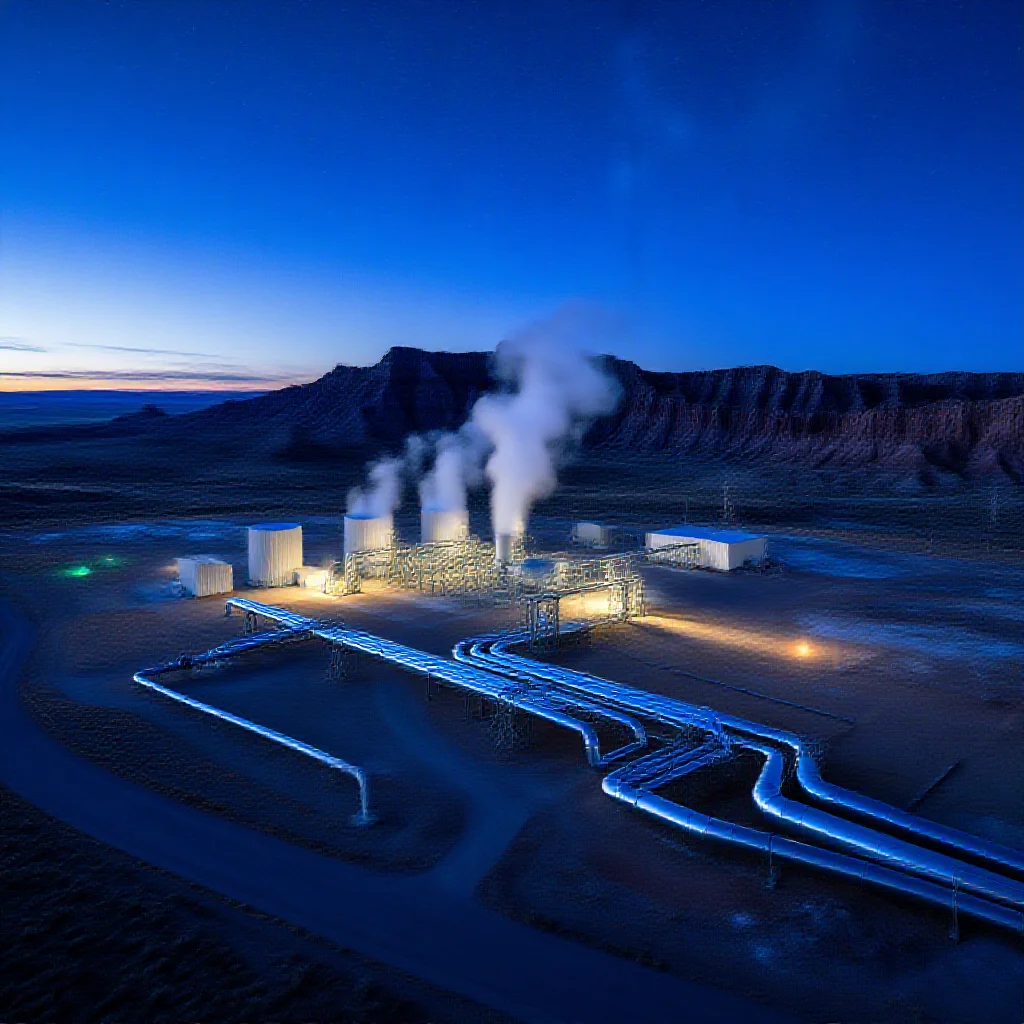
**Opening Summary** Fervo Energy has confidentially filed for an initial public offering with the U.S. Securities and Exchange Commission (Source 1: [Primary Data]). The filing contained specific operational details for its Cape Station enhanced geothermal systems (EGS) project in Utah. The first 90-megawatt phase is scheduled for completion in 2026, with the full 400-megawatt facility expected by 2028 (Source 2: [Primary Data]). The company has secured power purchase agreements with Southern California Edison and Google for the project's output.
The Filing as a Blueprint: Decoding Fervo's Confidence Beyond the IPO A confidential IPO filing typically shields a company's financials, but Fervo Energy's submission functions as an unprecedented technical and commercial disclosure for the geothermal sector. The decision to specify the Cape Station's 90MW (2026) and 400MW (2028) completion timelines within the SEC filing represents a calculated credibility signal. These are not aspirational press release targets but milestones presented under regulatory scrutiny, intended to substantiate claims for capital markets. This contrasts with the generalized potential often promoted by clean-tech startups. The inclusion of executed utility-scale power purchase agreements shifts the narrative from technological potential to contracted, revenue-generating execution. The filing provides a rare, concrete blueprint for scalable EGS, moving the industry discussion from laboratory papers to bankable project finance documents.
*Image Suggestion: An infographic-style image comparing traditional geothermal with Fervo's enhanced geothermal system (EGS) well design.*
Cape Station: The Technical and Commercial Proof Point for Next-Gen Geothermal The selection of the Cape Station location in Utah is a strategic technical and commercial decision. The region's geology is considered suitable for demonstrating the viability of EGS, which involves creating permeable rock reservoirs at depth to extract heat where natural permeability is insufficient. The phased economic logic of the project is designed to mitigate technical and financial risk. The initial 90MW phase serves as a revenue-generating proof-of-concept, with proceeds and operational data de-risking the subsequent scale-up to 400MW. The power purchase agreements with Google and Southern California Edison carry strategic weight beyond offtake. These entities are not merely customers but validation partners; their procurement criteria for firm, 24/7 clean power provide an independent commercial endorsement of EGS's value proposition over intermittent renewables.
*Image Suggestion: A map of Utah highlighting the Cape Station location and transmission lines towards California.*
The Ripple Effect: How Fervo's Move Reshapes the Clean Energy Investment Landscape A successful public listing for Fervo Energy would establish a new, liquid pathway for institutional capital to access geothermal technology. This could recalibrate the risk profile of the entire sector, moving it from a venture capital niche to an asset class for mainstream infrastructure funds. The scale implied by Cape Station and subsequent projects would generate tangible demand for a specialized supply chain, including directional drilling rigs, high-temperature well casing, and binary cycle power plants. This activity would create a positive feedback loop, lowering costs through scale and competition. Furthermore, the commercialization of firm, zero-carbon geothermal power applies competitive pressure to other developing baseload solutions, including small modular nuclear reactors (SMRs) and green hydrogen-based generation, by presenting an alternative timeline and cost curve for investors and utilities.
*Image Suggestion: A conceptual graph showing projected capital flow into geothermal vs. other renewables post a major IPO event.*
Verification and Context: Separating Milestone from Aspiration The disclosed timelines for Cape Station require cross-referencing with external validation points. Project execution is contingent upon state permitting processes in Utah, interconnection studies with grid operators, and the logistical chain for specialized equipment. Fervo's technology did not emerge in isolation; it is contextualized within decades of U.S. Department of Energy-funded research, notably the Frontier Observatory for Research in Geothermal Energy (FORGE) initiative in Utah, which provides a public testbed for EGS techniques. An assessment of execution capability extends to the track record of Fervo's management and its investors, whose experience in scaling complex energy projects will be a determinant in translating filed plans into operational power plants.
*Image Suggestion: A photo of drilling rigs at a geothermal site, emphasizing the industrial scale.*
The Long Game: Geothermal's Path in a Decarbonizing Grid The significance of Fervo Energy's IPO filing is its function as a potential market inflection mechanism. It provides a measurable, investable benchmark against which future geothermal projects will be evaluated. If the phased construction at Cape Station proceeds as documented, it will generate a continuous stream of performance and financial data, reducing the informational asymmetry that has historically constrained geothermal investment. The long-term industry impact will be determined by the replicability of the Cape Station model in diverse geological settings. Success could catalyze a new wave of project finance and developer competition, positioning geothermal not as a regional curiosity but as a globally scalable component of firm, zero-carbon electricity generation, complementing the variable output of solar and wind.
**Neutral Market/Industry Prediction** The immediate effect of the filing is an increase in analytical scrutiny of the EGS sector by financial institutions. The medium-term trajectory of the geothermal market will be sensitive to the reported progress against the 2026 and 2028 Cape Station milestones. Successful on-time, on-budget delivery of the initial 90MW phase is predicted to trigger increased venture and private equity flow into competing EGS developers and technology providers. Conversely, significant delays or cost overruns would reinforce prevailing investor caution regarding subsurface risk. The filing, irrespective of the ultimate IPO valuation, has irrevocably shifted the geothermal discourse from scientific potential to project finance metrics.