Beyond the Meter: How Georgia Power''s New Program Signals a Shift in Utility-Customer Dynamics
Georgia Power's newly approved program, allowing large customers like data centers to directly fund and connect new clean energy projects to the grid, is more than a simple tariff option. It represents a fundamental shift in the utility-customer relationship, driven by the immense power demands of the digital economy. This analysis explores the program as a strategic response to the risk of 'grid defection' by major consumers, a novel model for financing grid-scale renewables without shareholder risk, and a potential blueprint for other utilities facing similar pressures. We examine the long-term implications for ratepayers, the utility's business model, and the acceleration of Georgia's energy transition.
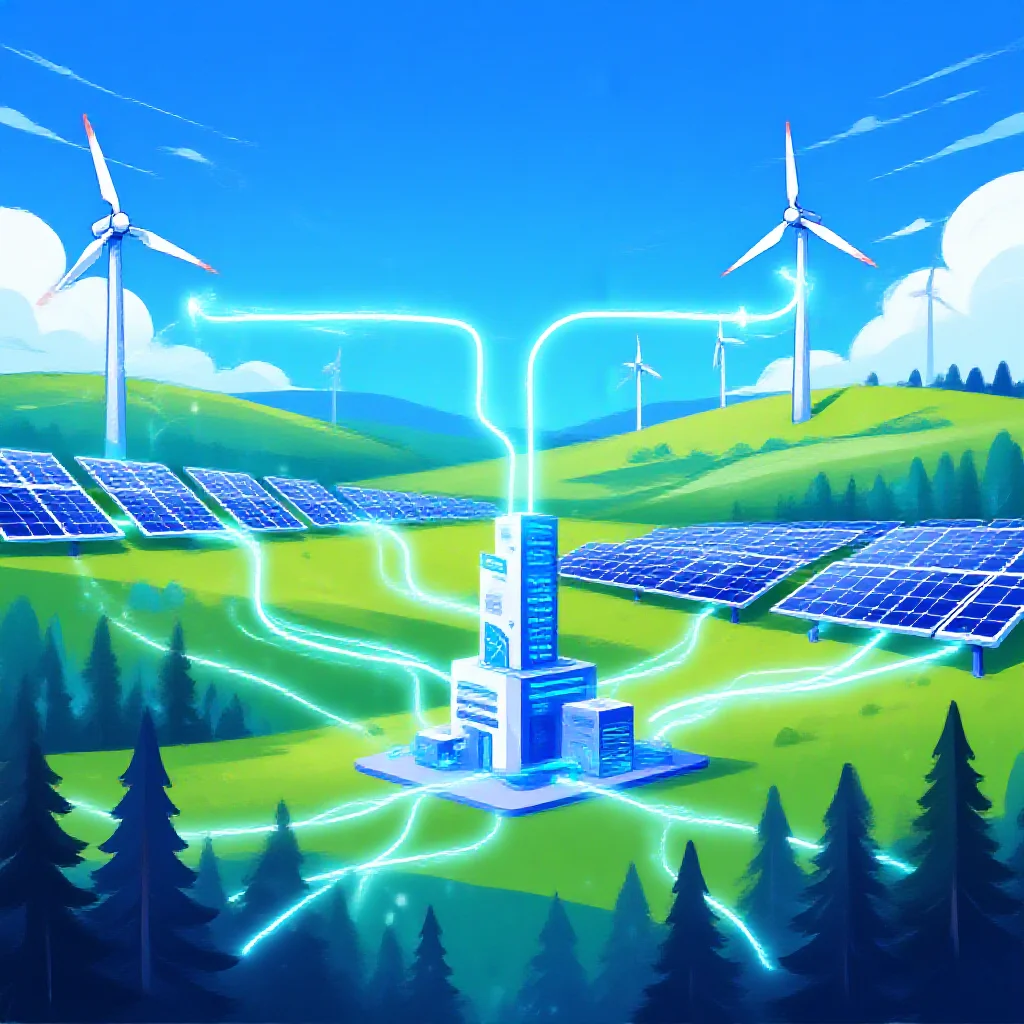
Beyond the Meter: How Georgia Power's New Program Signals a Shift in Utility-Customer Dynamics
Introduction: A Permission Slip for Self-Funded Power
Last week, the Georgia Public Service Commission (PSC) granted regulatory approval to a novel program proposed by Georgia Power. The initiative permits large commercial and industrial customers, such as data centers, to directly fund the construction of new clean energy projects and connect them to the utility’s grid. (Source 1: [Georgia Public Service Commission Approval Timeline]) While framed as a tariff option, the program’s authorization represents a significant regulatory milestone. It signals a fundamental strategic pivot by the investor-owned utility, moving from a purely centralized procurement model to one that accommodates direct customer investment in generation. This shift is not merely an additional service but a defensive innovation designed to retain the utility’s largest, most power-hungry customers in an emerging era of energy choice and economic pressure.
The Hidden Economic Logic: Preempting Grid Defection
The program’s architecture is a direct response to a specific and growing economic threat: grid defection. For hyperscale data centers and other large-load facilities, their immense and predictable energy consumption makes alternative procurement models increasingly viable. These customers possess the capital and scale to finance their own off-grid renewable microgrids or, more commonly, enter into long-term power purchase agreements (PPAs) directly with independent renewable energy developers. Such a move would bypass the utility entirely, eroding its revenue base and control over grid operations.
Georgia Power’s program is a calculated countermeasure. It allows the utility to keep these customers formally connected to its system, maintaining its role as the grid operator and preserving its revenue stream from transmission and distribution services. Crucially, the model transfers the capital cost and development risk of new generation assets to the customer. The utility facilitates interconnection and offtake but does not assume the asset on its balance sheet or seek traditional, ratepayer-funded cost recovery for its construction. This contrasts sharply with the traditional utility-led build-out, where the cost of new generation is socialized across all customer classes through regulated rates.
The Regulatory Gambit: PSC Approval as a Strategic Enabler
The Georgia PSC’s approval was the critical enabler for this strategic shift. The commission’s rationale, as documented in the official order, likely balanced competing imperatives: fostering economic development by accommodating the specific energy demands of large corporate customers, while insulating the broader body of residential and small commercial ratepayers from the financial burden of funding dedicated infrastructure for a single customer class. (Source 2: [PSC Order Docket Reference])
By sanctioning this model, the PSC has established a precedent that redefines the concept of “public convenience and necessity” in a load-growth environment dominated by a few massive consumers. It acknowledges that the traditional cost-of-service model may be ill-suited to the investment pace required by the digital economy. This regulatory gambit provides Georgia Power with a new tool to manage load growth without immediately triggering a general rate case for generation expansion, effectively using corporate capital to augment system capacity.
Beyond Data Centers: A Blueprint for Industrial Decarbonization?
While data centers are the immediate target, the program’s structure creates a potential blueprint for other energy-intensive sectors. Manufacturing plants, industrial facilities, and large institutions with ambitious Environmental, Social, and Governance (ESG) targets face similar pressures to decarbonize their energy supply. This program offers a regulated pathway for them to do so while remaining integrated with the grid.
The long-term implication for Georgia’s energy mix is substantial. If widely adopted, this mechanism could transform corporate decarbonization mandates into a primary driver for new solar, wind, and storage capacity within the state. This would represent a de facto outsourcing of a portion of the state’s clean energy build-out to private corporate capital, accelerating the transition at a pace potentially faster than a utility-led, ratepayer-funded model could achieve alone. However, it raises a critical question regarding equity and system planning: does this model create a two-tiered grid where large customers can fund a cleaner, more resilient energy supply for themselves, while the pace and cost of the transition for general ratepayers follows a separate, potentially slower trajectory?
Conclusion: A New Paradigm of Conditional Monopoly
Georgia Power’s program is more than a new tariff; it is an adaptation to a changing market reality. It signifies a move from a pure monopoly model to a conditional one, where the utility’s role is maintained not by exclusivity, but by providing a service platform valuable enough that the largest customers choose to remain connected. The model offers utilities a template for managing explosive load growth from the digital economy without assuming disproportionate shareholder risk. For regulators, it presents a tool to facilitate economic development and clean energy expansion while attempting to firewall costs.
The ultimate test will be in its execution and scalability. Its success or failure will be closely monitored by utilities nationwide facing parallel pressures, potentially establishing it as a standard approach for integrating the capital and decarbonization goals of corporate America into the architecture of the traditional regulated grid. The era of the passive ratepayer is diminishing; in its place is emerging an active, investing customer whose needs are reshaping utility strategy from the meter back to the power plant.