The ''Set-and-Forget'' Grid: How Smart Thermostats Are Building Invisible Power Plants
A new generation of smart thermostats, like those from Renew Home, is shifting from consumer gadgets to critical grid infrastructure. Utilities such as Arizona's Salt River Project are deploying them en masse, paying for installation and offering bill credits. In exchange, they gain the ability to subtly adjust temperatures during peak demand, creating aggregated 'Virtual Power Plants' that enhance grid stability. This article explores the hidden economic logic behind this trend, where customer comfort becomes a tradeable commodity for utilities seeking cost-effective demand management, and examines the long-term implications for energy markets and consumer relationships with power providers.
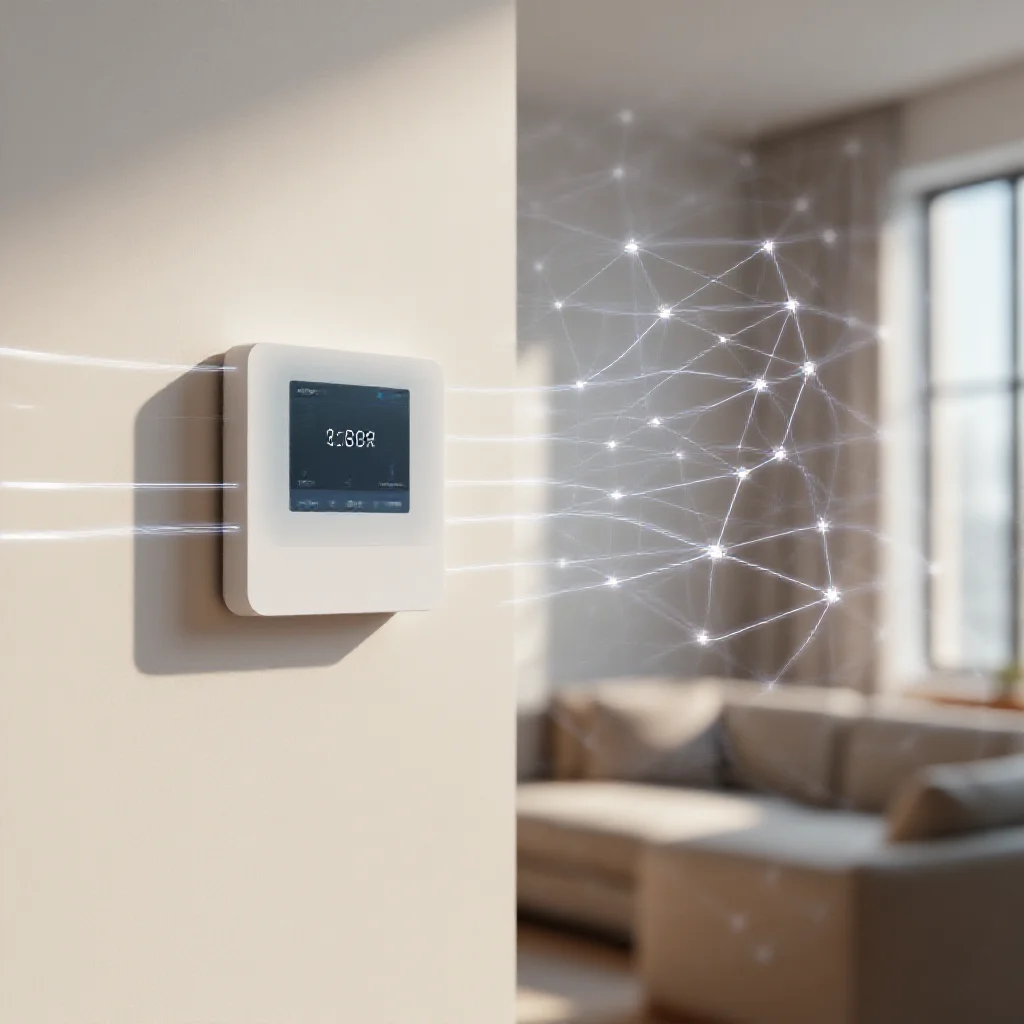
The 'Set-and-Forget' Grid: How Smart Thermostats Are Building Invisible Power Plants
From Gadget to Grid Asset: The Quiet Revolution of the Smart Thermostat
The smart thermostat has undergone a fundamental redefinition. Its evolution has shifted from a consumer-centric device for personalized comfort and efficiency to a grid-operational asset designed for autonomous, utility-directed function. The traditional model required user engagement via applications and schedules. The emerging paradigm, exemplified by devices like the Renew Home smart thermostat, is engineered for "set-and-forget" operation (Source 1: [Primary Data]). The core technological shift is in the primary user interface: it is no longer the homeowner's smartphone, but the utility's grid management system.
This transition is enabled by hardware designed for direct, reliable communication. The Renew Home device integrates with existing HVAC systems and establishes a cellular connection directly to the utility, bypassing home Wi-Fi dependencies (Source 1: [Primary Data]). This design ensures operational integrity, making the device a predictable and controllable endpoint for grid operators. The consumer-facing interaction becomes minimal, while the device's primary function—participating in automated demand-response events—occurs in the background.
The Utility's Calculus: Why Paying for Your Thermostat Makes Financial Sense
For utilities, the economic logic of provisioning these devices is a straightforward capital allocation analysis. The Salt River Project (SRP) in Arizona provides a clear case study. SRP pays for the Renew Home smart thermostat and its installation for program participants (Source 1: [Primary Data]). In exchange, the utility gains the right to make minor, pre-authorized temperature adjustments during periods of critical peak demand.
The financial benefit is measured against the alternative: the construction and operation of "peaker" power plants, which run only during high-demand periods and are among the most expensive forms of generation. SRP's deployment of over 65,000 units provided a quantifiable grid asset. During a July 2023 heatwave, the aggregated reduction in demand from these thermostats reached nearly 30 megawatts (Source 1: [Primary Data]). This is equivalent to deferring or reducing the need for a small-to-midsize power plant. The cost of the program, including the $50 annual bill credit to participants (Source 1: [Primary Data]), is substantially lower than the capital and operational costs of traditional grid infrastructure, not accounting for the additional costs of grid instability or emergency purchases of power.
Building the Invisible Power Plant: The Rise of the Residential VPP
The aggregation of thousands of these distributed devices forms what is known as a Virtual Power Plant (VPP). A VPP is a network of decentralized, controllable energy assets—like smart thermostats, batteries, or electric vehicle chargers—that can be managed as a single, dispatchable resource. In this model, a utility can "dispatch" demand reduction from a portfolio of homes with the same reliability as turning on a gas turbine, but without the fuel cost or emissions.
The strategic expansion of this model is evident. Following SRP's large-scale deployment, other major utilities, including Southern California Edison and Pacific Gas & Electric, are conducting pilots with similar "set-and-forget" thermostat technology (Source 1: [Primary Data]). The trend indicates a move toward utilities directly provisioning hardware to ensure interoperability, reliability, and scale for their VPP portfolios. This direct control over the asset base allows for more sophisticated and reliable grid balancing strategies, transforming residential demand from a passive, statistical load into an active, manageable grid resource.
The Unspoken Trade-Off: Comfort as a Commodity and the New Consumer Contract
This operational model establishes a new, implicit contract between consumers and power providers. It normalizes the ceding of minor, automated control over a home's environment—a few degrees of temperature adjustment for limited durations—in exchange for financial compensation and systemic grid benefits. The long-term implication is the treatment of residential comfort as a tradeable commodity within energy markets.
This shift raises technical and contractual questions that extend beyond immediate bill credits. The cellular, direct-to-utility communication model centralizes data flow, placing usage and responsiveness data firmly within the utility's domain. This has implications for data ownership and privacy frameworks. Furthermore, the infrastructure enables more dynamic pricing and control models in the future. The logical progression of this trend points toward the aggregation of other residential loads—water heaters, electric vehicle chargers, and pool pumps—creating a fully dispatchable home. The endpoint is a scenario where a significant portion of a home's energy consumption is orchestrated by grid needs, with consumer preferences acting as parameters within a larger optimization algorithm.
The market prediction is a continued, accelerated rollout of utility-provisioned smart devices. Their value as grid assets will be rigorously quantified, and their aggregation will become a standard tool in regional transmission organization (RTO) and independent system operator (ISO) portfolios. The consumer relationship will increasingly be framed not merely as a purchase of kilowatt-hours, but as a participation agreement in a distributed, automated grid stability system.