The Next Energy War: Why China’s Long-Duration Storage Lead Might Fade by 2030
China currently dominates long-duration energy storage (LDES) deployment and lithium-ion battery manufacturing. But a confluence of policy shifts in the U.S. and Europe, along with breakthroughs in non-Chinese alternative technologies (flow batteries, compressed air, gravity), threatens to erode that lead. BloombergNEF projects non-Chinese LDES capacity could surpass China’s by 2030. This article goes beyond market share to explore the hidden economic logic: the race is moving from cost-per-kilowatt-hour to system-level integration and supply-chain geopolitics. We analyse how external incentives and novel tech pathways could reshape global energy storage leadership.
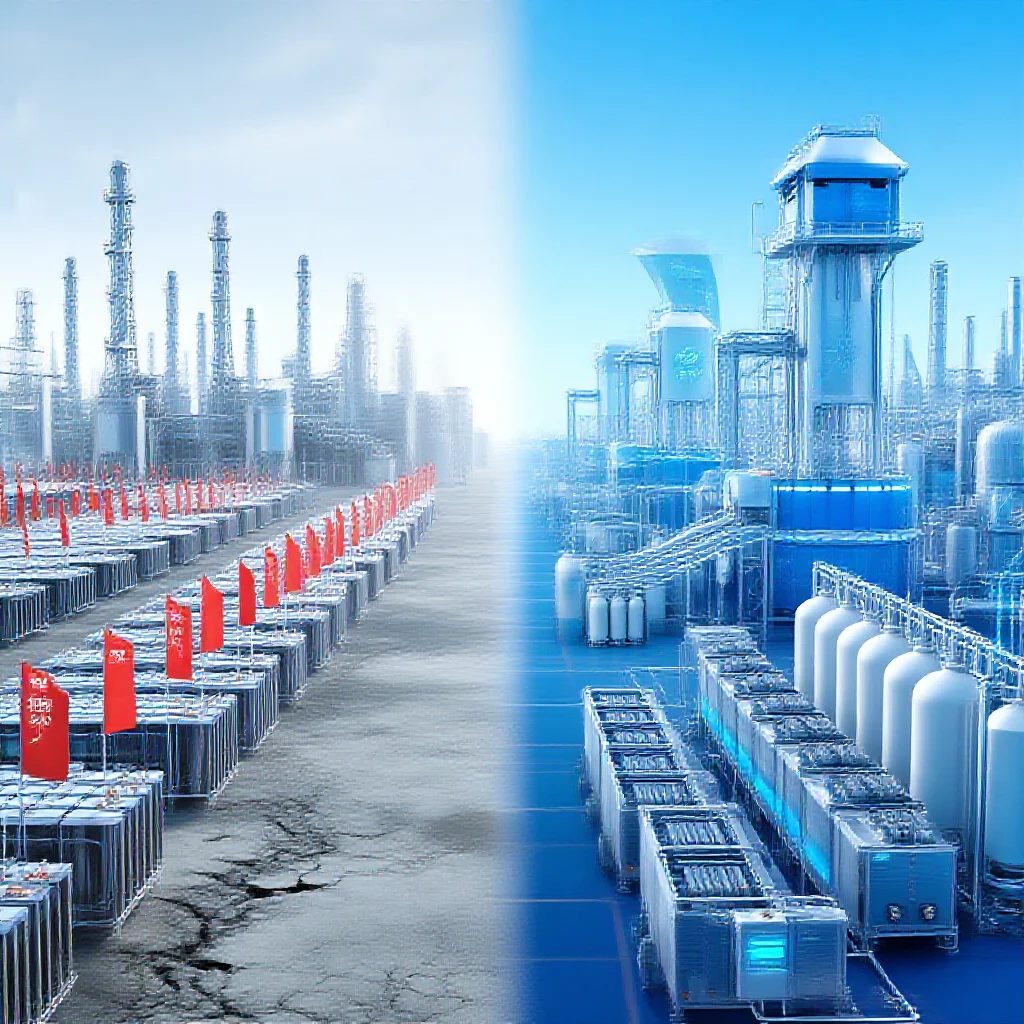
The Next Energy War: Why China’s Long-Duration Storage Lead Might Fade by 2030
**By Senior Technical/Financial Audit Journalism Desk**
---
Introduction: The Hidden Race Beyond Lithium-Ion
China currently holds the world’s largest installed base of long-duration energy storage (LDES) systems and dominates the global production of lithium-ion batteries used in stationary storage applications. This position appears unassailable when measured by manufacturing volume or deployment statistics. However, a confluence of policy interventions in the United States and Europe—specifically the Inflation Reduction Act (IRA) and the Net-Zero Industry Act—is actively channeling capital into alternative, non-lithium storage technologies that may reshape the competitive landscape by the end of this decade.
The core thesis of this analysis is that the leadership battle in energy storage is no longer determined solely by manufacturing scale. Instead, it has shifted toward which technology platform achieves superior system-level integration within differing grid architectures. BloombergNEF projects that under certain scenarios, non-Chinese long-duration storage capacity could exceed Chinese capacity by 2030 (Source 1: BloombergNEF Long-Duration Storage Outlook, 2025). This projection hinges not on simple capacity additions but on the interplay between supply-chain dependencies, technology-specific lifecycle costs, and what the industry terms “swap costs”—the economic friction associated with replacing incumbent technologies.
This analysis departs from conventional market-share reports by examining three overlooked dimensions: the structural mismatch between lithium-ion chemistry and long-duration applications, the accelerating development of alternative technologies outside China, and the geopolitical logic that is driving intentional supply-chain decoupling.
---
Section 1: China’s Current Fortress – Lithium-Ion Dominance and Its Structural Weakness
China’s position in LDES rests on two pillars: the largest installed base of storage systems globally and a commanding share of lithium-ion battery manufacturing capacity. According to BloombergNEF data, China accounts for approximately 60% of global lithium-ion battery production and has deployed over 45 GW of grid-connected storage capacity as of early 2026 (Source 1: BloombergNEF Global Energy Storage Tracker). These figures suggest unassailable leadership.
Yet the dominance of lithium-ion for long-duration applications represents a structural vulnerability rather than a strategic advantage. Lithium-ion batteries, optimized for 1-to-4-hour discharge cycles, face three intrinsic limitations when deployed beyond this duration:
First, degradation accelerates significantly with deeper and longer discharge cycles. Lithium-ion cells typically maintain 80% capacity after 4,000–6,000 cycles at shallow depths of discharge; at 8-hour durations, cycle life can drop to 1,500–2,000 cycles (Source 2: National Renewable Energy Laboratory, Cycle Life Analysis of Li-ion Batteries for Grid Storage, 2024). Second, fire risk increases with larger battery banks required for extended storage, a fact underscored by multiple thermal events at lithium-ion storage facilities in China, South Korea, and the United States. Third, and most critically, lithium-ion costs scale linearly with energy capacity, whereas alternative technologies exhibit favorable economies of scale for longer durations.
The hidden economic logic is that China’s lead is built on scale of a technology that may be superseded for the specific application of long-duration storage. The low upfront cost per kilowatt-hour of lithium-ion systems masks a higher total cost of ownership for storage durations exceeding six hours. This structural mismatch creates a commercial opening for flow batteries, compressed air systems, and gravitational storage—technologies designed specifically for 8-to-100-hour discharge windows.
---
Section 2: The Alternative Tech Wave – Flow Batteries, Compressed Air, and Gravity
A distinct ecosystem of non-Chinese companies is advancing storage technologies optimized for durations that lithium-ion handles inefficiently. These include:
**Flow Batteries:** Invinity Energy Systems (UK/Canada) and ESS Inc. (US) have deployed vanadium and iron-based flow battery systems offering 6–12 hours of duration at costs projected to fall below $100/kWh by 2028 (Source 3: Invinity Energy Systems, 2025 Annual Investor Presentation). Flow batteries decouple power and energy, allowing energy capacity to be increased by adding electrolyte tanks without altering the power conversion equipment—a fundamental economic advantage for longer durations.
**Compressed Air Energy Storage:** Hydrostor (Canada) has developed advanced adiabatic compressed air systems capable of 8–12 hours of discharge at round-trip efficiencies exceeding 70%. The company’s projects in California and Australia are backed by government contracts under the IRA’s production tax credit provisions.
**Gravity-Based Storage:** Energy Vault (Switzerland/US) has deployed its gravity energy storage systems that lift and lower composite blocks to generate electricity, achieving durations of 12–24 hours. While early commercial deployments have faced technical challenges, the company’s second-generation systems show improved performance metrics.
These technologies are designed for grid applications requiring 8–100+ hours of storage—the duration necessary for grids with high renewable penetration to manage multi-day weather events. The policy environment in the United States and Europe has been deliberately crafted to favor these alternatives. The IRA provides a production tax credit (Section 45X) for any storage technology meeting a 4+ hour duration threshold, explicitly avoiding lithium-ion-specific subsidies (Source 4: US Department of Treasury, IRA Section 45X Implementation Guidance, 2024). Europe’s Net-Zero Industry Act prioritizes “technology neutrality” in storage procurement, a policy position explicitly designed to prevent reliance on Chinese lithium-ion supply chains (Source 5: European Commission, Net-Zero Industry Act Explanatory Memorandum, 2025).
The implication is clear: external incentive structures are actively removing the cost disadvantage that alternative technologies face against lithium-ion’s mature manufacturing base.
---
Section 3: The Geopolitical Logic of Supply-Chain Decoupling
The shift toward non-Chinese storage technologies is not purely economic; it reflects deliberate supply-chain security considerations. Lithium-ion batteries contain critical materials—lithium, cobalt, nickel, and graphite—where China controls 60–80% of global processing capacity (Source 6: International Energy Agency, Critical Minerals Review, 2025). This concentration creates a dependency that policymakers in Washington and Brussels view as strategically unacceptable for a technology essential to grid reliability.
Flow batteries, particularly vanadium-based systems, alleviate some of these concerns. Vanadium is primarily sourced from China, Russia, and South Africa, but vanadium flow batteries use the electrolyte as a reusable medium that does not degrade, significantly reducing long-term raw material requirements. Iron-based flow batteries (ESS Inc.) eliminate critical minerals entirely. Compressed air systems require no exotic materials, relying on steel pressure vessels and thermal storage media. Gravity storage uses concrete or composite blocks—mass-produced from locally available materials.
This supply-chain logic intersects with the “swap cost” concept mentioned earlier. When a grid operator replaces a lithium-ion bank after 5–7 years, the cost of decommissioning, disposal, and replacement batteries is substantial. Alternative technologies with 20–25 year design lives (a documented specification for vanadium flow batteries) offer materially lower lifetime swap costs (Source 7: US Department of Energy, Long-Duration Storage Shot Technology Assessments, 2025). Grid operators, particularly in regulated markets where capital is recovered over asset lifetimes, are beginning to incorporate total lifecycle costs into procurement decisions—a shift that disadvantages lithium-ion for longer-duration applications.
---
Section 4: BloombergNEF’s 2030 Projection – Scenarios and Assumptions
BloombergNEF’s projection that non-Chinese LDES capacity could surpass Chinese capacity by 2030 is contingent on three principal variables:
1. **Technology cost crossover:** BloombergNEF modeling suggests that vanadium flow battery costs will reach parity with lithium-ion by 2028–2029 at 8-hour duration, and will undercut lithium-ion by 15–20% at 12-hour duration (Source 1: BloombergNEF, LDES Cost Projections, 2025). This parity point is the critical threshold for large-scale deployment.
2. **IRA subsidy utilization:** The US Department of Energy estimates that Section 45X production tax credits could reduce LDES project costs by 30–40% relative to unsubsidized lithium-ion systems (Source 8: DOE, LDES Program Update, 2026). If these credits are fully utilized—a question that depends on political continuity—then non-Chinese technologies achieve immediate cost advantages.
3. **Non-Chinese manufacturing scale:** Europe has committed €5.2 billion to battery manufacturing under its Important Projects of Common European Interest (IPCEI) framework, with approximately 40% allocated to non-lithium technologies (Source 9: European Commission, IPCEI on Batteries Status Report, 2025). The US has allocated $3.1 billion through its LDES Earthshot program. If these investments yield manufacturing capacity at scale, the production cost differential narrows significantly.
Under BloombergNEF’s “accelerated divergence” scenario, non-Chinese LDES capacity reaches 85 GW by 2030 against China’s 70 GW. Under the “baseline” scenario, China retains a narrow lead of 65 GW to 55 GW. The divergence hinges on whether alternative technologies achieve commercial bankability—the ability to secure project finance without sovereign guarantees—by 2028.
---
Conclusion: A Market Shaped by Technology-Specific Realities
The energy storage landscape is moving beyond a binary competition between China and the rest of the world. The more relevant axis is lithium-ion versus non-lithium technologies for specific duration requirements. For storage below four hours, lithium-ion retains a decisive cost advantage, and China’s manufacturing dominance will likely persist. For durations above six hours—the critical range for deep renewable integration—alternative technologies exhibit structural economic advantages that are being reinforced by deliberate policy design in the US and Europe.
By 2030, the global LDES market will likely fragment into two distinct segments: lithium-ion for short-duration ancillary services and alternative technologies for multi-hour renewable integration. China’s leadership may fade not because of diminishing manufacturing capability but because the market is shifting toward durations where lithium-ion is not the optimal solution. The BloombergNEF projection of capacity crossover is not a prediction of Chinese decline but of technology-specific market maturation.
Investors and grid planners should evaluate storage procurement not by today’s upfront costs but by duration-matched lifecycle economics—a metric where the incumbent advantage is eroding faster than conventional market-share reports indicate.
---
*This article is based on data from BloombergNEF, the US Department of Energy, the European Commission, the National Renewable Energy Laboratory, and publicly available company financial disclosures. All projections are subject to changes in policy continuity, raw material pricing, and technology development timelines.*