Beyond the Battlefield: Why Europe''s Defense Industry is Turning to the EIB for Energy Security
European defense contractors are seeking support from the European Investment Bank (EIB) to navigate the ongoing energy crisis, revealing a critical vulnerability at the intersection of national security and industrial policy. This move signals more than a short-term operational challenge; it highlights a systemic dependency where the production of military assets is threatened by volatile energy markets. The article explores the strategic implications of this dependency, questioning the resilience of Europe's defense industrial base and examining whether the EIB's involvement marks a new phase of 'securitized' industrial policy. We analyze the long-term risks to supply chains, the potential redefinition of the EIB's mandate, and what this means for European strategic autonomy in an era of geopolitical competition.
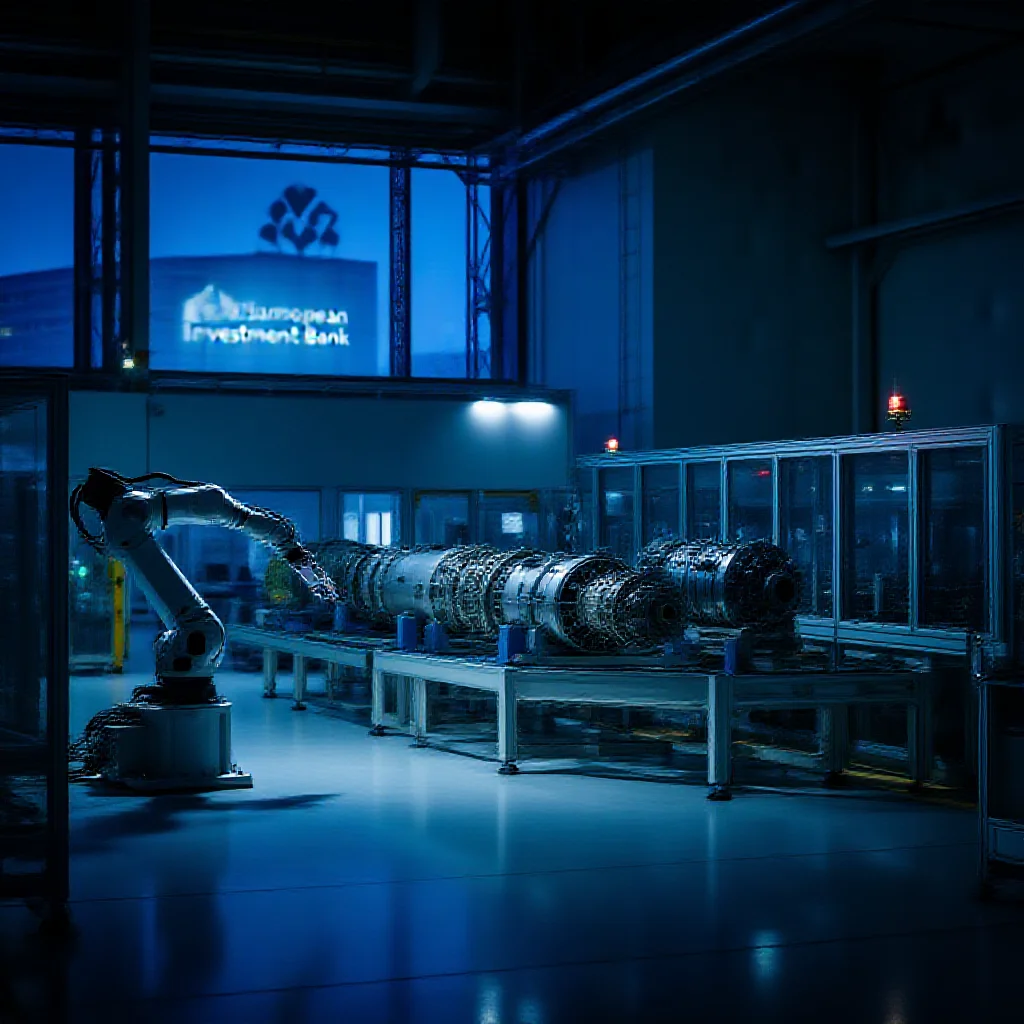
Beyond the Battlefield: Why Europe's Defense Industry is Turning to the EIB for Energy Security

**Summary:** European defense contractors are seeking support from the European Investment Bank (EIB) to navigate the ongoing energy crisis, revealing a critical vulnerability at the intersection of national security and industrial policy. This move signals more than a short-term operational challenge; it highlights a systemic dependency where the production of military assets is threatened by volatile energy markets.
Introduction: The Unseen Frontline – Energy as a National Security Input
Defense companies are formally approaching the European Investment Bank for support related to energy supply issues. (Source 1: [Primary Data]) This development redefines the energy crisis from a macroeconomic concern into a direct input for national security. The operational continuity of defense contractors, responsible for manufacturing complex platforms from fighter jets to armored vehicles, is now contingent upon stable and affordable energy. The core inquiry is not merely financial but strategic: the capacity to produce defense assets is demonstrating a foundational dependency on civilian energy markets.

Beyond the Headline: Decoding the 'Ask' to the EIB
The strategic significance lies in the choice of institution. Approaching the EIB, rather than solely relying on national governments or commercial lenders, indicates a search for pan-European, structural solutions. The requested support likely extends beyond emergency liquidity. Analysis suggests it encompasses financing for capital-intensive energy resilience projects: transition to on-site renewable generation, deployment of industrial-scale battery storage, and modernization for extreme energy efficiency. This represents a securitization of industrial policy, where traditional tools of economic development are leveraged to harden a sector critical to continental security.

The Deep Audit: Systemic Vulnerabilities in the Defense Supply Chain
The vulnerability is systemic and extends beyond prime contractors. Modern defense manufacturing relies on just-in-time, precision processes such as metal forging, composite curing, and semiconductor fabrication. These are exceptionally energy-intensive and sensitive to both price volatility and physical interruption. A disruption at a subcontractor specializing in high-grade aluminum or advanced circuit boards can cascade, delaying flagship European defense initiatives like the Future Combat Air System (FCAS) or the Main Ground Combat System (MGCS). The long-term risk is the potential offshoring of critical production stages to regions with lower and more stable energy costs, directly undermining the stated goal of European strategic autonomy.

The EIB's Dilemma: Banker, Strategist, or Both?
The EIB operates under a mandate focused on climate action, sustainable infrastructure, and innovation, with historical lending policies excluding purely military assets. Supporting defense firms' energy infrastructure creates a jurisdictional and policy nexus. The bank must determine if such support qualifies as critical infrastructure investment, akin to hardening a digital grid or transport network, or if it constitutes a de facto expansion into defense industrial policy. Its involvement would signal a recognition that the industrial base underpinning security is a legitimate object of European financial policy, blurring long-standing lines between civilian and defense financing.
Future Trajectories: Securitization, Subsidization, and Strategic Autonomy
The trajectory points toward deeper securitization of economic policy. One probable outcome is the establishment of dedicated EIB financing facilities for cross-border industrial resilience projects with dual-use or security implications. Concurrently, national governments may increase subsidies or price caps specifically for defense-critical energy consumption, raising questions of market distortion and WTO compliance. The most significant prediction is the accelerated integration of energy sovereignty planning into defense procurement criteria. Future requests for proposals may mandate detailed energy resilience plans, making sustainable power generation a non-negotiable component of military manufacturing. The energy crisis is acting as a stress test, revealing that strategic autonomy depends not only on technological prowess but on the fundamental stability of the industrial ecosystem's utilities.