Japan’s Solar 10% Milestone: The Hidden Supply Chain and Grid Logic Behind a Quiet Energy Shift
In 2025, solar power rose to 10% of Japan’s total electricity generation—a modest-sounding figure that masks profound shifts in grid economics, battery storage demand, and module supply chains. This article goes beyond the headline percentage to unpack the hidden pattern: how Japan’s land scarcity, aging grid infrastructure, and post-Fukushima policy inertia are forcing a ‘distributed-first’ solar strategy that differs from China or Europe. Using Ember''s verified data as a keystone, we explore what this milestone means for inverter makers, land-use regulations, and corporate power purchase agreements (PPAs) in a country that must balance renewables with energy security.
Japan’s Solar 10% Milestone: The Hidden Supply Chain and Grid Logic Behind a Quiet Energy Shift
**In 2025, solar photovoltaic generation accounted for 10% of Japan’s total electricity output, according to energy analytics firm Ember (Source 1: [Primary Data]).** This figure, while modest by global standards—China exceeded 6% in 2023 and the European Union reached 9% in 2024—represents a structural inflection point for an economy historically dependent on liquefied natural gas (LNG) and coal, with nuclear power generation stagnating at approximately 5-7% of the mix following the 2011 Fukushima Daiichi accident. The 10% milestone masks a more significant transformation: the shape, distribution, and supply chain logic of Japan’s solar expansion differ fundamentally from the utility-scale models dominant in China, the United States, or the Middle East. This analysis examines the grid bottlenecks, land constraints, and component market dynamics that define Japan’s distributed-first solar strategy.
The Land Constraint Paradox: Why Japan’s Solar Growth Is Different
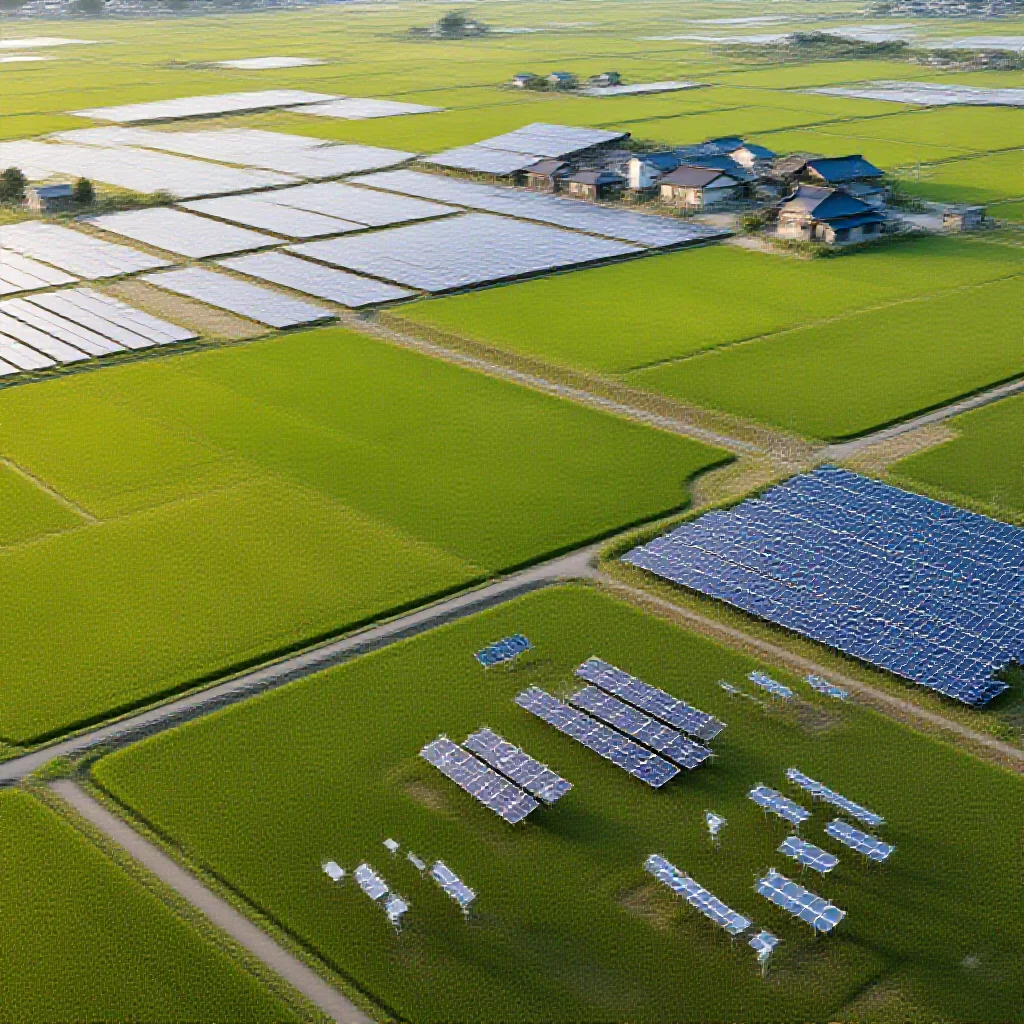
Japan possesses approximately 145,000 square kilometers of flat, habitable land—roughly 38% of its total territory—concentrated in the Kanto, Kansai, and Nobi plains. The remaining 62% consists of mountainous terrain, dense urban agglomerations, and fragmented agricultural plots. This geographical reality forces solar deployment into three distinct categories: rooftop installations on residential and commercial buildings, floating photovoltaic arrays on reservoirs and irrigation ponds, and small-scale ground-mount systems on abandoned farmland.
The Japanese Ministry of Economy, Trade and Industry (METI) reports that approximately 70% of Japan’s solar capacity is connected to the low-voltage distribution network, typically systems under 50 kilowatts installed on rooftops. By contrast, utility-scale solar farms exceeding 1 megawatt constitute less than 15% of total capacity, with the remainder in medium-scale commercial installations (Source: METI 2024 Renewable Energy Statistics). This distribution profile generates downstream effects that shape the entire component supply chain.
For module manufacturers, the Japanese market demands high-efficiency panels that maximize energy yield per square meter. Monocrystalline PERC (Passivated Emitter and Rear Cell) cells with efficiencies exceeding 22% dominate new installations, while bifacial modules—capable of capturing reflected light from rooftops and water surfaces—have seen compound annual growth of 18% in Japan since 2022. The country’s aging building stock, much of which was constructed before 1981 seismic code revisions, imposes strict roof-load limits of 10-15 kilograms per square meter, creating demand for lightweight glass-glass modules and frameless panels that weigh 30-40% less than standard designs.
Land leasing regulations compound the economic calculus. The 2014 Act on Promotion of Renewable Energy requires solar project developers to secure land-use agreements for a minimum of 20 years, with annual rent payments typically indexed to local agricultural land values. In the Kanto region, land lease costs for solar installations range from ¥150,000 to ¥300,000 per 0.1 hectare annually—approximately 3-5 times the equivalent cost in Spain or Chile (Source: Japan Photovoltaic Energy Association, 2024 Market Report). These elevated fixed costs compress project internal rates of return, forcing developers to optimize for higher capacity factors rather than lower module prices.
Grid Bottleneck: The Invisible Brake on 10% and Beyond
Japan operates one of the world’s most fragmented electricity grids, divided between a 50-hertz zone covering eastern Japan (Tokyo, Tohoku, Hokkaido) and a 60-hertz zone covering western Japan (Osaka, Chubu, Kyushu). The interconnection capacity between these two frequency zones, managed through three frequency converter stations in Shin Shinano, Sakuma, and Higashi-Shimizu, totals approximately 1.2 gigawatts—insufficient for significant power transfers during peak solar generation periods.
**Ember’s 10% figure reflects gross generation, not net deliverable energy, and this distinction is critical.** During sunny spring and autumn days, when solar output coincides with low base load demand, multiple regional utilities have implemented output curtailment. In 2024, Kyushu Electric Power Company curtailed 3.7% of its solar generation during March and April, while Tohoku Electric curtailed 2.1% during similar periods (Source: Japan Electric Power Exchange, Daily Curtailment Reports). These curtailment events, while quantitatively small, represent foregone revenue for solar asset owners and create negative pricing hours in the spot market.
The grid constraint has two direct implications for technology procurement. First, battery energy storage systems (BESS) attached to solar installations have become economically attractive. Japan’s cumulative installed BESS capacity for grid-connected solar reached 4.8 gigawatt-hours by end-2024, with 63% of new solar projects over 500 kilowatts incorporating some form of storage (Source: BloombergNEF, Japan Energy Storage Outlook 2025). The economic case relies on arbitrage: storing excess midday generation and discharging during evening peak hours, when wholesale prices can reach ¥25-35 per kilowatt-hour compared to ¥8-12 during solar hours.
Second, inverter manufacturers targeting the Japanese market must prioritize grid-support functions. Japanese grid codes under the 2022 Grid Connection Requirements (revised 2024) mandate that all new solar inverters above 10 kilowatts provide voltage-reactive power control, frequency-watt response, and low-voltage ride-through capability. Chinese inverter suppliers, including Huawei and Sungrow, have invested in dedicated engineering teams to comply with these specifications, which exceed the requirements of most European markets. The premium pricing for grid-compliant inverters in Japan—typically 15-25% above global baseline—has made the country a high-margin market for manufacturers with advanced power electronics capabilities.
Supply Chain Ripple: What 10% Means for Module and Component Makers
The transition from Japan’s generous feed-in tariff (FIT) system, which began tapering in 2019 and was largely replaced by feed-in premium (FIP) mechanisms and corporate power purchase agreements (PPAs) by 2023, has altered the market structure for solar components. Under the FIT regime, project developers had guaranteed tariffs of ¥36-42 per kilowatt-hour (2012-2014 vintage), which enabled high module cost tolerance. The current FIP reference price for solar projects above 50 kilowatts stands at ¥12.8 per kilowatt-hour, with PPAs for commercial consumers averaging ¥11-14 per kilowatt-hour as of early 2025.
This price compression has driven three observable trends in component procurement:
**First, demand for high-efficiency cells has accelerated Japan’s adoption of heterojunction (HJT) technology.** HJT modules, combining crystalline silicon with thin-film amorphous silicon layers, achieve conversion efficiencies of 23-24% and maintain better temperature coefficient performance (-0.25%/°C versus -0.35%/°C for PERC). Japanese module manufacturer Kaneka has reported that HJT production capacity utilization at its 1.2-gigawatt factory reached 94% in Q4 2024, driven primarily by domestic rooftop demand.
**Second, the replacement cycle has begun.** Early FIT installations from 2012-2015 are approaching their 10- to 12-year operational midpoint, with panels experiencing annual degradation rates of 0.5-0.8%. Replacement demand for modules in existing installations is projected to grow from 1.8 gigawatts in 2025 to 4.5 gigawatts by 2028 (Source: RTS Corporation, Japan PV Module Market Analysis 2025). This replacement cycle favors domestic and regional module manufacturers with established logistics and warranty servicing networks, given the complexity of roof-penetration repairs in Japan’s seismic building environment.
**Third, microinverter and power optimizer adoption exceeds global averages.** Japan’s residential solar market, which accounts for approximately 40% of new capacity additions by count if not by megawatt, has embraced module-level power electronics at a rate of 68% of new installations, compared to 32% in the United States and 18% in Germany (Source: IHS Markit, Microinverter and Optimizer Market Tracker 2024). This high penetration reflects the prevalence of partial shading from adjacent buildings, complex roof geometries, and the cultural preference for per-module monitoring systems that display generation data on household energy management screens.
Market Structure: The Corporate PPA Transition
The shift from FIT to corporate PPAs has altered the counterparty risk profile for downstream participants. Under the FIT system, all off-take risk was effectively sovereign, with the state-backed Renewable Energy Special Account guaranteeing payments. The current FIP system introduces market price exposure, with participants receiving a premium above spot market prices capped at ¥4.8 per kilowatt-hour for systems above 500 kilowatts.
Corporate PPAs have emerged as the primary financing vehicle for new commercial and industrial solar installations. As of 2024, cumulative contracted corporate PPA volumes in Japan reached 2.3 gigawatts, with an average contract duration of 15 years and fixed pricing ranging from ¥11.5 to ¥13.2 per kilowatt-hour (Source: Environmental Business International, Japan Corporate PPA Database 2025). Off-takers span manufacturing, logistics, and retail sectors, with Toyota, NTT Group, and Seven & i Holdings among the largest corporate buyers.
The PPA structure shifts technical risk from off-takers to project developers, creating demand for performance guarantees and output insurance products. Japanese non-life insurers, including Tokio Marine and Sompo Japan, have developed solar irradiance index insurance policies that compensate for generation shortfalls relative to historical weather data, with premiums of 2-3% of annual revenue.
Forward Indicators: Beyond 10%
Several structural factors suggest that Japan’s solar penetration will continue rising but at a decelerating rate. The 7th Strategic Energy Plan (2025 revision) targets solar generating capacity of 130-150 gigawatts by 2035, compared to approximately 85 gigawatts installed at end-2024. However, achieving this target requires resolving the frequency interconnection bottleneck, with planned investments of ¥2.3 trillion ($15.4 billion) in new converter stations and HVDC links by 2030.
The land constraint may prove more binding than the grid constraint. Japan’s Ministry of Agriculture, Forestry and Fisheries has designated 280,000 hectares of abandoned farmland as potentially available for solar development, but only 41,000 hectares have received preliminary approvals due to soil contamination concerns, archaeological survey requirements, and local zoning restrictions. The floating solar segment, which avoids land-use competition, has performed strongly with 1.2 gigawatts of installed capacity on irrigation ponds and reservoirs, but faces technical limitations from wave loading and biological fouling in Japan’s seasonal climate.
For component manufacturers, Japan offers a premium market with exacting technical requirements. The 10% milestone signals that the country has passed the initial adoption phase and entered a period of system optimization, retrofits, and grid-integration challenges. The commercial opportunity lies not in volume growth but in value-added technologies: high-efficiency modules, grid-support inverters, module-level power electronics, and integrated storage systems that address the specific constraints of Japan’s distributed-generation architecture.
The data from Ember, derived from monthly generation statistics published by the Agency for Natural Resources and Energy, provides the first verified confirmation that solar generation has reached this threshold. Future quarters will reveal whether the curtailment rate accelerates, whether corporate PPA pricing can sustain developer returns, and whether Japan’s dual-frequency grid can absorb the next five percentage points of solar penetration.