Renewable Energy Market 2035: From Capacity Race to Grid Integration – The Hidden Economic Shift
The global renewable energy market is set to surge from USD 1.54 trillion in 2025 to USD 5.79 trillion by 2035, at a CAGR of 14.18%. While solar power leads and Asia-Pacific dominates, the real story lies beneath the surface: a tectonic shift from pure capacity expansion to grid integration and storage. This article unpacks the economic logic behind mandates like Rajasthan''s BESS requirement, the rise of green hydrogen financing, and how falling technology costs are unlocking new growth corridors in North America and beyond. Using recent deals from Masdar, Zeo Energy, and Quino Energy, we reveal why the next decade will be defined not by how much renewable capacity we install, but by how intelligently we integrate it into the energy system.
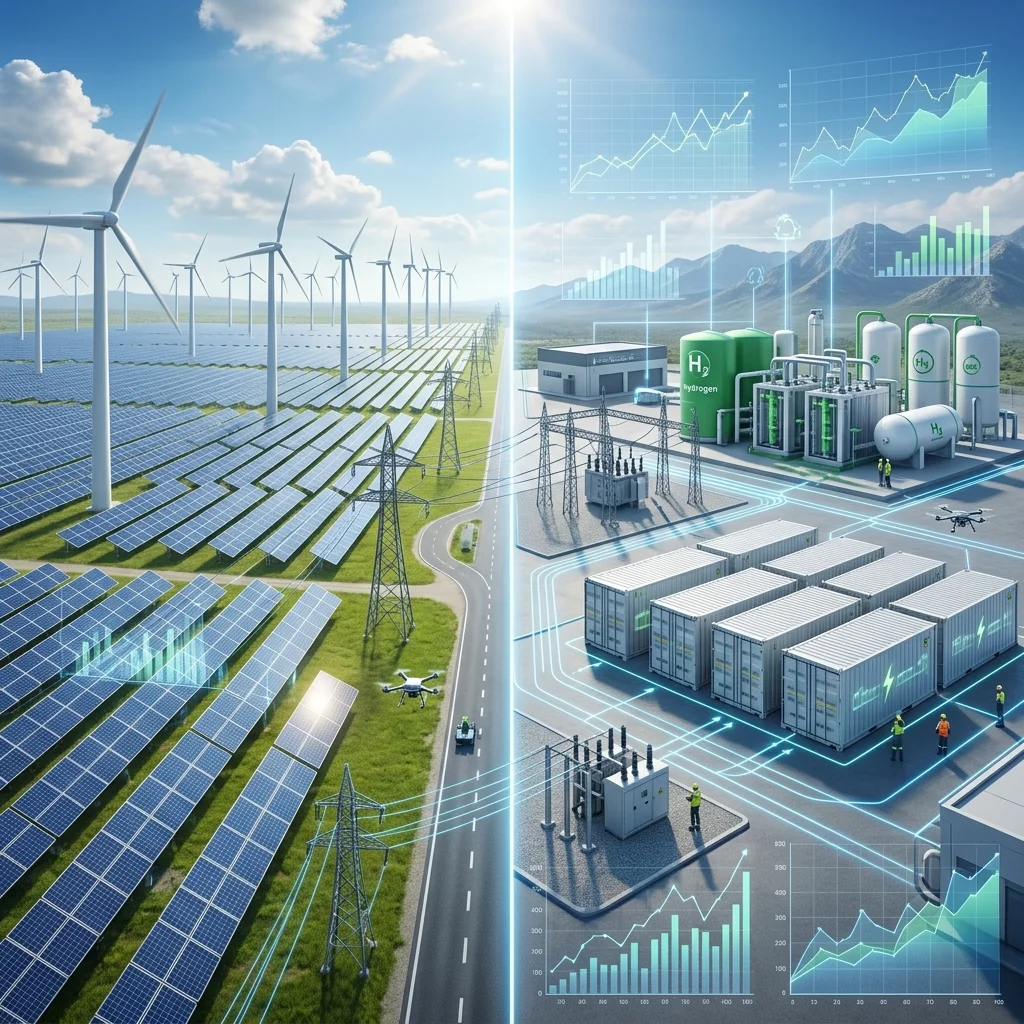
Renewable Energy Market 2035: From Capacity Race to Grid Integration – The Hidden Economic Shift
Introduction: The Market at a Crossroads
The global renewable energy market is undergoing a fundamental transformation. Valued at USD 1.54 trillion in 2025, it is projected to reach USD 5.79 trillion by 2035, growing at a compound annual growth rate (CAGR) of 14.18% according to recent industry analyses. These headline numbers reflect an industry that has matured beyond the early adoption phase, but they conceal a more nuanced story.
In 2024, global renewable capacity surged by 15.1% to reach 4,448 gigawatts, as reported by IRENA and the World Economic Forum. Yet beneath this impressive growth, grid bottlenecks and storage gaps are emerging as the most critical barriers to continued expansion. The era of simply installing more solar panels and wind turbines—the “capacity race”—is giving way to a more complex challenge: how to integrate these variable energy sources into a reliable and flexible electricity system.
[IMAGE: A world map heatmap showing renewable capacity growth with overlay of grid congestion zones.]
The core thesis of this article is that the next wave of market value will not come from adding more panels and turbines alone. Instead, it will be driven by the intelligence and infrastructure that connects generation to consumption—energy storage, grid modernization, green hydrogen, and integrated project models. This shift is already visible in regulatory mandates, corporate deal-making, and financing flows across Asia-Pacific, North America, and Europe.
The Numbers That Matter: Market Size, Segments, and Regional Power Shifts
To understand where the renewable energy market is heading, it is essential to examine its current structure. Solar power holds the largest revenue share in 2025, driven by declining module costs and widespread adoption across residential, commercial, and industrial segments. Industrial applications dominate usage, accounting for the bulk of demand due to manufacturing processes that require consistent, low-cost electricity.
Geographically, Asia-Pacific leads the market by a wide margin. China alone has installed over 1,450 GW of renewable capacity, while India ranks fourth globally. The region benefits from aggressive national targets, favorable manufacturing ecosystems, and large-scale project pipelines. However, the growth narrative is shifting. North America is expected to register a faster CAGR over the forecast period, propelled by policy tailwinds from the Inflation Reduction Act in the United States and a surge in corporate power purchase agreements (PPAs). Tech giants, data center operators, and industrial manufacturers are increasingly signing long-term contracts for renewable energy, driving demand for both generation and the supporting infrastructure.
[IMAGE: Bar chart comparing 2025 and 2035 market size by region (APAC, NA, Europe, RoW).]
A surprising element in the segmentation forecast is the hydropower segment, which is projected to see the highest growth rate over the 2025–2035 period. While solar and wind dominate headlines, hydropower—especially pumped storage hydro—is gaining renewed attention as a long-duration storage solution critical for grid stability. This twist underscores the market’s pivot toward reliability over raw capacity.
Hidden Driver: The Storage and Green Hydrogen Tipping Point
The most consequential trend reshaping the renewable energy market is the rapid maturation of energy storage and green hydrogen. These technologies are no longer experimental add-ons; they are becoming economic necessities.
Falling battery costs are the primary catalyst. Lithium-ion battery pack prices have dropped by more than 80% over the past decade, and the trend continues. This cost decline has enabled regulators to impose storage mandates. A landmark example is the state of Rajasthan in India, which now requires that all renewable projects above 5 MW include battery energy storage systems (BESS) covering at least 5% of capacity. Such mandates force developers to internalize storage costs—a sign of market maturity and a shift from generation-only to integrated solutions.
Green hydrogen is following a similar trajectory. In June 2024, the World Bank approved a USD 1.5 billion loan to India to support its National Green Hydrogen Mission, marking the largest single public financing commitment for hydrogen to date. This signals that hydrogen is no longer a niche technology but a large-scale solution for industrial decarbonization, particularly in sectors like steel, fertilizers, and heavy transport where direct electrification is difficult.
[IMAGE: Infographic of a solar farm with battery storage and hydrogen electrolyzer, labeled with cost trend arrows.]
Private capital is reinforcing this trend. In September 2024, Quino Energy raised USD 16 million to deploy solar-plus-storage solutions across the Americas, including Latin America and the Caribbean. The company’s focus on integrated systems—rather than standalone solar—reflects the growing investor preference for projects that can demonstrate grid reliability. Similarly, Zeo Energy’s USD 10 million acquisition of Heliogen in late 2024 shows how capital is flowing into companies that combine solar generation with storage and advanced control systems. These deals are not outliers; they are the new normal.
Deals and Mandates: The Real-World Proof of Integration
The theoretical shift toward grid integration is being validated by real-world transactions and policy actions across multiple continents. Examining a few key developments from 2024 and 2025 reveals a clear pattern: the market is rewarding projects and portfolios that bundle generation with storage, services, and grid-smart design.
In November 2025, the Philippines conducted its fourth Green Energy Auction (GEA-4), awarding over 10 GW of capacity. Crucially, the auction included floating solar and energy storage requirements—a model that emerging markets are increasingly adopting. By mandating storage alongside generation, the Philippines is leapfrogging the capacity-only approach and building a more resilient grid from the outset.
[IMAGE: Timeline of key deals and mandates from 2024–2025, including auction results and corporate acquisitions.]
In October 2025, KPI Green Energy secured a 200 MW solar project with SJVN Limited in India, valued at Rs. 6.96 billion (approximately USD 83 million). The contract includes not only engineering, procurement, and construction (EPC) but also operations and maintenance (O&M)—a bundled service model that ensures long-term reliability and performance. This type of integrated contracting is becoming standard in markets where grid stability is a premium.
Earlier, in September 2024, Masdar—Abu Dhabi’s renewable energy giant—completed its USD 1.4 billion acquisition of Saeta Yield, a European renewable energy asset manager with a diversified portfolio of wind and solar projects. The deal signals that major players are pivoting from building new capacity in isolation to acquiring integrated portfolios that offer immediate grid connections and operational synergies. In the same month, Reliance Power raised USD 183 million through a preferential share allotment, with plans to invest in solar, wind, and storage projects across India.
These transactions share a common thread: value is being created not by the megawatt alone, but by the system around it. Investors are paying a premium for projects that come with storage, grid interconnection agreements, and long-term service contracts. This is the economic logic that will define the next decade.
Conclusion: The Integration Era Begins
The renewable energy market in 2035 will look fundamentally different from today. The capacity race of the 2010s and early 2020s has laid a strong foundation, but the real growth engine for the remaining decade will be integration. Storage mandates, green hydrogen financing, bundled EPC and O&M contracts, and the strategic acquisition of grid-connected portfolios are all evidence that the industry is moving from “how much” to “how well.”
For stakeholders—from policymakers to project developers to investors—the message is clear. The competitive advantage will no longer come from simply building the largest solar farm or wind park. It will come from designing projects that can deliver power when and where it is needed, that can balance variability with storage, and that can connect seamlessly to evolving grid infrastructure. As falling technology costs continue to unlock new growth corridors in North America, Asia-Pacific, and beyond, the winners will be those who embrace this hidden economic shift.
The numbers tell one story: USD 5.79 trillion by 2035. But the real story—the one happening beneath the surface—is about a smarter, more resilient energy system. And that story is only just beginning.