Canva''s Freemium Empire: How a 2012 Startup Redefined Design Economics and Democratized Creativity
This analysis moves beyond a simple feature list to explore the underlying economic and strategic logic behind Canva's explosive growth. We examine how its freemium model, massive template library, and focus on accessibility have not just captured 60 million monthly users but fundamentally disrupted the traditional graphic design software market. By analyzing its pricing tiers, feature distribution, and user-centric approach, we uncover how Canva built a platform that serves both casual users and professional teams, creating a new paradigm for design tool economics and challenging established industry giants.
Canva's Freemium Empire: How a 2012 Startup Redefined Design Economics and Democratized Creativity
Introduction: Beyond Templates – The Architecture of a Design Revolution
The graphic design software market, long characterized by high-cost, professional-grade tools with steep learning curves, underwent a fundamental shift following the 2012 launch of Canva in Sydney, Australia. The platform’s rise to over 60 million monthly active users (Source 1: [Primary Data]) represents more than mere product-market fit; it signifies a strategic re-engineering of design economics. Canva’s model is not predicated on selling software capability but on delivering completed design outcomes through an accessible interface. This analysis posits that Canva’s market position is built upon a meticulously engineered freemium funnel and a self-reinforcing "content moat," comprising over 250,000 free templates and 75 million stock assets (Source 1: [Primary Data]). These mechanisms have systematically lowered the barrier to entry, effectively democratizing graphic design and disrupting established competitive dynamics.
Deconstructing the Freemium Funnel: The Economic Engine of User Acquisition
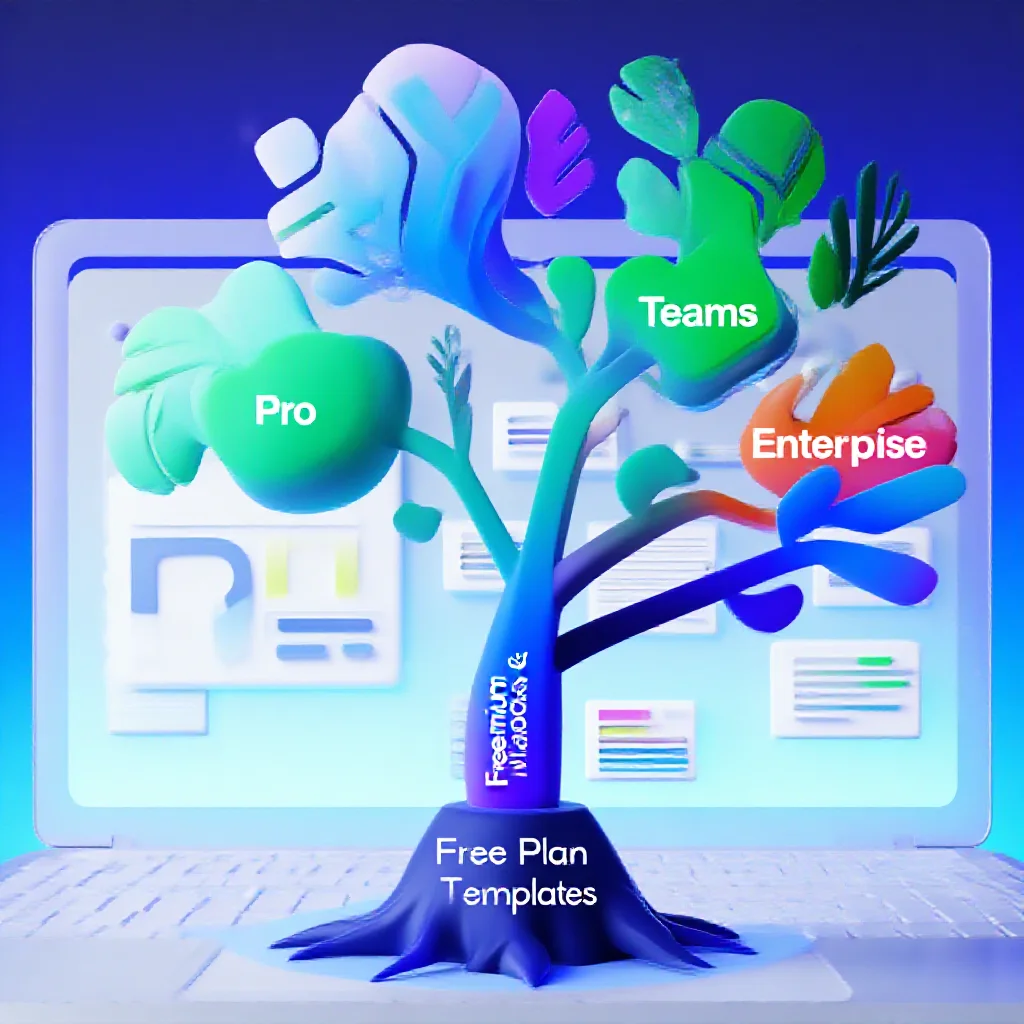
Canva’s growth is driven by a multi-tiered freemium model engineered to maximize user acquisition and conversion. The free plan operates as a comprehensive loss leader, granting full access to core design tools and the vast template library. This strategy eliminates trial friction and establishes the platform as the default solution for non-professional design tasks.
The economic logic becomes clear in the upgrade path. The transition to Canva Pro, priced at $12.99 per month or $119.99 annually (Source 1: [Primary Data]), is triggered by specific, high-value pain points encountered during sustained use. Features like the Brand Kit, essential for maintaining visual consistency, the Background Remover tool, and the social media Content Planner are strategically placed behind the paywall. These are not mere enhancements but productivity multipliers that justify the subscription for serious individual users and freelancers.
The model scales through collaboration. Canva for Teams, priced at $14.99 per user per month for the first five members (Source 1: [Primary Data]), introduces network effects and organizational lock-in. Shared brand kits, template libraries, and workflow tools transform Canva from an individual utility into a departmental or small business infrastructure. This tier migrates the platform’s economic relationship from transactional subscriptions to entrenched B2B SaaS, increasing lifetime value and reducing churn.
The Content Moat: How 75 Million Assets Create Unbreakable User Loyalty
Canva’s most formidable competitive advantage is its asset library, a "content moat" that creates significant switching costs. The provision of over 75 million stock images, videos, graphics, and 250,000 templates across 100+ design types (Source 1: [Primary Data]) represents a massive upfront investment that competitors cannot easily replicate. This library reduces the time, cost, and skill required to produce designs from hours to minutes.
This ecosystem generates a self-reinforcing loop. High user engagement with templates and assets yields data on design trends and usability, informing platform improvements and new feature development. The model inverts the value proposition of traditional design software. Where legacy tools sell a *process* (complex software for creation from a blank canvas), Canva sells an *outcome* (a finished design). This outcome-oriented approach is the core of its democratization thesis, catering to the "prosumer" and SMB market that prioritizes speed, affordability, and adequacy over limitless creative control.
Strategic Implications: Disruption, Market Position, and Future Challenges
Canva’s strategy has positioned it as a potent disruptor to the established monopoly of vendors like Adobe. By competing on simplicity, accessibility, and integrated content rather than raw feature depth, Canva has carved out and expanded the market for non-specialist design. It has effectively created a new user category between casual consumers and professional designers.
The platform’s future challenges are inherent in its strategic position. First, the reliance on a vast, licensed asset library carries ongoing content acquisition costs and potential legal complexities. Second, as user sophistication grows, demand for more advanced features may increase, potentially pushing Canva into more direct competition with high-end tools and challenging its core ethos of simplicity. Third, the freemium model requires continuous innovation in premium features to sustain conversion rates without degrading the free tier’s value.
Market analysis suggests Canva’s trajectory will involve deeper vertical integration into organizational workflows through its Teams and Enterprise offerings, and potential expansion into adjacent content creation spaces like video editing. Its success has validated a new paradigm in design software economics: one where accessibility and integrated content are primary competitive levers, and user growth is systematically monetized through a graduated freemium architecture. The long-term industry impact will be determined by how effectively incumbents respond to this redefined value proposition and how Canva navigates the tension between simplicity and advanced capability.