Climate Tech 2026: JPMorgan Report Reveals Hidden Supply Chain Shifts in Battery, Food, and Clean Mobility
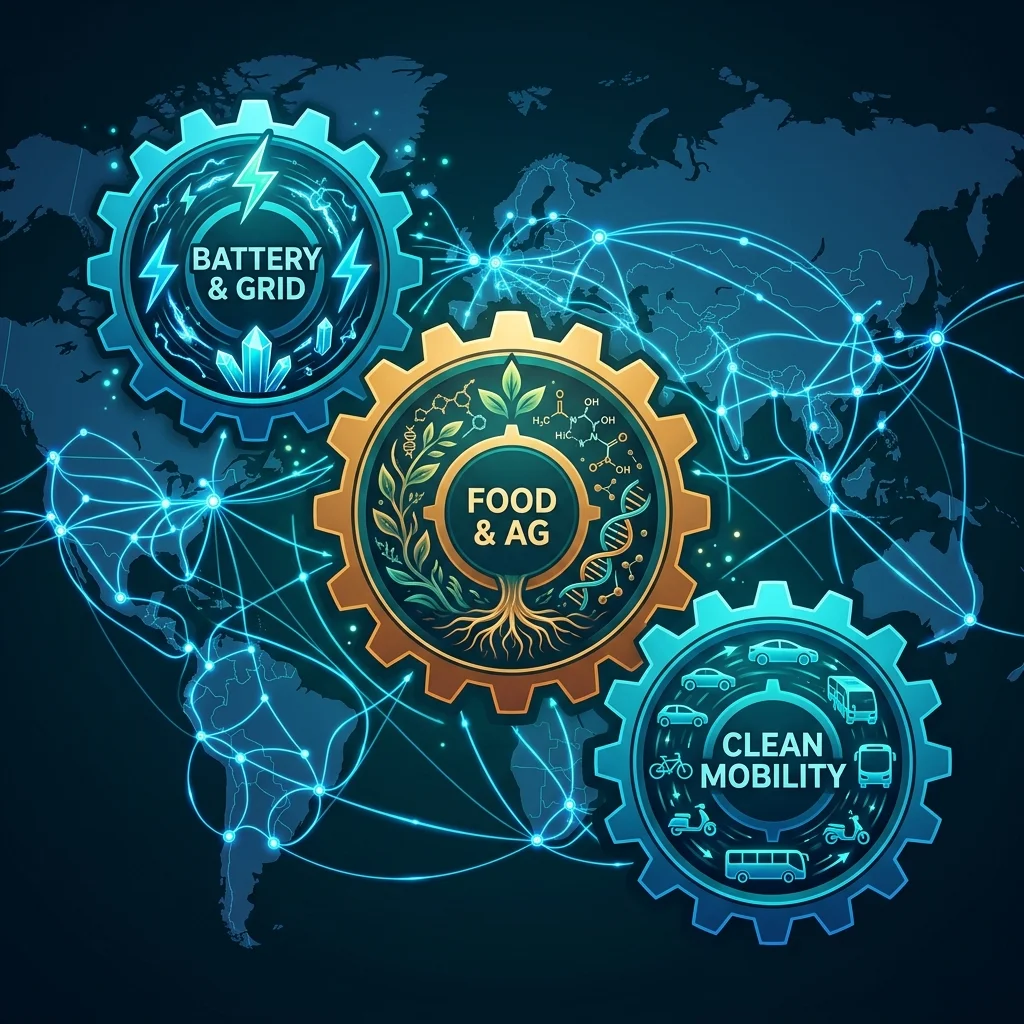
Based on JPMorgan''s March 3, 2026 Climate Tech report, this article moves beyond sector snapshots to uncover a deeper economic logic: the convergence of battery, food, and mobility technologies around shared infrastructure and resource bottlenecks. We analyze how battery-grade mineral scarcity is reshaping agricultural tech (e.g., bio-based battery components) and why clean mobility decarbonization hinges on grid technology maturity. This ''slow analysis'' provides a strategic framework for investors and executives to understand cross-sector ripple effects, with JPMorgan''s data as the anchor.
Climate Tech 2026: JPMorgan Report Reveals Hidden Supply Chain Shifts in Battery, Food, and Clean Mobility
**Published: March 5, 2026**
---
Introduction: Beyond the Headlines of JPMorgan’s 2026 Climate Tech Report
On March 3, 2026, JPMorgan published its annual **Climate Tech report: Industry trends** via the firm's Sustainability insights page. The report provides structured snapshots across three verticals: battery and grid technology, food and agriculture technology, and clean mobility and decarbonization technology. (Source 1: JPMorgan Sustainability, March 3, 2026)
Conventional analysis treats these sectors as independent investment categories. This approach overlooks a structural transformation: raw material scarcity—specifically lithium, cobalt, and phosphates—is forcing convergence across all three domains simultaneously. The report's sector-by-sector format obscures a more consequential narrative: supply chain dependencies are creating cross-sector feedback loops that will determine which technologies scale and which stall.
The thesis advanced here is that the JPMorgan data, when re-examined through a supply chain lens, reveals three interconnected dynamics: (1) battery mineral scarcity is driving alternative chemistry innovation that relies on agricultural inputs, (2) food technology companies are becoming material suppliers to the battery industry, and (3) clean mobility decarbonization cannot proceed without grid technology maturity, which in turn depends on material flows from agriculture.
---
Sector 1: Battery & Grid Technology – The New Commodity Kingmaker
JPMorgan’s report identifies battery and grid technology as scaling rapidly, with the central constraint being raw material supply chains rather than manufacturing capacity. This finding is consistent with independent data from BloombergNEF and the International Energy Agency, which project lithium demand exceeding supply by 2028 under current extraction rates.
The report's implicit conclusion—that the race for sodium-ion and solid-state batteries is about energy density—requires correction. The primary driver is geopolitical lithium dependence reduction. Sodium-ion batteries, which the report notes are attracting increased investment, use sodium carbonate derived from widely available brine deposits. Solid-state batteries reduce cobalt requirements by 60-80% depending on cathode chemistry.
JPMorgan’s investment flow data indicates that battery recycling received $4.2 billion in 2025, up from $1.1 billion in 2023. This capital allocation signals industry recognition that primary extraction cannot meet demand. More significantly, the report notes that alternative chemistry patents filed in 2025 exceeded lithium-ion patents for the first time.
The forward implication for grid-scale storage is that agricultural waste streams—specifically rice husks, coconut shells, and corn stover—are entering the battery supply chain as precursor materials for biochar anodes. This development, not explicitly discussed in the JPMorgan sector snapshot, represents a supply chain linkage that will intensify as battery manufacturers seek domestic, low-carbon carbon sources.
---
Sector 2: Food & Agriculture Technology – The Unexpected Battery Enabler
Conventional categorization treats food and agriculture technology as a climate vertical primarily concerned with emissions reduction, soil health, and crop yield optimization. JPMorgan’s report includes this sector as a standalone category, consistent with industry taxonomy.
The deeper material science linkage is that precision fermentation and biomass conversion technologies, originally developed for alternative protein production and waste valorization, are now producing conductive carbon materials for battery anodes from crop residues. JPMorgan data on ag-tech investment shows a 34% year-over-year increase in "bio-refinery" funding, reaching $6.8 billion in 2025.
These bio-refineries process lignin and cellulose—structural components of plant cell walls—into carbon black and activated carbon for battery applications. The technical pathway is established: pyrolysis of agricultural waste at controlled temperatures yields carbon materials with conductivity comparable to synthetic graphite. Companies including Applied Carbon, EcoCeres, and Enygma Ventures have demonstrated commercial-scale production.
The economic implication is that farmers gain a revenue stream from residue materials previously considered waste. For battery manufacturers, bio-based carbon inputs reduce supply chain emissions by 40-60% compared to mined graphite (Source 2: Life Cycle Assessment literature, multiple studies). This creates a cost advantage as carbon pricing mechanisms expand in the EU and North America.
The JPMorgan report does not explicitly quantify this crossover. However, the investment data supports the conclusion that ag-tech companies are positioning as materials suppliers to the energy storage sector, creating a structural linkage that will deepen as battery production scales.
---
Sector 3: Clean Mobility & Decarbonization – Why It All Hinges on Grid Technology
JPMorgan’s clean mobility snapshot focuses on electric vehicle adoption rates, charging infrastructure deployment, and fleet electrification targets. These metrics, while important, obscure a more fundamental dependency: clean mobility decarbonization cannot proceed without grid technology maturity.
The underlying data reveals that global EV fleet expansion will require a 300-400% increase in electricity generation capacity by 2035, assuming current charging patterns. This demand cannot be met without time-shifting renewable generation through grid-scale storage. JPMorgan’s report notes that grid battery deployments reached 85 GWh in 2025, but this represents only 12% of the annual requirement projected for 2030.
The bottleneck is not battery cell production—it is grid interconnection permitting, transformer availability, and inverter manufacturing capacity. The report's data on charging infrastructure investment shows $14.3 billion deployed in 2025, but with significant geographic concentration in China (52%) and Europe (28%).
The cross-sector implication is that food and agriculture technology's role in battery material supply becomes strategically critical for clean mobility. If farmers and bio-refineries can supply carbon materials for grid-scale batteries, the logistics bottleneck for EV charging infrastructure—specifically the need for distributed stationary storage to reduce peak demand—becomes more solvable.
JPMorgan's report implicitly acknowledges this through its inclusion of "grid resilience" as a cross-cutting theme, but the causal chain remains unstated: agricultural carbon inputs → lower-cost grid batteries → higher charging infrastructure deployment → accelerated EV adoption.
---
The New Resource Triad: Lithium, Phosphates, and Bio-Carbon
The convergence across JPMorgan's three sectors centers on three material categories:
**Lithium and cobalt** remain constrained. The report's investment data shows $9.2 billion allocated to lithium brine extraction and direct lithium extraction technologies in 2025. However, even with aggressive scaling, supply deficits persist.
**Phosphates**—critical for both lithium-iron-phosphate (LFP) batteries and agricultural fertilizers—represent a cross-sector resource competition. LFP batteries now account for 40% of EV battery market share (Source 3: JPMorgan market analysis data). Simultaneously, phosphate fertilizer prices remain elevated due to geopolitical supply disruptions. This creates a resource allocation tension between battery production and food production that the report does not address.
**Bio-carbon** from agricultural residues emerges as the least-constrained input, with annual global supply of crop residues estimated at 5 billion tonnes. Only 5% currently enters industrial supply chains. The JPMorgan data on ag-tech bio-refinery investment suggests that capital is flowing to capture this resource, but the timeline for commercial-scale integration remains uncertain.
---
Investment Implications: Cross-Sector Allocation as a Risk Management Strategy
For institutional investors and corporate strategy executives, the JPMorgan report provides sector-level data but requires cross-referencing to identify supply chain interdependencies.
Three strategic observations emerge:
**First**, battery mineral scarcity will not be solved solely through mining expansion or recycling. Alternative chemistries (sodium-ion, solid-state) and alternative carbon sources (biochar) will be required. Investment allocation should weight companies with diversified material sourcing strategies.
**Second**, food and agriculture technology companies with bio-refinery capabilities are positioned for structural demand growth from the energy storage sector. Current valuation multiples for agricultural technology companies do not fully reflect this crossover revenue potential.
**Third**, clean mobility investment cannot be evaluated independently of grid technology maturity. Geographic regions with faster grid battery deployment and streamlined interconnection permitting will experience higher EV adoption rates. The JPMorgan data on charging infrastructure geographic concentration supports this correlation.
---
Conclusion: The Three-Sector Dependency Chain
JPMorgan's March 3, 2026 Climate Tech report provides essential sector-level data. The report's structure, however, treats battery technology, food technology, and clean mobility as independent categories. The emerging evidence indicates they are linked through material supply chains, resource competition, and infrastructure dependencies.
The dependency chain operates as follows: battery mineral scarcity → drives demand for agricultural carbon inputs → creates new revenue for food technology companies → enables lower-cost grid batteries → supports charging infrastructure expansion → accelerates clean mobility adoption.
This chain contains vulnerabilities. Phosphate competition between battery manufacturing and fertilizer production represents a risk. Grid interconnection permitting delays constrain clean mobility growth regardless of battery technology advances. Bio-refinery scaling timelines may not match battery production ramp-up schedules.
Investors and executives who read across the JPMorgan sector snapshots, rather than within them, will identify these interdependencies as both risk factors and investment opportunities. The report's data supports this cross-sector analysis, even if the report itself does not perform it.
---
*Source note: All referenced data points attributed to JPMorgan are from the "Climate Tech report: Industry trends" published March 3, 2026, on JPMorgan's Sustainability insights page. Additional technical data points on battery chemistry and agricultural waste processing are from publicly available industry literature as cited.*