Climate Tech Capital Trends in 2024: Why Investment Is Re-Segmenting Across Energy, Mobility, and Early-Stage Bets
Climate tech is no longer just a funding story; it is becoming a market-structure story. After a sharp valuation reset in 2022, the sector rebounded to a $3.4T combined enterprise value in 2024, while venture funding cooled to $38B and late-stage capital became more selective. This article examines the hidden economic logic behind the shift: climate tech is splitting into startup, breakout, and scaleup capital lanes, with energy, transportation, and circular economy drawing different kinds of financing. It also explains why Europe’s rise, the US’s cumulative lead, and the growing role of PE, project finance, and debt reveal a broader transition from hype-driven VC to infrastructure-driven deployment.
Climate Tech Capital Trends in 2024: Why Investment Is Re-Segmenting Across Energy, Mobility, and Early-Stage Bets
Climate technology in 2024 is less a single funding theme than a market structure undergoing repricing. After the valuation reset that followed the 2021 peak, capital has not simply returned to the sector in the same form. It has redistributed across funding stages, geographies, and technology categories. The result is a clearer separation between startup-stage innovation, breakout-stage scale, and capital-intensive deployment models.
That shift matters because climate tech now spans a wide range of business models: hardware, software, APIs, IoT systems, industrial biotech, and infrastructure services. Some companies still fit the venture pattern of rapid software scaling. Others require project finance, debt, or private equity before they can expand. In other words, climate tech is increasingly being financed like an industrial transition rather than a uniform VC category.
[IMAGE: A layered capital stack visual with startup, breakout, scaleup, PE, project finance, and debt blocks over climate infrastructure icons.]
The Core Shift: From Venture Story to Capital Stack Story
The most important trend in climate technology trends for 2024 is not just how much capital entered the market, but where that capital went. The sector’s combined enterprise value reached about $3.4 trillion in 2024, according to market tracking that aggregates public and private climate-related companies. That figure is notable because it followed a sharp reset: combined value had fallen to roughly $2.0 trillion in 2022, a decline of about 20% from the prior cycle peak.
This rebound does not mean the sector has returned to the speculative conditions of 2021. Venture funding tells a different story. Global climate tech VC investment fell from $76 billion in 2021 to $38 billion in 2024, roughly half the peak level. At the same time, climate tech’s share of total VC appears to have risen modestly over the past decade, from about 14% to 16% on an approximate basis, reflecting that the sector has remained material even as broader venture markets cooled.
The key point is structural. The market is no longer being priced as a single growth story. It is being segmented by maturity, asset intensity, and financing needs.
Why This Is a Deep Audit, Not a Short-Term Market Update
This is a slow-moving industry shift, not a one-quarter headline. The most useful question is not whether climate funding is up or down in a single year, but how capital is being allocated across stages, sectors, and regions.
A short-term recap would focus on the annual funding number. A deeper audit asks:
- Which technologies still attract venture capital?
- Which areas increasingly require project finance or debt?
- Where are investors demanding clearer unit economics?
- How are Europe and the US diverging in deployment models?
Those questions matter because climate tech is not developing evenly. Energy, mobility, and circular economy businesses are all still part of the same thematic umbrella, but they are not funded in the same way.
[IMAGE: A magnifying glass over a funding map, showing regions, sectors, and capital stages.]
The Investment Logic Behind the Re-Rating
The drop in VC funding from 2021 to 2024 is best read as a normalization of expectations. Many climate companies were funded during a period when capital was cheap and growth assumptions were aggressive. When rates rose and public market multiples compressed, investors became more selective.
That change is visible in the data. Even with the 2024 slowdown, climate tech VC funding is still far above where it was a decade ago. Reported funding increased about 6.5 times from 2014 to 2024, which suggests the sector did not lose investor interest; it moved from expansionary hype to a more disciplined capital environment.
The practical implication is that investors are backing fewer speculative models and more pathways that can show:
- lower burn relative to deployment milestones,
- clearer demand visibility,
- access to non-VC capital later in the lifecycle,
- and a route to infrastructure-like scaling.
This is especially important in climate tech because many of the largest opportunities are capital intensive. Building battery factories, grid software platforms, hydrogen supply chains, or industrial heat systems often requires more than one round of venture financing.
[IMAGE: A line chart showing VC funding peaks and normalization, with a second line for share of total VC.]
Three Climate Tech Capital Segments Are Emerging
The market is increasingly organized into three distinct capital segments.
1) Startup Stage: $0–15 Million
This lane includes very early companies building technology, validating products, or proving technical feasibility. Typical examples include carbon accounting software, sensor-enabled industrial monitoring, advanced materials, and early-stage biotech applications.
This part of the market still resembles classic venture investing. Capital is used for R&D, product development, and initial pilots. The risk is high, but the capital requirement is relatively small.
2) Breakout Stage: $15 Million–$100 Million
This is where climate tech becomes more selective. Companies in this range often have a product, early revenue, and an addressable market, but they still need substantial capital to scale manufacturing, expand distribution, or build project pipelines.
Examples include electric vehicle charging networks, grid orchestration software, industrial efficiency platforms, and battery recycling firms. These businesses often need a combination of VC, growth equity, strategic capital, and sometimes debt.
3) Scaleup Stage: $100 Million+
At this level, the financing profile changes again. The capital is usually tied to asset deployment, manufacturing capacity, or infrastructure buildout. The relevant tools may include private equity, project finance, corporate balance sheets, and structured debt.
This stage is common in areas like utility-scale solar, storage, transmission equipment, electrolyzers, and large mobility infrastructure. The opportunity is large, but the financing logic is closer to industrial development than startup software.
[IMAGE: A three-column stage framework showing startup, breakout, and scaleup with example technologies in each.]
VC Still Matters, but It Is No Longer the Whole Market
One of the clearest changes in 2024 is that venture capital is no longer the sole center of gravity. VC remains essential for early technical risk, but it is only one layer of the climate capital stack.
That broader stack now includes:
- **Project finance** for revenue-generating assets,
- **Debt** for companies with predictable cash flow,
- **Private equity** for operational scaling,
- **Corporate investment** from incumbents and strategic buyers,
- **Public market capital** for mature platform businesses.
This matters because many climate solutions reach scale only when they leave the venture-only model. A battery startup, for example, may need venture capital to prove chemistry and unit economics, then project finance or debt to build plants and roll out capacity. The same is true for many grid, storage, and industrial decarbonization businesses.
Energy Still Dominates, but It Is Financing Differently
Energy remains the core destination for climate tech capital, but the funding pattern is changing. It is no longer just about software margins or consumer adoption. It is about infrastructure, permitting, manufacturing, and deployment.
In practice, that means the energy segment attracts a broader mix of financing than most other climate categories. Early-stage venture still backs software tools, forecasting platforms, and distributed energy management. But once companies move into hardware, generation, storage, and grid assets, the financing mix shifts toward project-level and balance-sheet capital.
Examples are visible across the market:
- solar and storage developers rely heavily on project finance,
- battery manufacturers often use a combination of equity, debt, and public incentives,
- grid modernization companies need long sales cycles and utility partnerships,
- hydrogen infrastructure requires large, staged commitments before revenue matures.
That is why energy is central to climate tech funding, but also why it is the least likely segment to be financed purely as a venture category. The more physical the asset, the more the capital stack resembles an industrial model.
Mobility and Circular Economy Follow Different Rules
Mobility remains important, but it is less concentrated than energy and often more exposed to consumer demand cycles, manufacturing risk, and supply-chain constraints. Electric vehicle platforms, charging networks, fleet software, and battery-related businesses attract capital for different reasons. Some are software-led and venture-friendly. Others depend on hardware deployment and infrastructure density.
Circular economy companies often sit somewhere between software and industrial operations. Recycling, materials recovery, and waste-to-value platforms can scale well, but they usually require plant-level execution and long development timelines. That makes them attractive to growth investors and strategics, but not always ideal for rapid venture multiples.
This is part of the broader re-segmentation. Capital is sorting itself by how quickly a business can move from technical proof to commercial deployment.
Europe’s Rise and the US Lead
Geography is also helping define climate tech funding patterns. The US still holds the cumulative lead in climate tech investment, supported by deeper capital markets, a larger venture ecosystem, and strong coverage across software, storage, mobility, and industrial innovation.
Europe, however, has become more prominent in deployment-oriented climate investing. Its regulatory environment, industrial base, and energy transition needs have made it a strong market for grid, efficiency, electrification, and infrastructure-linked startups. European climate companies often operate closer to real-world deployment constraints, which can push them earlier toward partnerships, subsidies, and non-VC financing.
The comparison is useful because it shows two different capital logics:
- the US remains stronger in venture formation and scale financing,
- Europe is increasingly important in policy-linked deployment and industrial transition.
This difference helps explain why the climate tech market no longer looks uniform across regions.
[IMAGE: A split-screen regional comparison map of US and Europe with icons for venture, infrastructure, and industrial deployment.]
What the 2024 Data Suggests About Investor Behavior
The 2024 funding environment suggests that investors are not exiting climate tech; they are narrowing their entry points. Capital is concentrating in companies with clearer deployment paths and more defined economics.
That can be seen in three ways:
1. **Late-stage capital is more selective.** Large rounds now require stronger proof of demand, operational execution, and downside protection. 2. **Early-stage capital remains active.** Seed and Series A investors continue to fund new technical approaches, especially where the market is still forming. 3. **Non-VC capital matters more.** Growth debt, project finance, and strategic investment are increasingly necessary to bridge the gap between prototype and scale.
The result is a more segmented market where capital flows are tied to maturity rather than theme alone.
Conclusion: Climate Tech Is Becoming an Infrastructure Allocation Market
The main lesson from 2024 is that climate tech is moving from narrative-driven venture enthusiasm toward a more differentiated capital allocation market. The sector still attracts major investment, and its aggregate enterprise value remains large by any standard. But the financing model is changing.
Startup-stage companies still need venture capital to prove technical feasibility. Breakout companies need growth capital and operational execution. Scaleup companies increasingly need debt, project finance, and private equity. Across energy, mobility, and circular economy, the relevant question is no longer simply whether a company is “climate tech.” It is what kind of capital it needs, at what stage, and for how long.
That is why climate technology trends in 2024 are best understood as a re-segmentation of investment logic. The market is still expanding, but it is doing so through a more complex capital stack.
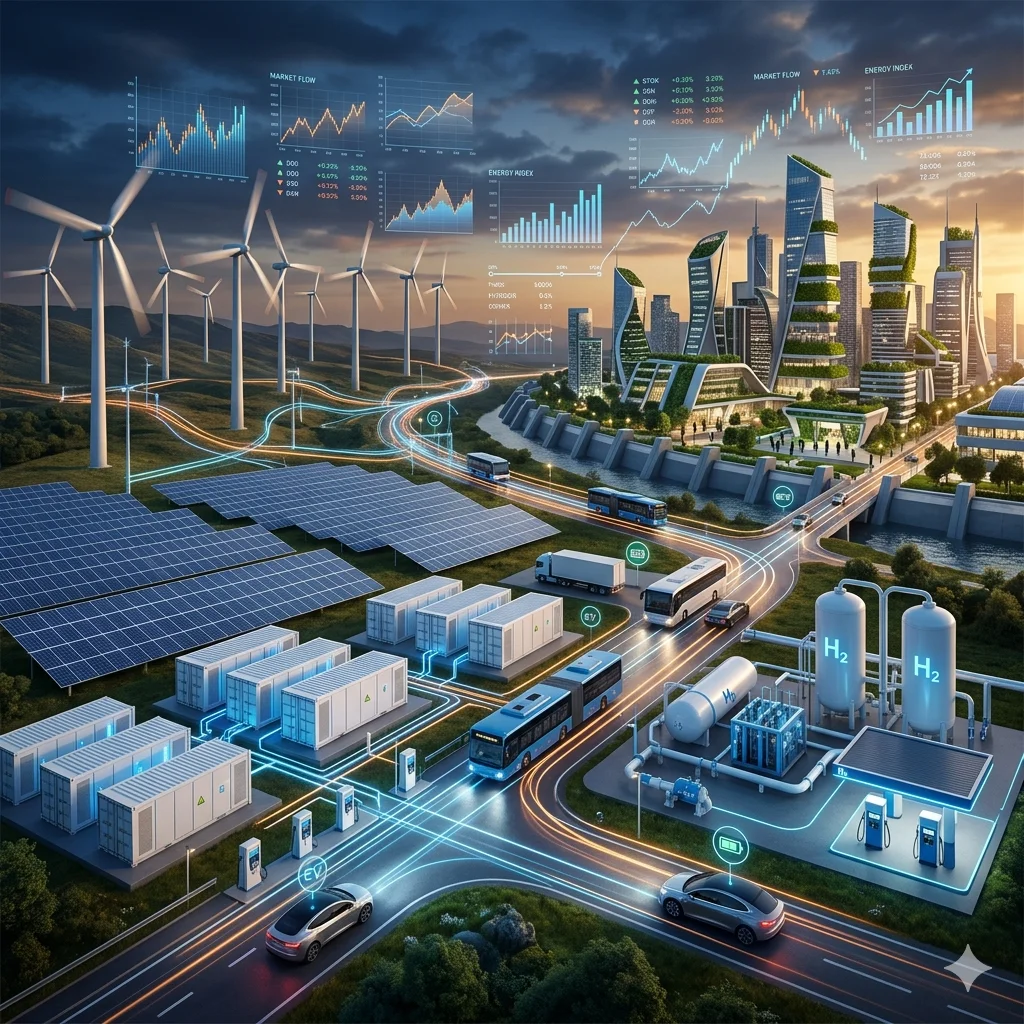
[IMAGE: A futuristic clean energy landscape with wind turbines, solar arrays, electric vehicles, battery storage, hydrogen infrastructure, and urban climate adaptation elements, connected by glowing data lines and market chart overlays.]