Climate Tech Trends 2026: Record Clean Energy Investment Meets Hydrogen Pipeline Reset
As clean energy investment surges past $2 trillion annually, the climate tech landscape in 2026 reveals a stark divergence: booming renewables and electrification versus a contraction in green hydrogen project pipelines. This analysis explores the hidden economic logic behind this recalibration, examining how capital flows are favoring mature technologies over speculative ventures. We dig into the implications for supply chains, electrolyzer manufacturers, and corporate strategy, with insights from industry players like ICL Group. The transitional year signals a new era of capital discipline in climate innovation.
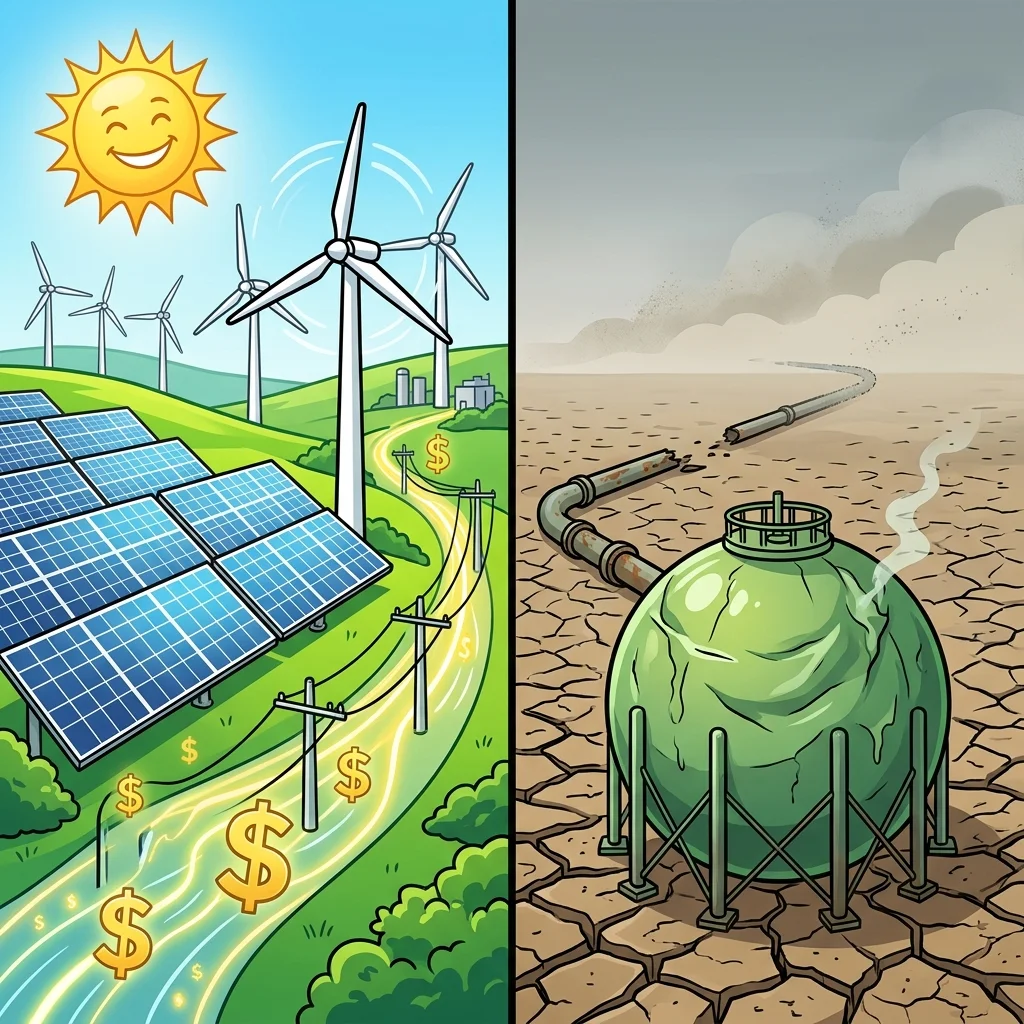
Climate Tech Trends 2026: Record Clean Energy Investment Meets Hydrogen Pipeline Reset
Introduction: The Great Divide in Climate Tech
The year 2026 is shaping up to be a defining pivot point for the climate technology landscape. On one side, global clean energy investment has shattered records, crossing the $2 trillion annual threshold for the first time. Solar farms, wind turbines, battery factories, and electric vehicle supply chains are absorbing capital at an unprecedented pace. On the other side, the green hydrogen sector—once hailed as the missing link for decarbonizing heavy industry—is undergoing a painful correction. Project pipelines are shrinking, timelines are slipping, and investors are pulling back from earlier commitments.
This divergence is not a sign of climate fatigue. It is a recalibration driven by hard economic logic: capital is fleeing hype-driven experimentation and flowing toward mature, bankable technologies with proven cost curves. The result is a two-speed climate economy—one where renewables and electrification race ahead, while speculative ventures like green hydrogen face a harsh reckoning with commercial reality.
Hadar Sutovsky, Vice President of Corporate Strategy at ICL Group, a global specialty minerals company with deep ties to the hydrogen storage and electrolyzer material supply chain, has observed this shift from the inside. “What we are seeing is a necessary market correction,” Sutovsky noted in a recent industry briefing. “The hype cycle created inflated expectations around green hydrogen. Now the industry is being forced to demonstrate real economics, not just promises.” ICL’s own strategy reflects this tension: the company continues to invest in materials critical for hydrogen storage and electrolysis, but it is also diversifying into battery-grade chemicals and other high-demand clean energy inputs where demand is more certain.
[IMAGE: World map with two color gradients – green for high clean energy investment regions, gray for contracted hydrogen projects]
The $2 Trillion Milestone: Where the Money Is Flowing
According to the International Energy Agency (IEA) and BloombergNEF (BNEF), global investment in clean energy and low-emission technologies surpassed $2 trillion annually in early 2026, marking a new record. This figure includes spending on renewable power generation, energy storage, electric vehicles, charging infrastructure, grid modernization, and efficiency measures. The growth trajectory has been remarkable: from just over $1 trillion in 2021, investments have roughly doubled in five years.
The bulk of this capital is flowing into sectors with established cost reduction trajectories. Solar photovoltaics (PV) alone accounted for over $400 billion in 2025, driven by module prices that have fallen by more than 90% over the past decade. Onshore wind continues to attract large-scale project finance, with levelized costs of energy now competitive with or cheaper than fossil fuels in most regions. Battery storage, once a niche market, has become a $150 billion annual industry as grid-scale deployments surge and electric vehicle demand drives manufacturing scale.
Electric vehicles are perhaps the most striking success story. Global EV sales reached 18 million units in 2025, and the associated battery supply chain has become a magnet for investment—from lithium mining to cell production to recycling. BNEF estimates that battery manufacturing capacity could exceed 4 terawatt-hours per year by 2027, enough to power over 40 million new EVs annually.
What makes 2026 different from previous boom years is the confluence of durable tailwinds. Policy frameworks like the U.S. Inflation Reduction Act and the European Union’s Green Deal Industrial Plan have created long-term certainty for capital deployment. Meanwhile, energy security concerns triggered by geopolitical instability have accelerated the shift away from fossil fuels. And the cost of capital, while higher than during the ultra-low interest rate environment of the early 2020s, has not deterred project developers—especially in renewables, where long-term power purchase agreements lock in revenue streams and hedge against inflation.
[IMAGE: Bar chart showing year-over-year clean energy investment growth (2015-2026) with annotations on major policy catalysts]
The Hydrogen Correction: A Pipeline Cleanup Unfolds
While renewables and electrification are booming, the green hydrogen sector is experiencing a starkly different reality. The global project pipeline for green hydrogen—defined as hydrogen produced via electrolysis using renewable electricity—is contracting. Industry tracking by the Hydrogen Council and the IEA shows that a significant number of announced projects have been cancelled, deferred, or placed under “feasibility review” since mid-2025. The pipeline “cleanup” is now in full swing.
Several structural factors explain this contraction. First, electrolysis costs remain stubbornly high. Although electrolyzer manufacturing capacity has expanded rapidly—companies like Nel, Plug Power, and ITM Power have scaled production—the actual installed cost of electrolysis systems, including balance-of-plant and grid interconnection, has not fallen as fast as anticipated. The green hydrogen production cost in many regions still sits at $4–$8 per kilogram, far above the $2–$3 target required to compete with gray hydrogen from natural gas.
Second, offtake agreements—the long-term contracts that project developers need to secure financing—remain scarce. Industrial users in steel, chemicals, and refining have been hesitant to commit to green hydrogen at current prices, especially when regulatory mandates are still being formulated. Without bankable offtake, lenders are unwilling to provide project finance. The result: a growing pile of “announced” projects that will never reach final investment decision.
Third, infrastructure gaps are a critical bottleneck. Green hydrogen requires dedicated storage (salt caverns, pressurized tanks) and transport (pipelines, liquefaction, or ammonia conversion) that are largely absent outside of a few pilot corridors. The cost of building this infrastructure from scratch, combined with the chicken-and-egg problem of demand creation, has led many project sponsors to put plans on hold.
ICL Group’s experience illustrates the recalibration. The company supplies specialty minerals—including bromine-based compounds and advanced metal hydrides—used in hydrogen storage and electrolyzer membranes. “We are seeing our customers become much more selective,” Sutovsky explained. “Instead of dozens of early-stage projects chasing funding, we now work with a smaller number of well-capitalized players who have clear cost targets and realistic timelines. It’s a healthier ecosystem, but it means slower near-term growth.” ICL itself is reorienting its R&D portfolio to align with technologies that have nearer-term commercial viability, such as battery materials and advanced mining chemicals for critical minerals.
[IMAGE: Infographic showing a shrinking pipeline of hydrogen projects across stages (announced, feasibility, final investment decision, operating)]
Hidden Economic Logic: Capital Efficiency Over Experimentation
The divergent trajectories of renewables and hydrogen are not random. They reflect a deeper shift in how climate finance operates. Investors, from institutional pension funds to venture capital firms, are applying increasingly stringent capital efficiency metrics to climate tech. The era of “impact at any cost” is giving way to disciplined asset allocation.
Renewables and battery storage offer exactly what risk-averse capital demands: predictable cash flows, proven technology, declining costs, and established regulatory frameworks. A solar farm with a 20-year power purchase agreement can be financed at leverage ratios of 70–80%, with returns that are largely immune to volatile energy prices. Battery storage projects, while newer, have rapidly built a track record of stacking multiple revenue streams—energy arbitrage, frequency regulation, capacity payments—that de-risk investment.
Green hydrogen, by contrast, sits in a precarious “valley of death.” The technology is proven at pilot scale but not yet commercialized at scale. The capital expenditure required for a single large electrolysis plant—hundreds of millions to billions of dollars—far exceeds what venture capital can provide, yet the technology is too unproven for traditional project finance without government guarantees. The result is a funding gap that the industry has struggled to close.
This divergence has profound implications for the climate tech market recalibration. Startups that once rode the green hydrogen wave are now scrambling to reposition. Some are pivoting to adjacent markets—such as hydrogen for ammonia production or hydrogen blending into gas grids—where demand is more tangible. Others are consolidating: the number of independent electrolyzer manufacturers has fallen by nearly a third since 2023, as larger players acquire or absorb smaller competitors.
For the broader clean energy investment 2026 landscape, the lesson is that technology maturity matters. “Investors are no longer willing to bet on a 10-year trajectory to profitability,” said Sutovsky. “They want to see a clear path within 3 to 5 years. That means doubling down on what works today and funding the next generation of technologies only when the fundamentals are solid.”
[IMAGE: Investment risk-return spectrum showing clean energy sectors ranked by technology readiness and capital efficiency]
Conclusion: A Recalibrated Path Forward
The climate tech landscape in 2026 is not signaling a slowdown in the energy transition—it is signaling a maturation. Record clean energy investment demonstrates that capital is ready and willing to finance decarbonization, but it demands bankability. The green hydrogen pipeline cleanup, while painful for many stakeholders, is a necessary correction that will ultimately produce a more realistic and viable industry.
Several implications are worth noting. For supply chains, the shift means that materials and components for solar, wind, and batteries will see sustained demand growth, while hydrogen-related supply chains will grow more slowly and with greater volatility. Companies like ICL that supply both sectors are diversifying their exposure. For electrolyzer manufacturers, the survivors will be those that focus on cost reduction, standardization, and forming strategic partnerships with industrial offtakers. For corporate strategists, the lesson is clear: align capital allocation with technology readiness levels, and be prepared to pivot when hype outstrips reality.
Looking ahead, 2026 may be remembered as the year when climate tech grew up. The transition from hype to discipline is never comfortable, but it is necessary for building an energy system that is not only clean but economically durable. The pipeline reset in hydrogen does not mean the technology is dead—it simply means it will take longer, cost more, and serve fewer markets than the optimists once predicted. Meanwhile, the technologies that are ready to scale today are already reshaping the global energy economy, one gigawatt at a time.
[IMAGE: Split visual: left side solar farm and wind turbines with dollar signs in energy flows; right side deflating hydrogen sphere and fading pipeline, cracked ground. High-contrast infographic style.]