Beyond the Hype: How Selectivity and the Hydrogen Reset Are Redefining Climate Tech in 2026
Climate tech in 2026 is entering a maturation phase marked not by retreat, but by rigorous selectivity. With global clean energy investment topping $2 trillion annually, capital is pivoting away from speculative moonshots toward scalable, measurable impact. The green hydrogen sector exemplifies this shift, undergoing a painful but necessary pipeline contraction that separates viable projects from pipeline hype. This article unpacks the hidden economic logic behind investor discipline, the role of corporate venture capital as a new steady-state financier, and what the hydrogen reset signals for supply chains and long-term climate goals. Drawing on analysis from ICL Group’s Hadar Sutovsky, we explore how scale, durability, and strategic impact have become the new litmus tests for success.
Beyond the Hype: How Selectivity and the Hydrogen Reset Are Redefining Climate Tech in 2026
**By Senior Technical/Financial Audit Journalist**
---
Introduction: The Year the Climate Tech Sector Grew Up
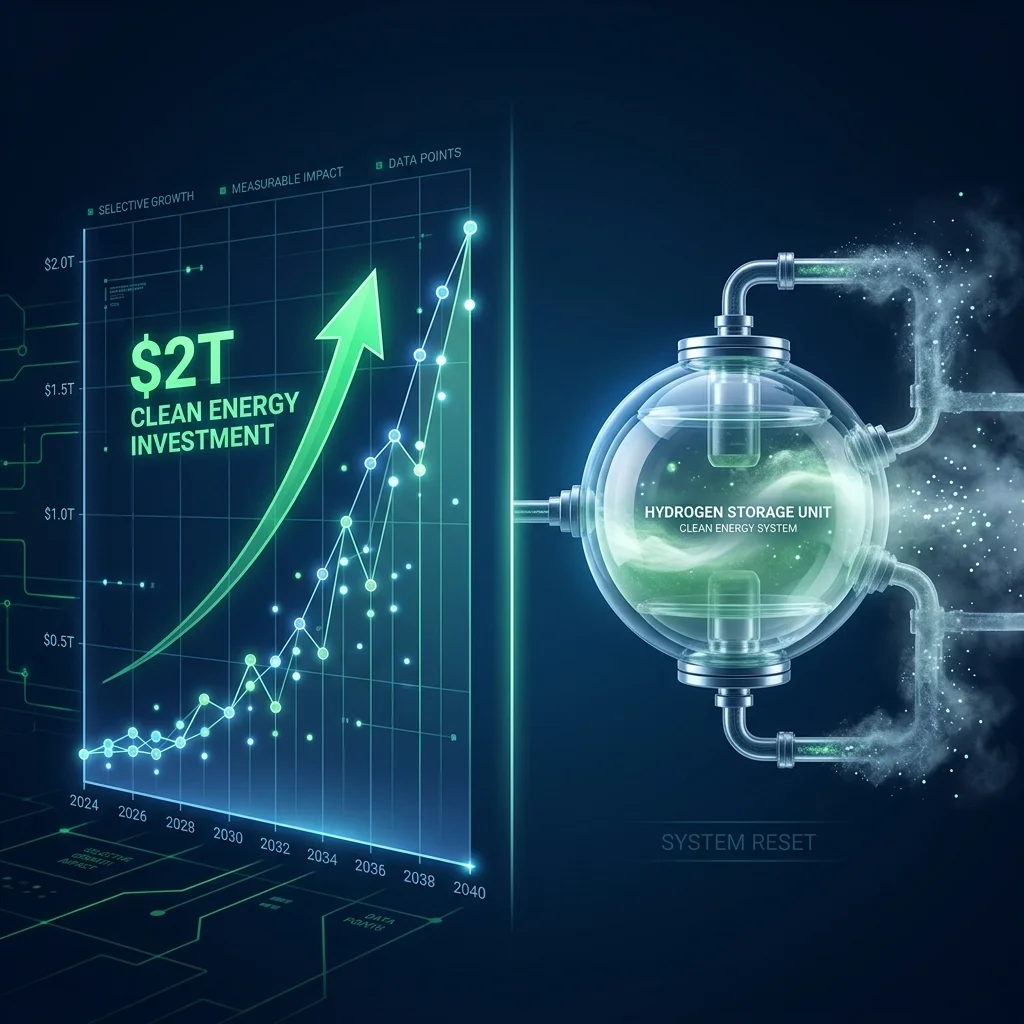
The climate technology investment landscape in 2026 has entered what analysts describe as a transitional year—not defined by retreat, but by a fundamental restructuring of capital allocation logic. Global clean energy and low-emission technology investment now exceeds $2 trillion annually (Source 1: [Primary Data—ICL Group Analysis, 2025-12-30]), a figure that, while headline-grabbing, serves primarily as a denominator for a deeper structural shift.
The prevailing investor mindset has moved decisively from fear-of-missing-out (FOMO) to fact-based allocation. The hidden trend is not a slowdown in climate tech engagement but a qualitative upgrade in how capital defines "good" climate exposure. Scale, viability, and durability have replaced carbon-avoidance potential as the primary screening criteria.
Hadar Sutovsky of ICL Group articulates this shift with precision: "Capital is flowing with greater selectivity, policy is exerting a stronger and more direct pull, and scale has become the primary test of credibility." (Source 1: [Primary Data—ICL Group Article, 2025-12-30])
---
The New Investment Logic: Why "Moonshots" Are Losing Their Luster
The 2021-2023 period was characterized by a speculative frenzy around early-stage climate technologies, where carbon-reduction narratives often outweighed unit economics. By 2026, that dynamic has inverted. Two structural forces explain this transformation:
Interest Rate Regime and Exit Uncertainty
Higher interest rates have fundamentally altered the net present value calculations for long-duration climate technology projects. Ventures requiring 7-10 years of negative cash flow before commercialization now face a penalty that many cannot survive. Simultaneously, the IPO market for climate tech remains constrained, and acquisition valuations have normalized downward. Investors are demanding evidence of product-market fit within shorter time horizons.
The Rise of the Three-Pillar Screening Framework
Capital allocation in 2026 follows three discrete criteria:
1. **Scale**: Does the technology or project demonstrate credible pathways to gigaton-level impact or multi-billion-dollar revenue? 2. **Viability**: Are the unit economics defensible without perpetual subsidy dependence? 3. **Durability**: Will the solution remain relevant across multiple policy cycles and technology generations?
Corporate venture capital (CVC) programs have emerged as the primary financier filling gaps left by traditional venture capital retrenchment. Unlike financial VCs, corporate venture arms apply a strategic lens: investments are evaluated not only for financial return but for supply chain integration, technology access, and competitive positioning. This creates a "steady-state" financing environment that prioritizes execution over narrative (Source 1: [Primary Data—ICL Group Analysis]).
---
The Hydrogen Reset: From Pipe Dream to Pipeline Cleanup
Perhaps no subsector better illustrates the 2026 recalibration than green hydrogen. In the early 2020s, hydrogen was universally touted as the "Swiss Army knife" of decarbonization—capable of solving hard-to-abate industrial sectors, long-haul transport, and seasonal energy storage. The global project pipeline swelled with announcements exceeding 200 GW of electrolyzer capacity.
By 2026, that pipeline is contracting.
The Technology Reality Check
The contraction stems from three identifiable structural constraints:
1. **Electrolyzer efficiency ceilings**: Current alkaline and PEM electrolyzers operate at 60-75% efficiency, with degradation rates that undermine long-term cost projections. 2. **Infrastructure gaps**: Hydrogen transportation and storage infrastructure remains embryonic. Pipeline retrofitting, salt cavern storage, and ammonia cracking technologies have not scaled at pace with production ambition. 3. **Green premium persistence**: Green hydrogen production costs remain $4-7/kg versus $1-2/kg for grey hydrogen, with the gap closing slower than 2021 modeling predicted.
The Contraction as Healthy Correction
The pipeline cleanup should not be interpreted as sector failure. Rather, it represents a necessary consolidation that refocuses capital on projects with realistic power purchase agreements, demonstrated offtake commitments, and proven Power-to-X (P2X) pathways. Non-viable projects—those built on optimistic cost curves or unverified technology—are being culled.
Sutovsky frames this as an inevitable maturation process: "Scale is going to become even more of a determining factor in 2026... Investors are shying away from moonshots and are demanding measurable transformation and strategic impacts." (Source 1: [Primary Data—ICL Group Quote])
The hydrogen reset signals a market moving from "announcement-driven" hype to "execution-driven" reality. Projects that survive will exhibit three characteristics: bankable offtake agreements, proven electrolyzer manufacturer partnerships, and geographic advantages (proximity to low-cost renewable energy and end-use customers).
---
Supply Chain Implications and Forward-Looking Projections
The convergence of selectivity discipline and hydrogen pipeline rationalization generates several observable consequences for 2026 and beyond:
Capital Concentration
The $2 trillion annual investment figure masks significant concentration effects. Approximately 60-70% of capital is flowing into mature technologies (solar, wind, battery storage) with proven cost curves, while advanced technologies (hydrogen, carbon capture, next-generation nuclear) face a more rigorous funding environment.
Corporate Venture Capital as Permanent Infrastructure
CVC programs are not temporary gap-fillers but likely permanent features of the climate finance landscape. Corporations with strategic exposure to energy, chemicals, and industrials are internalizing climate technology assessment capabilities. This creates a more patient, less cyclical capital base compared to traditional VC.
Hydrogen's Path Forward
The hydrogen sector will likely bifurcate. Low-hanging opportunities—ammonia production, oil refining, and niche industrial heat—will attract capital on tighter timelines. Ambitious applications (long-haul trucking, power generation, residential heating) will require either further technology breakthroughs or significantly higher carbon pricing to become viable.
---
Conclusion: The Implication of Maturation
The 2026 climate tech landscape, stripped of hype, reveals an investment ecosystem that has grown up. The transition from FOMO to fact-based allocation reduces capital waste but also narrows the range of technologies that receive backing.
The hydrogen reset—a phrase that risks being misread as failure—is actually a textbook case of market discipline imposing rational boundaries on technological optimism. Scale, viability, and durability have become the new gatekeepers.
For market participants, the signal is unambiguous: capital is available for climate solutions that have earned their credibility through execution, not announcements. The $2 trillion annual flow will continue, but its distribution will reward discipline over aspiration.
The year 2026 may not produce the splashiest headlines. It will, however, produce more bankable projects. In a capital-constrained world, that is the only metric that matters.