Beyond the Loan: How Germany''s €500M Climate Deal with South Africa Secures Critical Minerals and Reshapes Energy Transition Geopolitics
A €500 million concessional loan from Germany to South Africa, signed during Chancellor Olaf Scholz''s May 2024 state visit, is more than climate finance. This analysis reveals the deal''s dual-track strategy: funding South Africa''s Just Energy Transition (JET-IP) while establishing a strategic partnership on critical raw materials. We examine the underlying economic logic, where Germany secures future supply chains for its green industries, and South Africa leverages its mineral wealth for concessional capital. The article explores the long-term implications for global energy transition geopolitics, the risks of ''green resource colonialism,'' and how this bilateral model could influence other resource-rich nations.
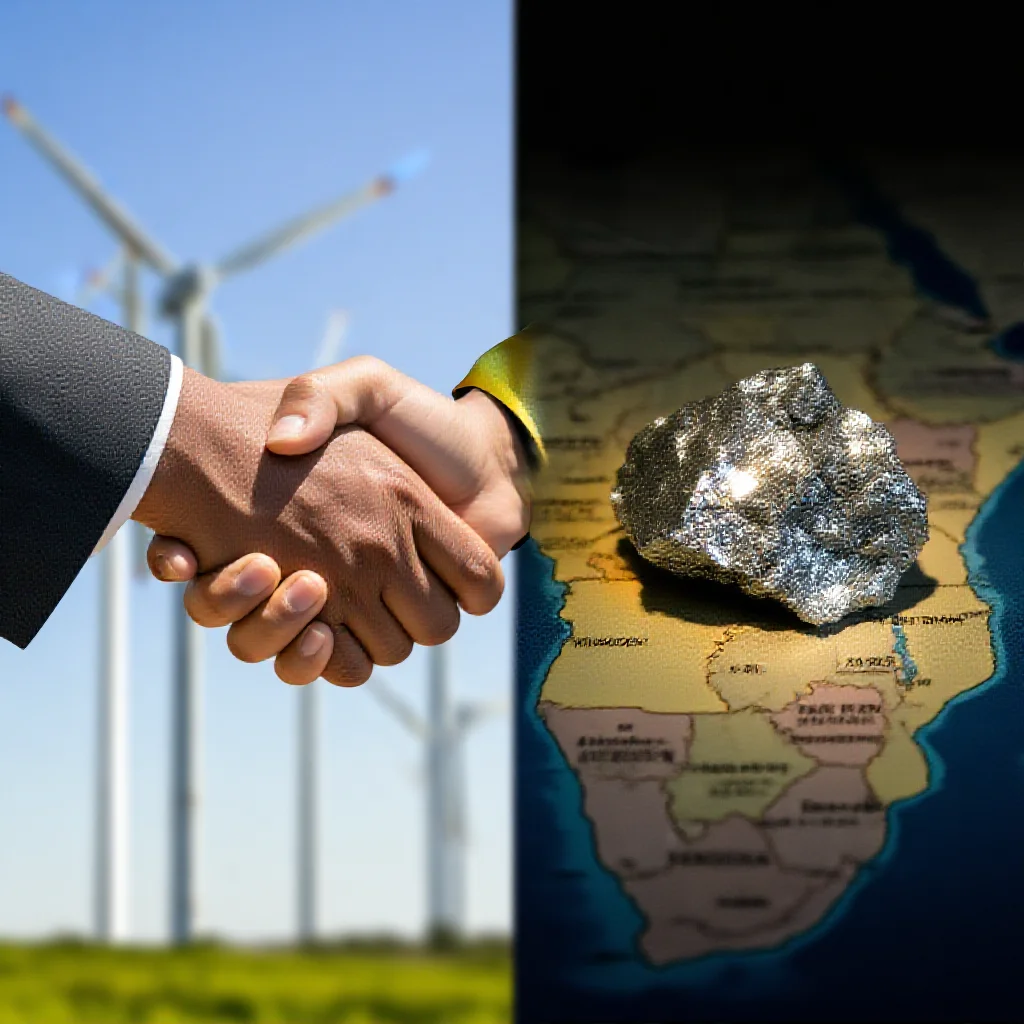
Beyond the Loan: How Germany's €500M Climate Deal with South Africa Secures Critical Minerals and Reshapes Energy Transition Geopolitics
**A €500 million concessional loan from Germany to South Africa, signed during Chancellor Olaf Scholz's May 2024 state visit, is more than climate finance. This analysis reveals the deal's dual-track strategy: funding South Africa's Just Energy Transition (JET-IP) while establishing a strategic partnership on critical raw materials. We examine the underlying economic logic, where Germany secures future supply chains for its green industries, and South Africa leverages its mineral wealth for concessional capital. The article explores the long-term implications for global energy transition geopolitics, the risks of 'green resource colonialism,' and how this bilateral model could influence other resource-rich nations.**
The Surface Deal: A Concessional Climate Loan for Energy Transition
During German Chancellor Olaf Scholz's state visit to South Africa in May 2024, the two governments formalized a €500 million climate loan agreement (Source 1: [Primary Data]). The financial terms are explicitly concessional, featuring a fixed interest rate of 2.5% and a five-year grace period before repayments commence (Source 1: [Primary Data]). This structure functions as a strategic incentive, reducing the immediate fiscal burden on the recipient.
The capital is formally earmarked for South Africa's Just Energy Transition Investment Plan (JET-IP), a framework designed to decarbonize the coal-dependent economy while addressing socio-economic challenges like job creation and local community support (Source 1: [Primary Data]). The transaction is executed through KfW Development Bank, positioning the German state-owned institution as a primary instrument in Berlin's international climate diplomacy toolkit. The public-facing narrative is one of developed-nation support for a complex, justice-oriented energy transition in an industrializing economy.
The Strategic Core: Unpacking the Critical Minerals Partnership
Concurrently signed was a Joint Declaration of Intent to establish a bilateral partnership on critical raw materials (Source 1: [Primary Data]). This document represents the strategic cornerstone of the visit, shifting the relationship from a donor-recipient dynamic to a structured economic partnership. The logic is grounded in material geography: South Africa holds globally significant reserves of platinum group metals (PGMs), manganese, and vanadium—minerals essential for hydrogen electrolyzers, battery cathodes, and high-strength steel (Source 2: [Analytical Inference]).
For Germany, a manufacturing powerhouse with legislated climate targets, securing stable, diversified supplies of these inputs is an industrial security imperative. The partnership directly aims to de-risk segments of Germany's energy transition by developing an alternative supply chain node, reducing over-reliance on a single dominant global processor (Source 2: [Analytical Inference]). The agreement establishes a framework for collaboration across the value chain, from sustainable extraction and processing to skills development and potential technology transfer.
Hidden Economic Logic: A New Model of Resource-for-Finance Barter
The dual announcements reveal an integrated economic logic. The concessional loan and the minerals partnership are analytically inseparable components of a single bilateral negotiation. The model operates on a long-term barter principle: Germany provides South Africa with below-market-rate capital to fund its energy transition, while South Africa provides Germany with preferential access and future supply chain stability for the minerals required for its own green industrial transformation.
This constitutes a distinct evolution from traditional development finance. The concessionality of the loan (the 2.5% rate and grace period) can be interpreted as a premium paid for strategic access. Germany's calculus invests in future industrial security; South Africa's calculus monetizes its subsurface wealth to fund its above-ground infrastructure transition. The partnership ties financial support directly to the lender's core economic interests, creating a mutually binding, interest-based alignment that may prove more durable than aid-based relationships.
Deep Dive: Geopolitical Ripples and Unanswered Questions
The agreement generates immediate geopolitical repercussions. It positions South Africa within competing critical mineral frameworks, notably the European Union's Critical Raw Materials Act, which seeks to diversify the bloc's sourcing. While not exclusive, the partnership offers South Africa a concrete avenue into the EU's strategic partnership network, potentially balancing other external engagements. For Germany, it represents a tangible step in implementing its "Raw Materials Strategy" and securing "friend-shored" supplies for its automotive and chemical sectors.
This model inevitably invites scrutiny under the lens of "green colonialism." The central risk is an imbalanced outcome where raw materials are exported with minimal local beneficiation, while value-added manufacturing and technological benefits accrue primarily to the German economy. The sustainability of the partnership will be measured by its ability to facilitate genuine value addition within South Africa, including technology co-development and capacity building beyond extraction.
The replicability of this blueprint is a key variable for global energy transition geopolitics. Similar structured deals are likely to be pursued by the EU, United Kingdom, Japan, and South Korea with other resource-rich nations in Africa, Latin America, and Southeast Asia. The South Africa-Germany pact establishes a precedent where concessional climate finance is explicitly linked to strategic minerals cooperation, creating a new template for bilateral negotiations in the energy transition era. The long-term trend suggests a fragmentation of global resource networks into competing, interest-based alliances centered on green industrialization.