Navigating Complexity: How Environmental Governance Innovation Drives Sustainability Transitions
The Environmental Policy Analysis (EPA) department, part of GreenDeal-NET, explores the shift from top-down government to decentralized, flexible governance for sustainability. This article unpacks three core research themes—governing under complexity, governance innovation and institutional change, and governance evaluation—revealing how new horizontal and vertical steering mechanisms address unintended effects and institutional interlinkages. By examining the hidden logic behind governance adaptation, it offers deep insights for policymakers and analysts seeking effective sustainability transitions.
```markdown # Navigating Complexity: How Environmental Governance Innovation Drives Sustainability Transitions
Introduction: The New Face of Environmental Governance
Environmental governance has moved far beyond the old model of top-down government command. Today, effective steering toward sustainability requires a blend of horizontal coordination among diverse actors and vertical alignment across multiple levels of decision-making. The Environmental Policy Analysis (EPA) department, part of the GreenDeal-NET research consortium, places this shift at the center of its inquiry. By studying how governance arrangements adapt to complex, wicked problems, the EPA aims to uncover what works—and what fails—in the pursuit of sustainability transitions.
Understanding governance is not an academic luxury; it is a practical necessity. Policymakers and analysts alike face persistent implementation gaps: ambitious environmental targets are set, yet on-the-ground outcomes lag. The EPA’s research addresses this disconnect by investigating three core themes: governing under complexity, governance innovation and institutional change, and governance evaluation. This article unpacks each theme to reveal the hidden logic behind governance adaptation, offering actionable insights for those designing and assessing sustainability policies.
[IMAGE: Simple side-by-side comparison: left side showing a top-down bureaucratic hierarchy (old government), right side showing a networked hub of diverse actors (new governance).]
Theme 1: Governing under Complexity
Wicked environmental problems—climate change, biodiversity loss, persistent pollution—do not yield to rigid rules or single-agency solutions. They are non-linear, cross-sectoral, and deeply uncertain. The EPA department investigates how governance systems can become more adaptive, embracing polycentric arrangements where multiple centers of authority interact without a single hierarchical controller.
Polycentric governance, in theory, allows experimentation, local tailoring, and responsive learning. But it also introduces unintended effects: fragmentation of responsibilities, coordination failures, and the risk that powerful actors capture decentralized decision-making. The EPA’s research examines these dynamics through empirical case studies and theoretical models, asking how feedback loops and institutional interlinkages can be designed to foster resilience rather than chaos.
Real-world complexity demands multi-level coordination. Climate action, for instance, requires simultaneous efforts from local municipalities, regional governments, national agencies, and international bodies. The EPA’s work highlights that effective governance under complexity is not about eliminating uncertainty but about building structures that can learn, adapt, and adjust as conditions evolve.
[IMAGE: A network diagram with many interconnected nodes (local, regional, national, global) and arrow loops showing feedback and unintended consequences.]
Theme 2: Governance Innovation and Institutional Change
Traditional regulatory approaches are increasingly supplemented—or replaced—by experimentalist governance: flexible, iterative policy frameworks that encourage learning and adaptation over time. These innovations include participatory budgeting, multi-stakeholder councils, co-management committees, and adaptive management protocols. The EPA explores how such innovations interact with existing rules, norms, and organizations—what scholars call institutional interlinkages.
Institutional change is rarely a clean slate. New governance forms must negotiate with established legal frameworks, bureaucratic routines, and power asymmetries. For example, a community-based natural resource management scheme may clash with central government mandates, leading to conflict or paralysis. The EPA’s research within GreenDeal-NET examines when institutional innovations accelerate sustainability transitions and when they inadvertently hinder them. Key factors include the degree of political support, the alignment of incentives, and the capacity for mutual adjustment among institutions.
Understanding these interlinkages is crucial because governance innovation is not an end in itself. It must be evaluated against the goal of steering society toward a sustainable future. The EPA’s work provides evidence on how to design institutions that are both innovative and robust.
[IMAGE: A timeline showing key governance innovations (e.g., participatory budgeting, co-management councils) with milestones marking institutional changes.]
Theme 3: Governance Evaluation
How do we know if a governance arrangement is effective? The EPA department places a strong emphasis on systematic evaluation, moving beyond simple input-output metrics to capture process, legitimacy, and long-term outcomes. Evaluation is not just a post-hoc exercise; it is integral to adaptive governance.
The EPA draws on theories that explain variation in governance outcomes, including path dependency—the way past decisions constrain future options—and power dynamics, which determine whose interests are served by governance designs. For instance, a seemingly participatory process may still reinforce existing inequalities if marginalized groups lack voice. By integrating these theoretical lenses, the EPA’s evaluation framework helps policymakers identify not only what works, but why.
Feedback loops are central to this approach. Effective governance requires mechanisms to monitor results, learn from failures, and revise strategies accordingly. The EPA’s research documents how iterative evaluation cycles can transform governance systems, turning unintended effects into opportunities for redesign.
[IMAGE: A cycle diagram: Input (policies) → Implementation → Outcomes → Evaluation → Feedback → Revision.]
Deep Dive: Unintended Effects and Institutional Interlinkages
Governance innovation, while promising, carries hidden risks. Decentralization can lead to fragmentation, where no single actor has a complete view of the system. Accountability gaps emerge when responsibilities are diffused among many bodies, making it difficult for citizens to attribute outcomes to specific decisions. Moreover, vested interests may capture new governance spaces, using them to advance narrow agendas rather than the broader sustainability goal.
The EPA’s research delves into these unintended effects, examining how institutional interlinkages between new and old governance structures either mitigate or amplify such risks. For example, a newly created climate council may find its recommendations ignored by established line ministries unless formal coordination mechanisms exist. Conversely, when interlinkages are carefully designed—through joint reviews, cross-membership, or shared data platforms—the risk of capture and fragmentation diminishes.
Lessons from the EPA’s work underscore that governance transitions are not purely technical exercises. They are deeply political and institutional. Success requires not only innovative designs but also strategies to align interests, build trust, and foster adaptive capacity across all levels. By revealing the hidden logic behind governance adaptation, the EPA provides policymakers and analysts with a roadmap for navigating complexity—turning the challenge of unintended effects into a catalyst for more resilient sustainability governance.
[IMAGE: A diagram showing two overlapping governance layers (new and old) with arrows indicating both positive synergies and friction points, labeled “Institutional Interlinkages.”]
Conclusion: Toward Adaptive and Effective Sustainability Governance
Environmental governance innovation is not a one-size-fits-all solution. It is a dynamic, context-sensitive process of learning, experimentation, and institutional adaptation. The EPA’s three research themes—governing under complexity, governance innovation and institutional change, and governance evaluation—offer a coherent framework for understanding and improving how we steer toward sustainability.
As the GreenDeal-NET consortium continues to advance this agenda, the insights generated will be vital for policymakers grappling with the intertwined crises of climate, biodiversity, and social equity. The path to sustainability transitions is paved not with rigid blueprints but with adaptive governance arrangements that embrace complexity, foster innovation, and continually evaluate their own performance. In doing so, they turn implementation gaps into stepping stones for genuine progress.
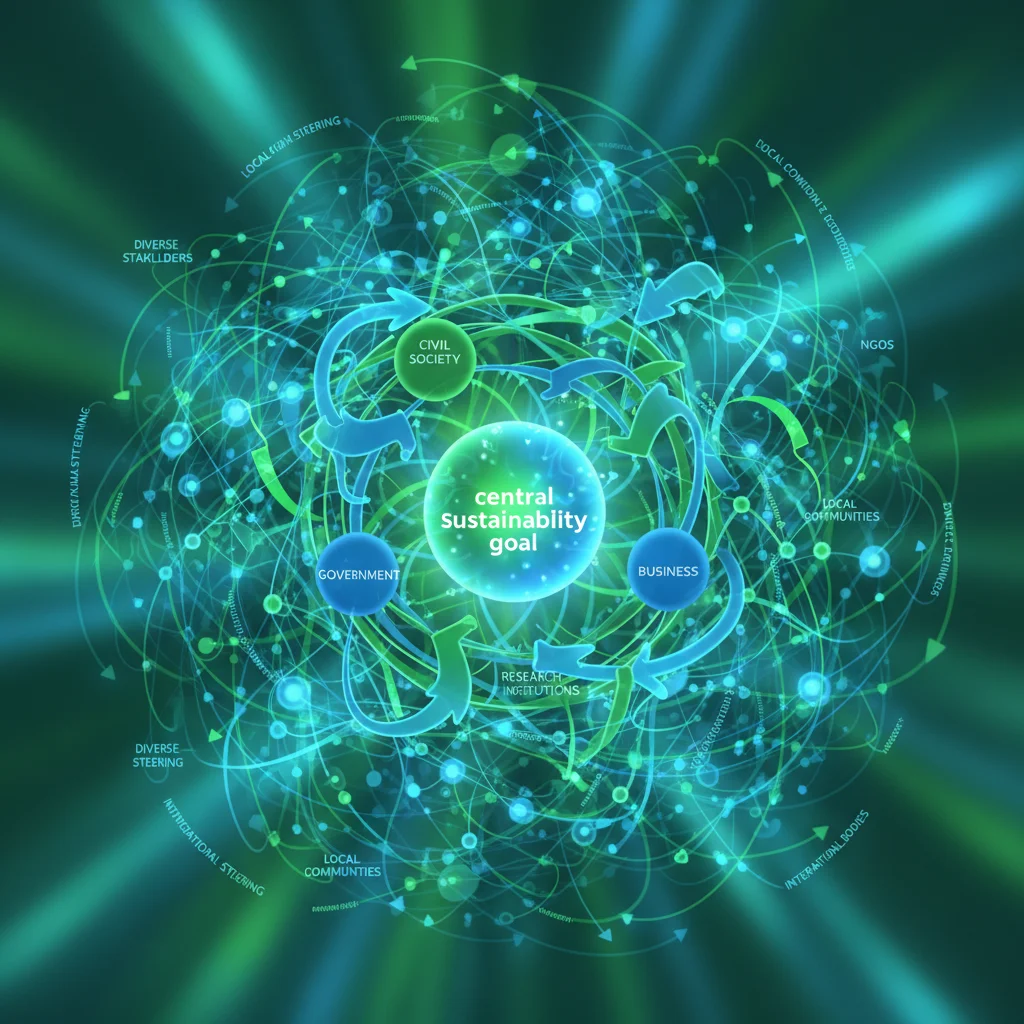
[IMAGE: Abstract visualization of multi-layered governance networks connecting diverse stakeholders around a central sustainability goal, using green and blue tones with dynamic flow and interconnectedness.] ```