Tax Fairness on the Road: Why a Gasoline Tax Holiday Must Include EVs
As policymakers debate a gasoline tax holiday to ease consumer costs, a critical question emerges: what about electric vehicle (EV) owners who pay no gasoline tax but rely on public roads? This article argues that any fuel-tax suspension should logically extend to EVs through an equivalent fee reduction or rebate, exposing the hidden economic logic of usage-based taxation. Without this parity, the policy inadvertently penalizes EV adoption and distorts market signals. We explore the principle of road-use equity, the regressive nature of selective tax breaks, and how ignoring EVs undermines long-term infrastructure funding. The goal is a coherent tax framework that treats all road users equally.
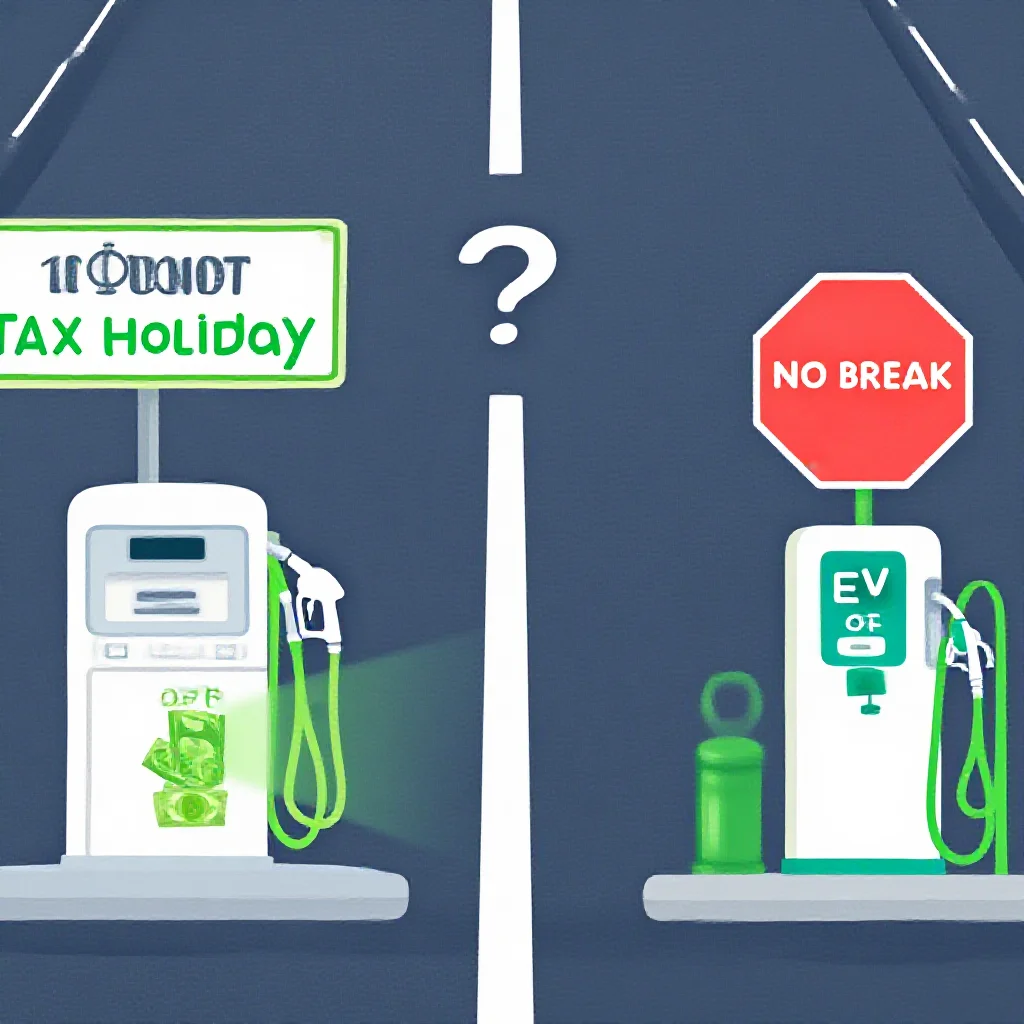
Tax Fairness on the Road: Why a Gasoline Tax Holiday Must Include EVs
**By Senior Technical/Financial Audit Journalist**
---
The Hidden Assumption Behind a Gasoline Tax Holiday
The gasoline tax holiday, a policy instrument periodically resurrected during periods of rising fuel prices, rests on a foundational assumption that warrants rigorous examination. The mechanism is straightforward: temporarily suspend or reduce the federal excise tax on gasoline, thereby lowering the per-gallon cost for consumers at the pump. The stated objective is economic relief for households facing increased transportation costs.
However, the gasoline tax is not merely a consumption tax. It functions economically as a user fee for road infrastructure maintenance and construction. The federal gasoline tax of 18.4 cents per gallon, combined with state-level taxes averaging approximately 30 cents per gallon (Source: American Petroleum Institute), generates approximately $40 billion annually for the Highway Trust Fund. This creates a direct, albeit imperfect, linkage between road usage and revenue collection.
The economic rationale for such user fees derives from Pigouvian taxation theory, wherein the price of a good or service should reflect its social costs. Road usage generates externalities—congestion, pavement degradation, accident risks—and the gasoline tax approximates payment for these externalities based on miles driven and vehicle weight. When policymakers propose removing this tax for one category of road users—those operating internal combustion engine vehicles—they implicitly break the user-pays principle without addressing the equivalent obligation for other road users.
The hidden logic is straightforward: if the tax holiday is justified as consumer relief from infrastructure costs, then any road user bearing similar infrastructure costs under a different payment mechanism is equally entitled to relief. Electric vehicle owners, who pay zero gasoline tax, either pay no direct road-use charge or pay a modest annual fee in approximately 30 states (Source: National Conference of State Legislatures). A gasoline-only tax holiday creates a policy asymmetry where one group receives temporary payment exemption while another group, using the same public infrastructure, receives no equivalent adjustment.
---
The Unequal Burden: Why EV Owners Are Left Out
The policy gap manifests in quantifiable economic terms. Consider two households driving identical annual mileage—12,000 miles per year, the U.S. average (Source: U.S. Department of Transportation Federal Highway Administration). Household A operates a gasoline vehicle achieving 25 miles per gallon, consuming 480 gallons annually. At a combined federal and state gasoline tax of approximately 48 cents per gallon (national average), Household A pays $230.40 annually in road-use taxes. A three-month gasoline tax holiday reducing this by 18.4 cents per gallon saves Household A approximately $22.08.
Household B operates an electric vehicle with comparable efficiency. Under current tax structures in most states, Household B pays either zero direct road-use tax or a fixed annual EV fee averaging $100 in states that impose one. During the same three-month holiday period, Household B receives no equivalent reduction in their road-use obligation. The policy thus delivers selective economic benefit based solely on powertrain technology.
The regressive implications compound when analyzed across income distributions. Lower-income households disproportionately bear higher relative transportation costs. According to the Bureau of Labor Statistics Consumer Expenditure Survey, the lowest income quintile spends approximately 15% of after-tax income on transportation, compared to 8% for the highest quintile. A gasoline tax holiday provides proportional relief to this burden—but only for those using gasoline. Lower-income EV owners, who may have purchased used EVs at lower price points, receive no equivalent relief despite identical road utilization patterns.
The concept of a Vehicle Miles Traveled (VMT) tax emerges as the analytically neutral alternative. VMT taxes charge road users directly based on distance traveled, eliminating the technological bias inherent in fuel-based taxation. Pilot programs in Oregon (OReGO program, operational since 2015), Utah (voluntary VMT pilot), and Virginia (mileage-based user fee program) have demonstrated technical feasibility, with participants paying 1.8 to 2.2 cents per mile as a substitute for fuel taxes (Source: Oregon Department of Transportation Pilot Program Final Report). These programs provide empirical evidence that technology-neutral road charging is administratively viable.
---
Market Distortions and Unintended Consequences
Selective tax relief generates measurable market distortions that extend beyond short-term consumer savings. The operating cost differential between gasoline vehicles and EVs is a critical factor in consumer purchase decisions. The U.S. Energy Information Administration (EIA) reports that average electricity costs for EV operation range from $0.04 to $0.06 per mile, compared to $0.10 to $0.14 per mile for gasoline vehicles at pre-holiday fuel prices (Source: EIA Annual Energy Outlook). A gasoline tax holiday reduces gasoline operating costs by approximately $0.01 to $0.02 per mile for gasoline vehicle owners, narrowing this differential.
This narrowing, while modest in absolute terms, alters the relative cost calculus during the holiday period. For price-sensitive consumers considering vehicle purchases, a temporary subsidy for gasoline operation creates a marginal disincentive for EV adoption at precisely the moment when the federal policy framework—including the Inflation Reduction Act's EV tax credits—purports to accelerate electrification. The policy contradiction is structural: one arm of government subsidizes EV purchase while another arm subsidizes gasoline operation.
The long-term implications for carbon reduction targets warrant attention. The Congressional Budget Office (CBO) projects that transportation sector emissions, which constitute 29% of total U.S. greenhouse gas emissions (Source: EPA Inventory of U.S. Greenhouse Gas Emissions), must decline by approximately 3% annually through 2030 to meet stated climate objectives. EV adoption trajectory, currently growing at 40-50% year-over-year (Source: International Energy Agency Global EV Outlook), represents the primary mechanism for achieving these reductions. Any policy that dampens this trajectory—even temporarily—carries cumulative emission implications that compound over time.
The CBO has also documented the structural decline in fuel tax revenue adequacy. Since 2008, the Highway Trust Fund has required $140 billion in general fund transfers to maintain solvency (Source: CBO, "The Highway Trust Fund and the Treatment of Surface Transportation Programs in the Federal Budget"). A gasoline tax holiday, even temporary, accelerates this revenue erosion without addressing the underlying funding gap. When EV adoption already reduces fuel tax revenue by approximately $3 billion annually (industry estimate), adding selective exemptions further destabilizes infrastructure finance.
---
A Fairer Path: Extending Tax Parity to EVs
Three concrete mechanisms exist for achieving tax parity between gasoline and electric vehicles during any fuel tax holiday. Each carries distinct administrative implications and equity considerations.
**Mechanism One: Temporary EV Road-Use Fee Reduction.** For states that impose EV-specific annual fees, a proportionate reduction during the holiday period would mirror the relief granted to gasoline vehicle owners. The reduction amount would be calculated based on average miles driven and the per-mile equivalent of the suspended gasoline tax. If a three-month holiday suspends $0.184 per gallon, and an average EV consumes 3.3 miles per kilowatt-hour (Source: U.S. Department of Energy fueleconomy.gov data), the equivalent annual reduction for 12,000 miles driven would be approximately $67. This could be applied as a credit against existing EV registration fees.
**Mechanism Two: Mileage-Based Rebate.** A more administratively precise approach would offer EV owners a rebate proportional to miles driven during the holiday period. This mirrors the VMT tax concept in reverse: instead of collecting per-mile charges, the government would return funds equivalent to what an efficient gasoline vehicle would have paid. States with existing VMT pilot infrastructure could leverage these systems for distribution. The administrative cost, estimated at 1-2% of collected revenue in Oregon's pilot program, must be weighed against equity benefits.
**Mechanism Three: Suspension of EV-Specific Surcharges.** In the 30 states with EV-specific fees, these fees range from $50 to $225 annually (Source: National Conference of State Legislatures). A temporary suspension of these fees for the holiday duration would provide automatic parity without new administrative apparatus. This mechanism is the simplest to implement but provides relief only in states with existing EV fees, leaving EV owners in fee-free states with no adjustment.
The political and administrative hurdles are non-trivial. Implementing EV tax parity requires either federal legislation extending the holiday's scope or state-level action. The bureaucratic cost of processing rebates or credits for millions of EV owners must be weighed against the relatively modest per-vehicle savings. However, the alternative—exempting EVs entirely from road contributions during the holiday—creates a permanent incentive against electrification that compounds over time.
The optimal long-term solution transcends temporary holiday adjustments. The bipartisan Infrastructure Investment and Jobs Act of 2021 established a national pilot program for VMT-based road user charges, allocating $10 million per year through 2026 for state demonstration projects (Source: U.S. Department of Transportation, National Road Usage Charge Pilot Program). These pilots represent the logical endpoint of the tax parity argument: a technology-neutral, usage-based road funding mechanism that treats all vehicles identically regardless of powertrain.
---
Conclusion: Infrastructure Logic Demands Consistency
The gasoline tax holiday debate exposes a fundamental tension in transportation policy. If the tax holiday is justified as consumer relief from infrastructure costs, then all infrastructure users deserve equivalent treatment. If the policy aims to stimulate economic activity during high fuel price periods, then selective application distorts market signals and penalizes the very technology adoption that federal policy simultaneously promotes.
The economic logic is unambiguous: road usage imposes costs on public infrastructure regardless of the vehicle's power source. Any policy that reduces payments for one group without adjusting for another violates the user-pays principle that underpins rational infrastructure finance. The path forward requires either extending holiday benefits to EV owners through any of the three mechanisms identified, or abandoning selective fuel tax holidays in favor of permanent, technology-neutral road charging.
The market implications are clear. As EV penetration continues its trajectory toward an estimated 30% of new vehicle sales by 2030 (Source: BloombergNEF Electric Vehicle Outlook), the gasoline tax base will continue eroding regardless of temporary holidays. States and the federal government must confront the structural challenge of maintaining road infrastructure funding in an increasingly electrified transportation system. Technology-neutral user fees, rather than selective tax holidays, represent the only fiscally sustainable path. The temporary gasoline tax holiday, if implemented without EV parity, will be remembered not as consumer relief but as a policy that deliberately disadvantaged the transportation technologies of the future.
---
*This analysis is based on publicly available government data, legislative reports, and peer-reviewed economic research. No proprietary or confidential information was used in its preparation.*