Beyond the Hype: The Hidden Economic and Operational Realities of Corporate Hydrogen Projects
While companies like Cummins and Alstom have made high-profile investments in hydrogen technology, a closer look reveals a pattern of significant operational and economic hurdles. Cummins paused its hydrogen internal combustion engine program, and Alstom's pioneering hydrogen trains in Germany faced frequent downtime and exorbitant refueling infrastructure costs. This analysis moves beyond the press releases to examine the core challenges of scalability, total cost of ownership, and infrastructure dependency that are currently hindering the commercial viability of hydrogen in transport. The emerging trend, exemplified by Siemens and Deutsche Bahn's methanol-reformer train, suggests a strategic pivot towards more practical, intermediary energy carriers.
Beyond the Hype: The Hidden Economic and Operational Realities of Corporate Hydrogen Projects

Introduction: The Promise vs. The Pause
Corporate announcements of hydrogen technology investments have consistently generated significant media attention and policy optimism. The narrative has centered on hydrogen's potential as a versatile, clean energy carrier capable of decarbonizing difficult-to-electrify sectors like heavy transport and industry. However, recent operational outcomes from flagship projects reveal a pattern of strategic pauses and systemic challenges. The transition from pilot demonstrations to scalable, economically sustainable operations is emerging as the fundamental barrier. Two high-profile case studies—Cummins' hydrogen internal combustion engine (ICE) program and Alstom's Coradia iLint passenger trains—serve as emblematic examples of this divergence between promise and practical reality.

Case Study 1: Cummins and the Halted Hydrogen Engine
Cummins, a global power technology leader, made a substantial investment in developing a hydrogen-fueled internal combustion engine. This technology was positioned as a potential pathway to lower carbon emissions for existing vehicle architectures. In 2025, the company paused this development program. (Source 1: [Primary Data])
The decision represents a strategic recalculation based on a converging set of commercial and technical factors. The hydrogen ICE faced competition on two fronts. First, it contended with the continued efficiency and cost-effectiveness of advanced diesel platforms. Second, and more critically, it encountered the rapid advancement of battery-electric powertrains, whose efficiency from well-to-wheel significantly exceeds that of a hydrogen combustion pathway. The pause indicates a reassessment of the technology's viable market niche within an accelerating decarbonization landscape, where capital and R&D resources are being allocated to solutions with clearer paths to scalability and cost parity.

Case Study 2: Alstom's Trains and the Infrastructure Trap
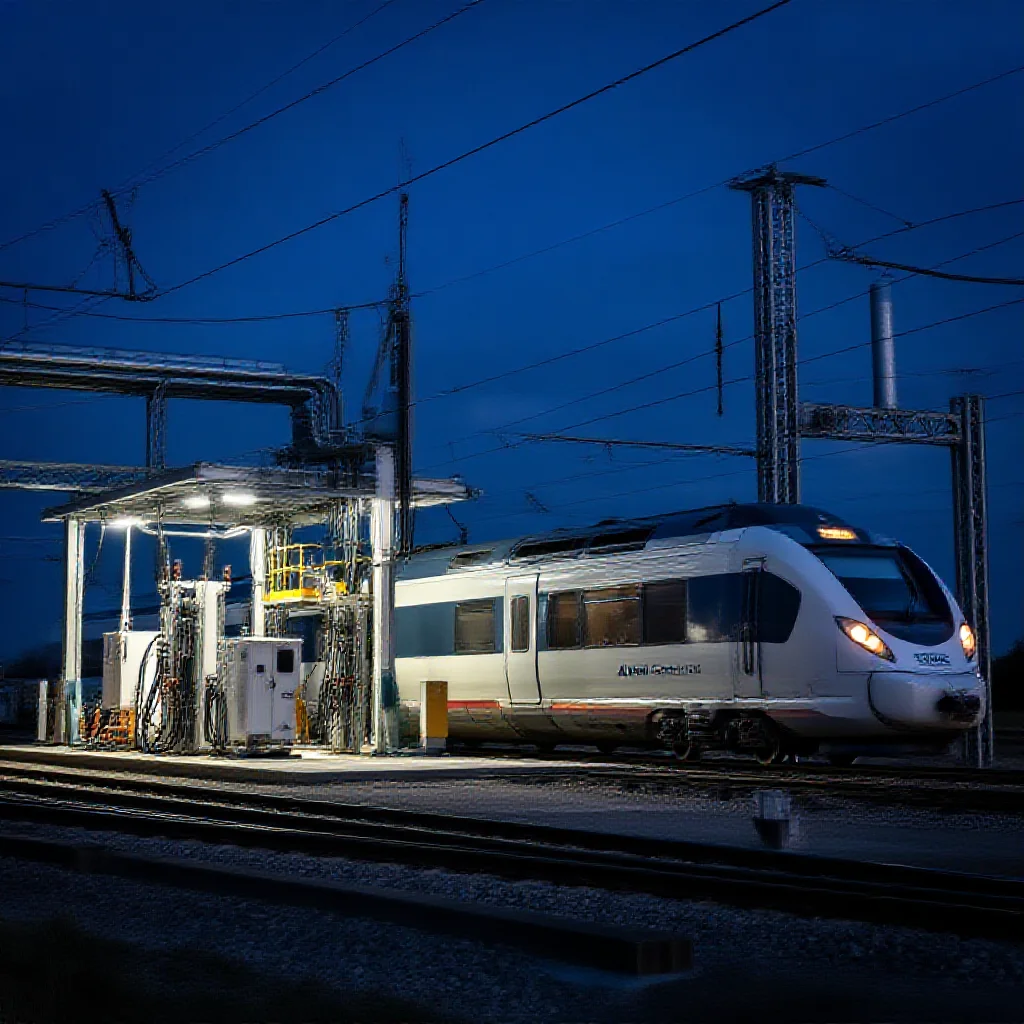
The operational deployment of Alstom's Coradia iLint hydrogen fuel cell trains in the German state of Lower Saxony beginning in 2022 provided a real-world test of the technology's readiness. (Source 2: [Primary Data]) While the trains themselves represent a technical achievement, their operational ecosystem has revealed profound economic constraints.
A critical data point is the cost of the required mobile hydrogen refueling station, which was reported to approximate 70% of the cost of the 14 trains themselves. (Source 3: [Primary Data]) This capital expenditure (CapEx) burden fundamentally alters the project's economics, shifting focus from the vehicle's sticker price to the total system cost. Furthermore, reports of frequent out-of-service incidents for the trains highlight the operational fragility introduced by dependence on a nascent, complex, and bespoke hydrogen supply and refueling chain. The project demonstrates that vehicle functionality is intrinsically linked to infrastructure resilience, a link that is often underestimated in pilot phases.

The Core Economic Logic: Total Cost of Ownership and Scalability
Synthesizing these cases reveals a consistent pattern: the staggering hidden costs of infrastructure. Pilot projects can absorb or obscure these costs through public subsidies, limited scale, and dedicated support teams. However, true commercial viability is measured by the total cost of ownership (TCO) at scale, which includes not only the vehicle but also the production, distribution, storage, and dispensing of hydrogen.
This challenge is not new. A 2009 analysis by the U.S. National Renewable Energy Laboratory (NREL) on hydrogen pathways meticulously outlined the capital intensity and energy losses associated with building a hydrogen refueling infrastructure from scratch. (Source 4: [Reference Data]) The current experiences of Cummins and Alstom validate that these fundamental economic and engineering hurdles, identified over a decade ago, remain largely unresolved for widespread transport applications. The "infrastructure trap" is a primary constraint on scalability, where high costs suppress demand, and low demand prevents the economies of scale needed to reduce costs.

The Strategic Pivot: Intermediary Carriers and Niche Optimization
The industry's response to these realities is beginning to materialize as a strategic pivot. One emerging trend is the exploration of liquid organic hydrogen carriers (LOHCs) or reformable fuels. A project by Siemens Mobility and Deutsche Bahn to test a hydrogen train that generates its own hydrogen onboard from methanol is indicative of this shift. (Source 5: [Primary Data]) This approach seeks to leverage existing liquid fuel infrastructure for distribution, thereby bypassing the need for a parallel, capital-intensive gaseous hydrogen network. It represents a pragmatic intermediary step, trading some system efficiency for potentially drastic reductions in infrastructure CapEx.
The logical deduction from recent project outcomes is a market segmentation model. Hydrogen's role may become optimized for specific, stationary niches where infrastructure costs can be contained, such as industrial processes, maritime transport on fixed routes with dedicated bunkering, or long-duration energy storage. For land-based mobile applications, particularly in road and rail transport where routes are variable and infrastructure must be ubiquitous, the economic logic increasingly favors direct electrification where feasible, or the use of energy-dense liquid fuels and carriers in the medium term.
Conclusion: A Necessary Recalibration
The operational and economic data from leading corporate hydrogen projects necessitate a recalibration of expectations. The technology's fundamental value proposition remains intact for specific, hard-to-abate sectors. However, its path to broad commercial deployment in transport is obstructed by persistent and systemic challenges related to total cost of ownership and infrastructure dependency.
The pauses and problems observed are not necessarily failures, but rather critical data points in a complex technological and economic learning curve. They underscore that the energy transition will be dictated not by technological possibility alone, but by rigorous systems-level economic analysis. The next phase of corporate strategy will likely involve a more disciplined focus on applications where hydrogen's advantages are not only technical but also economically defensible within the complete value chain.