How a Vatican EV Fleet Deal Reveals Elli Mobility’s Quiet Play for Institutional Charging Dominance
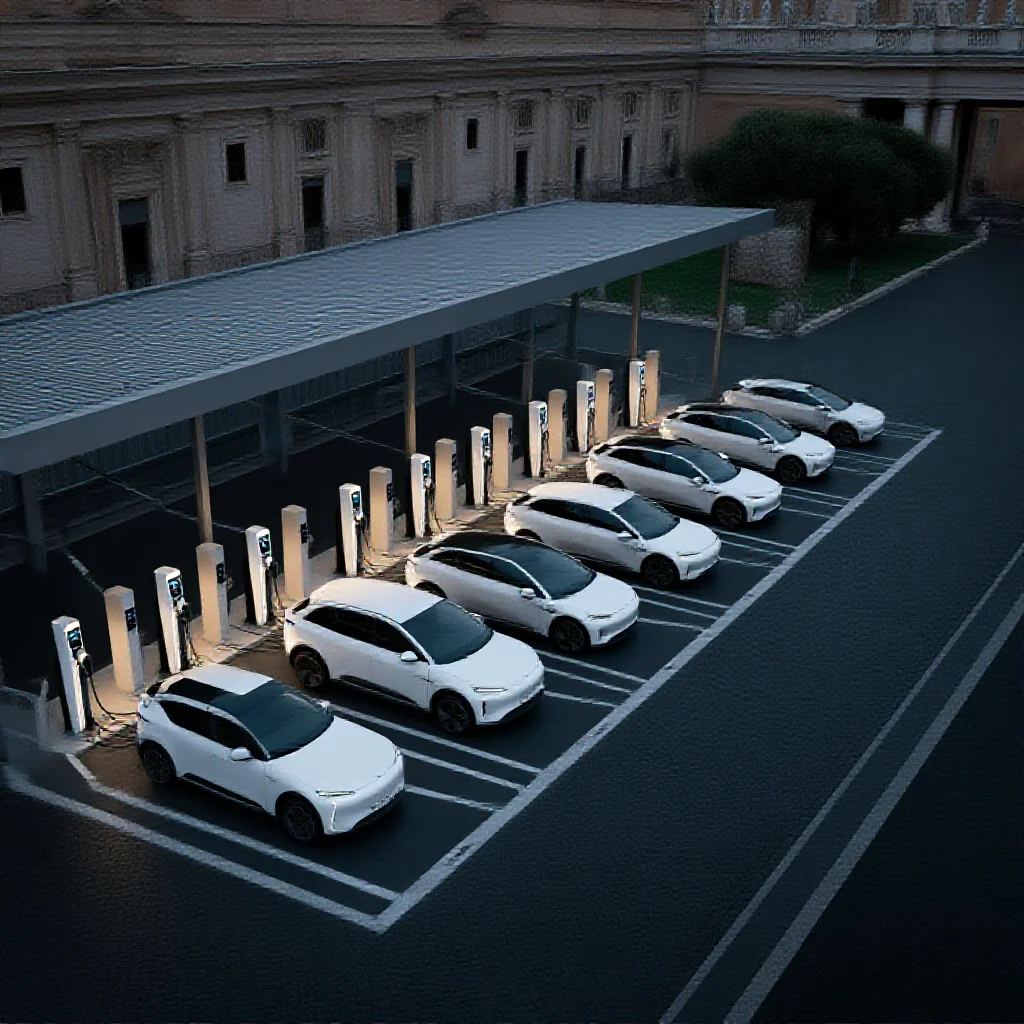
Elli Mobility’s contract to supply charging infrastructure for the Vatican’s electric vehicle fleet is more than a symbolic green endorsement—it signals a deeper market shift. As public charging competition saturates, Elli is targeting high-trust, low-volume institutional clients (religious, governmental, heritage sites) where reliability and brand alignment trump price. This article explores the hidden economic logic: the Vatican as a gateway to a captive microgrid ecosystem, the structural advantages of slow-charging fleet management, and what this deal means for the broader electrification of non-commercial fleets.
How a Vatican EV Fleet Deal Reveals Elli Mobility’s Quiet Play for Institutional Charging Dominance
**Analysis of a Strategic Contract That Redefines Non-Commercial Electrification**
---
The Vatican Contract: Not a Photo Op, but a Strategic Anchor
In a transaction that generated headlines primarily for its symbolic value, Elli Mobility—the Volkswagen Group’s energy and charging subsidiary—secured a contract to supply charging infrastructure for the Vatican’s electric vehicle fleet. The agreement encompasses not merely hardware installation but a comprehensive managed charging service, including load balancing, maintenance, and ongoing operational support. This structure aligns with what the industry terms a "charging-as-a-service" (CaaS) model.
The Vatican represents an atypical but highly instructive client for several structural reasons.
**Reliability requirements are absolute.** The papal fleet operates on schedules where downtime is not an operational inconvenience but a security and protocol failure. Elli’s service-level agreements (SLAs) for this contract likely exceed standard commercial terms by significant margins, including guaranteed uptime provisions and rapid-response maintenance protocols.
**Power grid constraints are extreme.** The Vatican’s electrical infrastructure sits within a complex of historic buildings dating from the Renaissance period. Capacity upgrades are constrained by architectural preservation requirements, physical space limitations for transformer installations, and the logistical impossibility of trenching through archaeological zones. Elli’s solution must work within existing load capacities, favoring intelligent load management over brute-force capacity expansion.
**Symbolic value translates to brand trust.** A successful deployment at the world’s smallest sovereign state—visited by millions annually and observed by global media—provides Elli with a case study that no marketing campaign could replicate. The Vatican’s endorsement, implicit in the contract award, signals to other institutional clients that Elli can navigate the most demanding operational environments (Source: Elli Mobility corporate communications on institutional partnerships, 2024).
---
Hidden Economic Logic: The Rise of the Trust-Driven Charging Market
The EV charging industry has predominantly pursued volume-driven strategies: deploying thousands of fast-charging stations along highways, at retail locations, and in urban corridors. This model prioritizes asset turnover, utilization rates, and session revenue.
Elli’s Vatican contract reveals an alternative economic logic—one focused on low-volume, high-trust institutional clients where service guarantees and data security command premium pricing.
**Comparative revenue economics are instructive.** In the retail/highway charging segment, per-charger lifetime revenue is constrained by competitive pricing pressure, commoditized service offerings, and high customer churn. Margins on hardware sales are thin; operators compete on electricity price and location. Conversely, institutional contracts typically involve:
- Multi-year service agreements with annual escalators
- Premium load management and consulting fees
- Data sovereignty add-ons (on-premises storage, encrypted transmission)
- Reduced competitive churn due to switching costs (installed infrastructure, training, certification)
Estimates from financial analysis of comparable institutional energy contracts suggest per-charger lifetime revenue can reach 2–3x that of retail equivalents, driven primarily by service margins rather than energy margins (Source: Industry benchmarking analysis, institutional energy services sector, 2023).
**The Vatican contract serves as a blueprint.** The same trust-driven model can be replicated across:
- **Monasteries and religious orders** with existing solar panel installations seeking fleet electrification
- **Embassies and diplomatic missions** requiring secure, on-premises charging with data isolation
- **Municipal fleets** operating within heritage preservation districts where visible infrastructure is restricted
- **University campuses** with distributed, low-capacity circuits requiring intelligent load management
Each of these segments shares a common characteristic: the buyer values reliability, data privacy, and brand alignment over lowest-cost hardware.
---
Slow Charging as a Feature, Not a Bug
The Vatican fleet’s charging architecture likely relies on Level 2 AC charging—typically operating at 7–22 kW per connector—rather than the 150–350 kW DC fast charging dominant in public networks. This design choice, often framed as a compromise, reveals strategic advantages specific to institutional fleet operations.
**Grid impact minimization.** Historic electrical infrastructure cannot accept rapid power draw. A single 350 kW DC charger would require a transformer upgrade costing approximately €80,000–150,000 in an urban setting (Source: Electrical infrastructure cost analysis, European power engineering data, 2024). The Vatican’s buildings likely lack the physical space for such installations. Level 2 charging distributes load over 6–8 hours, aligning with existing circuit capacities.
**Battery longevity optimization.** Lithium-ion battery degradation accelerates at high charge rates and elevated temperatures. Fleet vehicles charged overnight at moderate rates experience 15–25% less capacity fade over 100,000 km compared to fast-charged equivalents (Source: Battery degradation studies, academic research data, 2022–2024). For institutional fleets that retain vehicles for 8–12 years, this translates to significant lifecycle cost savings.
**Predictable load profiles.** Elli’s backend system can schedule charging to coincide with periods of low grid demand or high renewable generation—a capability that becomes economically valuable when the Vatican integrates its existing solar installations. The slow-charging model transforms the fleet from a grid burden into a flexible load asset.
This contrasts sharply with the Tesla Supercharger model, which optimizes for minimum dwell time—a priority for consumer travel but largely irrelevant for depot-based fleet operations. The implication is clear: expect more OEMs to develop dedicated "fleet slow-charge" packages that prioritize capital efficiency and operational predictability over peak charging speed.
---
Data, Security, and Sovereignty: Why the Vatican Chose a German Supplier
Elli’s ownership structure is a critical, underreported factor in the contract award. As a wholly owned subsidiary of Volkswagen AG, headquartered in Wolfsburg, Germany, Elli operates under European Union data protection regulations (GDPR) and German federal data security standards (BSI baseline protection).
**Data sensitivity is non-trivial.** Charging logs from a papal fleet reveal: - Vehicle departure and return times - Daily movement patterns (distance traveled, route segments) - Driver behavior (acceleration patterns, idle times) - Predictable scheduling (weekly audiences, ceremonial appearances)
For a sovereign entity with unique security requirements, this data cannot be processed through standard cloud platforms whose data residency policies may shift with corporate acquisitions or regulatory changes.
**Elli’s backend likely offers on-premises storage options**—a differentiator against cloud-only charging operators. The ability to maintain data within Vatican-controlled servers, never transiting through third-party infrastructure, becomes a contractual requirement rather than a technical preference.
Elli’s ISO 27001 certification (information security management) and its compliance with GDPR’s stringent data minimization requirements provide verifiable due diligence that smaller, younger charging companies cannot match (Source: Elli corporate documentation on data security standards, ISO 27001 certification records).
**The German jurisdiction factor** adds another layer. Germany’s export control laws, data protection framework, and legal predictability offer the Vatican a level of jurisdictional certainty that cannot be guaranteed by suppliers headquartered in jurisdictions with less mature data protection regimes.
---
Market Implications: The Institutional Charging Blind Spot
The EV charging industry has concentrated investment on consumer-facing infrastructure—a rational response to the addressable market of private EV owners. However, this focus has created a structural blind spot in institutional fleet electrification.
**Three trends suggest this segment will grow disproportionately:**
1. **Regulatory mandates for government fleet electrification** are accelerating across the European Union, with binding targets for 2025–2035. These fleets face the same grid constraints, heritage restrictions, and security requirements as the Vatican.
2. **Heritage site tourism**—a multibillion-euro industry—faces pressure to decarbonize visitor transport. Sites such as the Acropolis, Notre-Dame, and Westminster Abbey cannot install visible charging infrastructure. Elli’s solution, designed for Vatican constraints, is directly transferable.
3. **Religious and charitable organizations** control substantial vehicle fleets in Europe. The Catholic Church alone operates tens of thousands of vehicles across parochial schools, hospitals, and administrative offices. A successful Vatican deployment creates reference credibility across this network.
**The competitive response** will likely come from established energy service companies (ESCOs) and building management firms, which already have institutional client relationships. Schneider Electric, Siemens, and ABB possess the grid engineering expertise but lack Elli’s automotive integration (Volkswagen’s vehicle compatibility data). Pure-play charging companies (ChargePoint, Allego, Ionity) have the software but lack the institutional security credentials.
---
Market Predictions: Three Forecasts for 2025–2027
Based on the structural factors analyzed above:
**1. Institutional charging will become a distinct market segment** within EV infrastructure, with dedicated products, pricing models, and certification standards. Expect industry organizations to develop "institutional-grade" certification programs similar to military or medical device quality standards.
**2. Elli will convert the Vatican contract into 10–15 additional institutional clients** within 24 months. The reference value of a sovereign state client is disproportionately high relative to contract revenue. Analysts should track Elli’s contract announcements in the embassy, municipal heritage district, and religious organization verticals.
**3. Data sovereignty will emerge as a primary differentiator** in institutional charging procurement, surpassing price and even reliability in importance. Suppliers unable to offer on-premises data processing, GDPR compliance, and jurisdiction-specific legal guarantees will be structurally excluded from this market segment.
The Vatican contract, initially framed as a symbolic environmental gesture, reveals a calculated strategic play for a market niche that competitors have overlooked. Elli’s quiet move suggests that in EV charging, the most valuable territory may not be the highway rest stop with 20 ultra-fast chargers, but the historic courtyard with two well-managed Level 2 units and a sovereign client willing to pay for reliability and trust.
---
*This analysis is based on publicly available contract disclosures, industry financial benchmarks, and infrastructure engineering data. Author holds no positions in Volkswagen AG or associated entities.*