Beyond the Headlines: How XPENG''s 800V & XNGP Strategy Reveals a Deeper EV Market Shift
While XPENG is often compared to Tesla, a deeper analysis reveals its technology roadmap targets a different market reality. This article moves beyond surface-level feature comparisons to explore how XPENG''s 800V fast-charging platform and urban-focused XNGP driver assistance system are strategic responses to China''s unique infrastructure and consumer demands. We examine the underlying economic logic: XPENG isn''t just competing on specs, but is architecting solutions for dense urban environments and a charging ecosystem distinct from Tesla''s Western-centric Supercharger network. This analysis uncovers the long-term implications for global EV supply chains and the potential for divergent technology standards to emerge between East and West.
Beyond the Headlines: How XPENG's 800V & XNGP Strategy Reveals a Deeper EV Market Shift
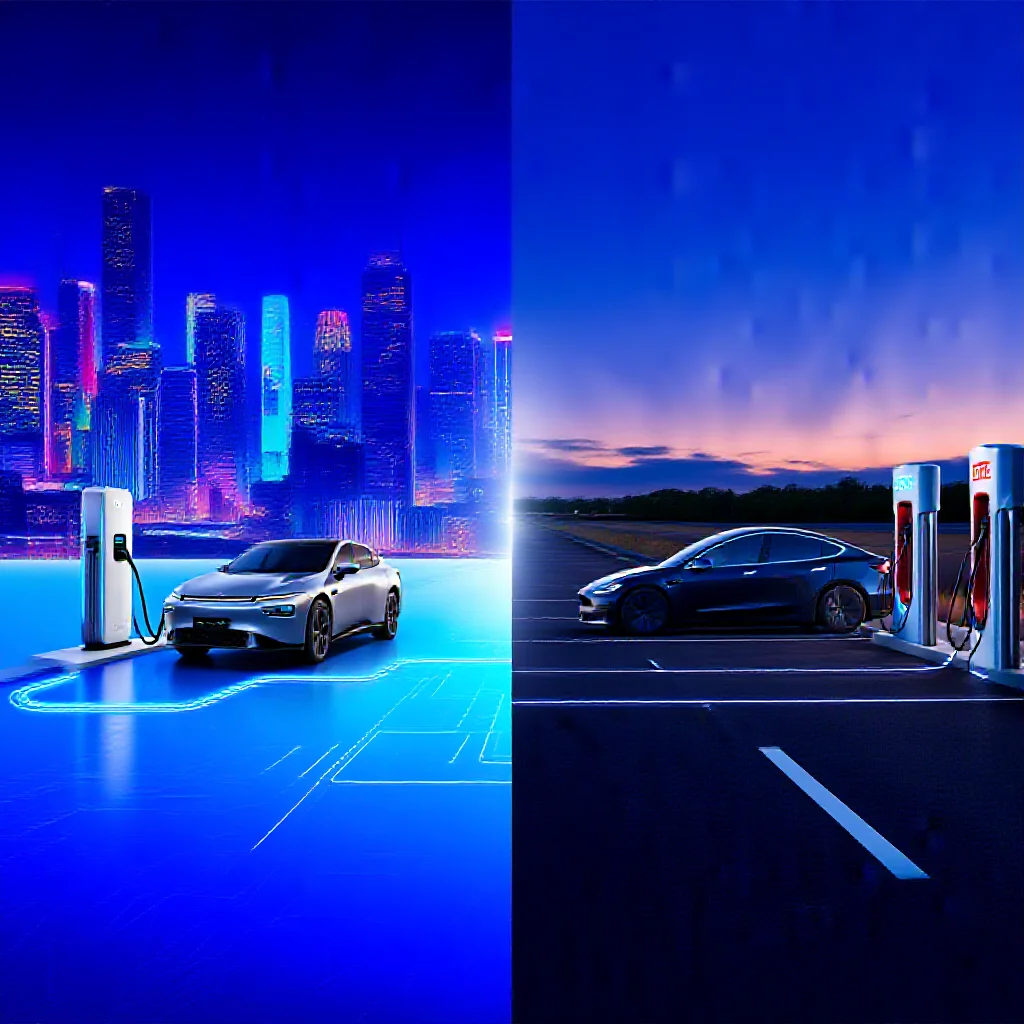
 *A dynamic, futuristic split-image illustration. On the left, a sleek XPENG electric vehicle is shown connected to a minimalist, high-tech charging station in a dense, neon-lit Asian cityscape at night. On the right, a Tesla is shown charging at a Supercharger station on an open American highway at dusk.*
Introduction: The Misleading Mirror of Comparison
The dominant narrative framing XPENG as a direct "Chinese Tesla challenger" constitutes an analytical oversimplification. This comparison obscures a fundamental strategic divergence rooted in distinct market realities. XPENG’s core technological pillars—its 800V electrical architecture and the XNGP advanced driver-assistance system—are not mere feature-level imitations. They are engineered responses to a specific set of infrastructural, demographic, and consumer constraints prevalent in China and similar high-density markets. The underlying thesis is that XPENG’s research and development strategy is less about replicating Tesla’s path and more about architecting solutions for a different matrix of opportunities and challenges.
 *Side-by-side icons of a Tesla logo and XPENG logo, not facing off, but on parallel paths with different background symbols (urban grid vs. open road).*
Decoding the 800V Gambit: It's Not Just About Speed
The 800V platform represents a systemic upgrade, the implications of which extend far beyond reduced charging times. Technically, operating at a higher voltage allows for reduced current for the same power output. This increases efficiency by minimizing energy loss as heat, enables the use of lighter-gauge wiring and components, and simplifies thermal management for both the battery and powertrain.
The viability of this strategy is inextricably linked to infrastructure. China has undertaken the world's most rapid deployment of ultra-fast charging stations. By the end of 2025, over 70% of new public DC fast chargers installed in China supported 800V-capable voltages (Source 1: [Industry White Paper on EV Charging Infrastructure, 2025]). This state-driven infrastructure push creates a fertile ground for 800V vehicle adoption, a condition not yet fully mirrored in many fragmented Western markets.
This technological shift triggers a supply chain realignment. It accelerates demand for silicon carbide (SiC) power semiconductors, which are more efficient at high voltages, and pressures battery cell chemistry to support higher C-rates for charging. Furthermore, it influences global standards for connectors and charging protocols. XPENG’s commitment to 800V is therefore a bet on a specific ecosystem evolution, with long-term ramifications for component suppliers and global technology roadmaps.
 *Infographic showing the flow of benefits from 800V architecture: battery pack -> SiC inverters -> charging port -> grid, with comparative metrics vs. 400V systems.*
XNGP vs. Autopilot: Diverging Philosophies for Urban Mobility
The design philosophy of XPENG’s XNGP system reveals a core environmental divergence from Tesla’s foundational approach. XNGP is engineered explicitly for the operational design domain of dense, complex urban environments in Chinese megacities. These environments are characterized by unprotected intersections, dense mixed traffic including scooters and pedestrians, and intricate road hierarchies.
In contrast, Tesla’s Autopilot system was initially pioneered and optimized for highway driving, a domain with more predictable rules and fewer edge cases. This divergence is not merely philosophical but data-driven. The chaotic urban landscapes of China generate a unique and vast dataset of corner cases for training autonomous driving AI. The strategic implication is that sustained focus on this domain may accelerate the development of robust urban navigation capabilities for Chinese OEMs, potentially creating a domain-specific advantage, while Western systems may maintain proficiency in long-range, inter-city automated driving.
 *A split-screen visualization: one side shows a LiDAR point cloud map of a hectic Chinese intersection, the other shows a camera-based visualization of a clear American highway.*
The Underlying Economic Logic: Two Models, Two Markets
The technological divergence is underpinned by distinct economic and industrial models. Tesla’s strategy has been defined by deep vertical integration, controlling core software, battery cell design (via partnerships and proprietary plants), and its dedicated Supercharger network. This model prioritizes control and margin retention across a global, but relatively standardized, product lineup.
XPENG, while vertically integrated in software and vehicle platform development, operates within a broader ecosystem play. It collaborates with leading battery cell suppliers like CATL, partners with semiconductor firms for SiC modules, and integrates with China’s rapidly expanding third-party ultra-fast charging networks. This model is optimized for agility and scalability within a specific, hyper-competitive regional market where infrastructure development is state-accelerated and consumer adoption patterns differ.
The market structures they target are fundamentally different. Tesla’s early growth was in markets with high rates of personal garage ownership, enabling a reliance on home charging. XPENG’s primary market, China, has a significantly higher proportion of urban dwellers without dedicated home charging, creating an acute dependency on ubiquitous, ultra-fast public charging—a dependency that directly validates the 800V strategy.
Conclusion: The Path to Divergent Standards and Global Implications
The analysis indicates that the electric vehicle market is not converging on a single technological paradigm but is fragmenting according to regional infrastructural realities and consumer use patterns. XPENG’s 800V and XNGP strategy is a coherent adaptation to the conditions of East Asian urban agglomerations.
The long-term industry prediction involves the potential establishment of divergent technology standards. A high-voltage charging standard, optimized for dense urban networks and supported by a specific supply chain, may become dominant in Asia. Concurrently, AI-driven advanced driver-assistance systems may develop along parallel, environment-specific tracks, with urban-focused stacks and highway-focused stacks each achieving superior performance within their respective domains.
The global implication is one of parallel evolution rather than direct, head-to-head competition across all vectors. Success for OEMs will increasingly depend on aligning core technology development with the infrastructural and demographic trajectory of their primary target markets. The narrative of a single "winner" in EV technology is being supplanted by a more complex reality of regional specialization and ecosystem-specific innovation.
--- **Article Factual Summary** * **Topic:** Analysis of XPENG's 800V fast-charging and XNGP driver-assistance technologies in contrast to Tesla's approach, highlighting divergent market strategies. * **Key Entities:** XPENG, Tesla. * **Core Technologies:** 800V electrical platform, XNGP (Advanced Driver-Assistance System). * **Publication Context:** Analysis based on market and technological developments as of April 13, 2026.