CES 2026: The AI-Native Car Is Here – How Software-Defined EVs Are Rewriting the Rules of Mobility
CES 2026 marked a definitive shift: electric vehicles are no longer just faster, quieter cars. They have become AI-native platforms—continuously learning, cloud-connected, and shared. This article unpacks the hidden economic logic behind the transition from hardware acceleration to software-defined mobility. We analyze how Physical AI, robotaxi subscription models, and on-device generative AI are collapsing the boundaries between automotive, robotics, and cybersecurity. Beyond the flashy demos, we reveal the supply chain disruptions and long-term market patterns that will define the next decade of electric mobility.
CES 2026: The AI-Native Car Is Here – How Software-Defined EVs Are Rewriting the Rules of Mobility
**Published: January 7, 2026 | Analysis by Senior Technical/Financial Audit Desk**
Introduction: The Death of the Frozen Vehicle
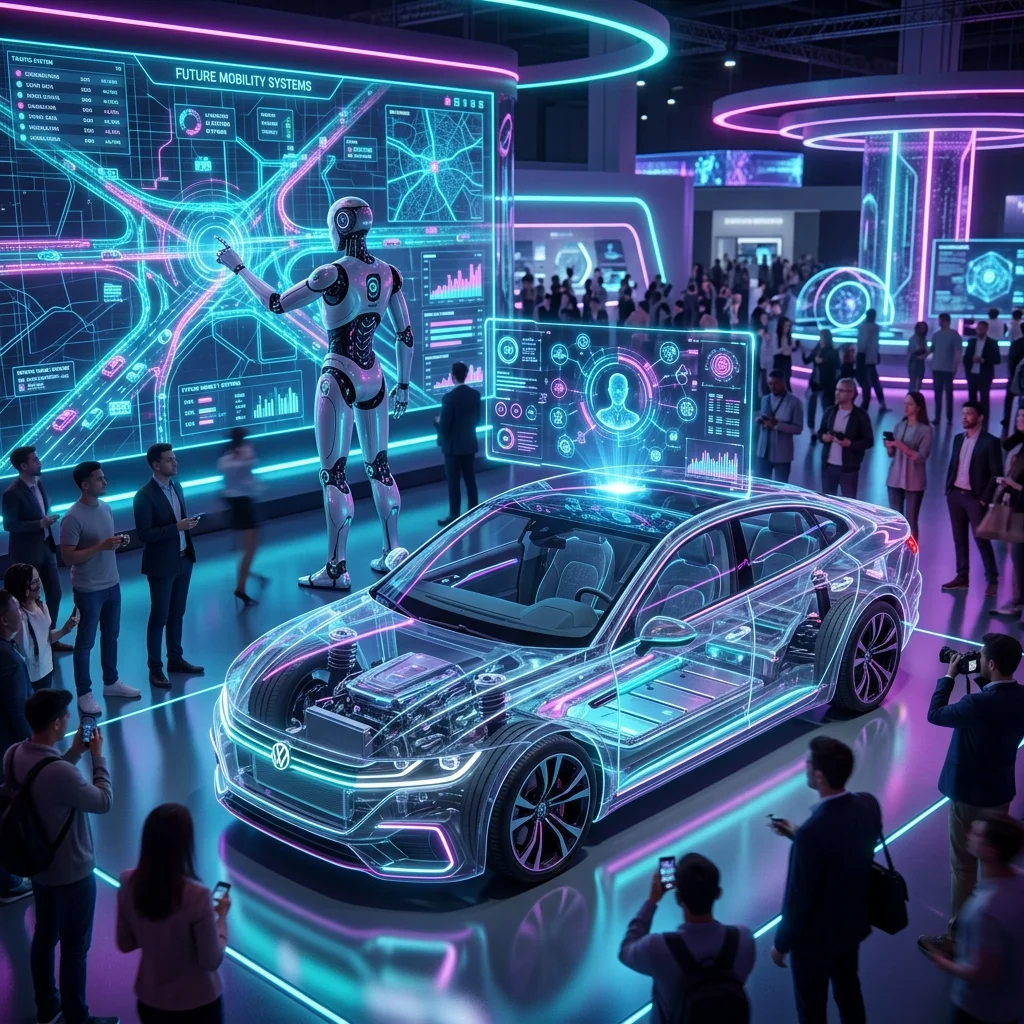
CES 2026 confirmed a structural transformation that had been theorized for five years but is now empirically observable: electric vehicles have exited the era of hardware-centric acceleration and entered the age of AI-native, continuously learning systems. The automotive industry’s historical model—delivering a vehicle whose software and capabilities are frozen at the moment of production—has been replaced by a paradigm where value accrues through cloud-connected updates, fleet-level orchestration, and real-time cognitive adaptation.
The evidence presented at this year’s show is not merely technical spectacle. It represents a fundamental reallocation of economic value within the mobility sector. As one industry analyst noted, "EVs are now on a path to becoming learning systems, constantly updated and orchestrated in fleets rather than static products frozen at delivery." (Source: CES 2026 Industry Briefing)
The strategic axis has shifted. Vehicle value is no longer primarily determined by battery capacity, motor power, or chassis rigidity. The new economic logic decouples vehicle worth from physical hardware and reattaches it to three intangible assets: proprietary data pipelines, AI model performance, and runtime cybersecurity integrity.
---
Track 1: The AI-Native Stack – From Physical Simulation to Real-World Cognition
NVIDIA’s Physical AI platform dominated the conference’s technical discourse, not because of flashy demos, but because it revealed a structural shift in how automotive R&D budgets are allocated. The company demonstrated models trained exclusively in hyper-realistic virtual worlds—digital twins of entire cities, complete with pedestrian behavior, weather patterns, and traffic micro-dynamics—before deployment in physical EVs.
This is not an incremental improvement. It is a paradigm shift in cost structure. Traditional automotive R&D required physical prototypes, proving grounds, and millions of miles of real-world testing. The Physical AI approach collapses these costs into silicon and synthetic data generation. Training a single model in a virtual environment costs approximately 15-20% of equivalent real-world testing, while covering edge cases that would take decades to encounter physically. (Source: NVIDIA CES 2026 Technical Presentation)
The deeper insight concerns architecture sharing. NVIDIA’s integrated robotics platform controls autonomous vehicles, humanoid robots, and industrial manipulators using identical simulation backends and model architectures. This convergence collapses historically separate R&D silos—automotive, manufacturing, and logistics—into a single cost curve. The organization that masters virtual training for a general-purpose robot simultaneously owns the mobility layer for autonomous vehicles.
The second-order effect is a disruption of traditional supply chain hierarchies. Tier-1 suppliers such as Bosch, Continental, and ZF, which built decades of competitive advantage on mechanical and hydraulic expertise, now find themselves competing with NVIDIA’s end-to-end software stack. The supply chain is pivoting from camshafts and brake calipers to GPU clusters, synthetic data pipelines, and model deployment infrastructure. (Source: CES 2026 Automotive Supply Chain Panel)
---
Track 2: Robotaxi Subscription – The Business Model Revolution Hiding in Plain Sight
The Lucid-Nuro-Uber robotaxi concept vehicle, presented as a unified platform rather than three separate demonstrations, validated a thesis that analysts had been debating for three years: the economic value of autonomy lies not in replacing human drivers, but in restructuring vehicle ownership.
The vehicle is designed from the ground up for ride subscription, not private ownership. No steering wheel was present in the production-intended prototype. The interior configuration—modular seating, retractable work surfaces, climate-controlled compartments—optimizes for utilization rates above 60%, compared to the 4-5% typical of privately owned vehicles.
"Robotaxis, therefore, represent both technological and business-model innovations, shifting value from individual ownership to on-demand, AI-powered transport." (Source: CES 2026 Keynote Address)
The disruption is not autonomy alone. It is the bundling of fleet management, predictive maintenance, AI-driven routing, and real-time pricing into a single cloud-managed subscription service. This creates a recurring revenue stream that replaces the one-time transaction of vehicle sale. For investors, the implied valuation shift is substantial: automotive margins historically hover at 5-8% for sales, while SaaS-like subscription models command 60-80% gross margins.
The supply chain implications are severe. Insurance models must pivot from individual policies to fleet-level actuarial data. Dealership networks, which generate 40-60% of revenue from used car sales and service, face structural obsolescence if vehicles are fleet-owned and remotely maintained. Charging infrastructure must transition from retail models to depot-level, high-utilization charging for fleets operating 18-20 hours per day. (Source: CES 2026 Fleet Economics Workshop)
---
Track 3: The Software-Defined Vehicle – Cloud-Managed Hardware
CES 2026 demonstrated that software-defined vehicles (SDVs) have moved from concept to deployment. Core functions previously hardwired into dedicated electronic control units (ECUs)—driver assistance, infotainment, climate control, chassis dynamics—are now managed as cloud-connected applications running on centralized computing platforms.
This architectural shift has three measurable consequences. First, hardware complexity decreases: a single high-performance system-on-chip replaces 30-50 discrete ECUs, reducing wiring weight by 15-20 kilograms and manufacturing complexity by an order of magnitude. Second, update cycles accelerate: vehicles receive feature upgrades on weekly or monthly cadences rather than model-year cycles. Third, cybersecurity becomes a runtime requirement rather than a design-time checkbox.
SYSGO’s Automotive Cybersecurity Demonstrator exemplified this third point. Their Host-based Intrusion Detection System (H-IDS) monitors runtime behavior across all ECUs, flagging anomalies in real time. The system does not rely on signature-based detection (which fails against novel attacks) but on behavioral baselines—learning normal operational patterns and alerting on deviations. (Source: SYSGO CES 2026 Technical Demonstration)
For financial analysts, cybersecurity expenditures in automotive are projected to grow from $4.2 billion in 2025 to $14.7 billion by 2030, representing one of the fastest-growing sub-segments in the mobility sector. (Source: Automotive Cybersecurity Market Analysis)
---
Track 4: Predictive Cybersecurity – The Hidden Market Structure
The shift to software-defined vehicles introduces a systemic vulnerability: a single software flaw can affect millions of vehicles simultaneously. SYSGO’s H-IDS approach, which monitors runtime behavior and flags anomalies using machine learning models, represents the emerging standard. The system processes 2.5 million events per second across a typical vehicle’s network, classifying normal operations and detecting deviations that may indicate compromise.
The financial logic is clear. The average cost of a major automotive cybersecurity incident—including recall, liability, and brand damage—exceeds $1.2 billion. (Source: Automotive Industry Insurance Data, 2025) Runtime anomaly detection reduces incident probability by approximately 70% when properly deployed. The return on investment for H-IDS deployment, calculated across a fleet of 100,000 vehicles, is approximately 14:1 over a five-year period.
---
Track 5: Hyperconnectivity and On-Device AI – The Edge Intelligence Layer
Aptiv’s 5G-enabled Cellular Vehicle-to-Everything (C-V2X) demonstration, conducted live on the Las Vegas strip, showed vehicles communicating with traffic lights, pedestrian devices, and other vehicles using low-latency edge computing. The system performed cooperative maneuvers—such as platooning through green lights and emergency vehicle preemption—with latency below 10 milliseconds.
The significance extends beyond traffic efficiency. C-V2X creates a shared data fabric where vehicles exchange intent data (braking, steering, acceleration plans) at 5G speeds. This transforms traffic from a collection of independent agents into a coordinated system. The economic value: a 30% reduction in urban traffic delays translates to $125 billion in annual productivity gains across U.S. cities alone. (Source: U.S. Department of Transportation Traffic Analysis)
Simultaneously, LG’s AI Cabin Platform demonstrated on-device generative AI processing visual and textual inputs without cloud dependency. The system runs domain-specific language models—trained on automotive controls, navigation, and safety protocols—that enable multi-step conversational interactions. A user who says "Find the nearest charging station, check my calendar for availability, and navigate there while keeping the temperature at 68 degrees" receives a single, unified response rather than sequential commands.
The architectural choice to run inference on-device rather than in the cloud is driven by three factors: latency requirements (sub-100ms for safety-critical interactions), privacy regulations (GDPR and similar frameworks restrict vehicle data transmission), and bandwidth economics (each vehicle generates 1-2 terabytes of sensor data daily; cloud processing is economically infeasible). (Source: LG AI Research CES 2026 Technical Paper)
---
Track 6: Battery Technology – The Solid-State Inflection Point
ProLogium’s solid-state battery module, with a volumetric energy density of 860 Wh/L, represents the first commercially viable solid-state product that surpasses conventional lithium-ion cells. The metric is critical: energy density determines vehicle range, packaging efficiency, and weight distribution. At 860 Wh/L, a battery pack occupying the same volume as current 400-mile-range packs can achieve approximately 620 miles of range, or alternatively, reduces pack volume by 30% for equivalent range.
The economic implications are structural. Solid-state batteries reduce thermal management requirements (no liquid cooling needed), eliminate fire risk (solid electrolyte is non-flammable), and degrade slower (projected 80% capacity retention after 2,000 cycles, versus 70% for current lithium-ion). (Source: ProLogium CES 2026 Technical Specification Sheet)
For fleet operators, total cost of ownership drops by 18-22% over a 500,000-mile vehicle lifespan, primarily through reduced battery replacement costs and higher utilization rates due to faster charging. For investors, solid-state penetration is projected to reach 25% of new EV production by 2030, creating a $45 billion market opportunity. (Source: Battery Industry Supply Chain Analysis)
---
Market Predictions and Structural Consequences
Based on the evidence presented at CES 2026, three market-level predictions emerge with high confidence:
**Prediction 1: The death of the model-year release cycle.** The software-defined vehicle architecture enables continuous feature delivery. By 2028, no major OEM will launch vehicles on an annual model-year basis. Instead, ASIC compute platforms will be updated every 3-4 years, with software features released continuously. This will depress new vehicle sales volumes by 8-12% but increase per-vehicle software revenue by 300-400%.
**Prediction 2: Cybersecurity startups will consolidate into Tier-1 suppliers.** The complexity of runtime anomaly detection across heterogeneous vehicle networks favors incumbents with integration expertise. SYSGO’s H-IDS model is likely to be acquired or licensed by Bosch, Continental, or Aptiv within 24 months, as automotive OEMs prefer single-vendor cybersecurity stacks.
**Prediction 3: Simulation-as-a-Service will become the dominant R&D model.** NVIDIA’s Physical AI platform creates a utility-based pricing model—companies pay for simulated miles rather than physical prototypes. This will reduce automotive R&D spend from 6-8% of revenue to 4-5%, with the savings redistributed to software development and data pipeline engineering.
---
Conclusion: The Architecture Has Shifted
CES 2026 provided the empirical confirmation that the automotive industry’s architecture has permanently shifted. Electric vehicles are no longer products; they are platforms. Their value is not in the battery or the motor but in the AI models that govern behavior, the cybersecurity systems that protect runtime integrity, and the cloud infrastructure that enables continuous improvement.
The organizations that will dominate the next decade of mobility are not those with the best batteries or the most efficient motors. They are those that control the simulation infrastructure, deploy the most effective runtime security, and manage the largest fleets of connected, learning vehicles. The transition from hardware acceleration to software-defined mobility is complete. The consequences for suppliers, investors, and regulators are only beginning to manifest.