Electric Mobility Market 2025–2034: Solid-State Batteries, Policy Drivers, and the Reshaping of Global Supply Chains
The global electric mobility market is projected to surge from $768.56 billion in 2025 to $5.73 trillion by 2034, driven by a 24.68% CAGR. Asia Pacific leads with a 61.58% share, while solid-state batteries promise a step-change in performance—Toyota targets 2026 and BMW partners with Solid Power. This article explores the hidden economic logic behind market growth: how falling lithium-ion costs and stricter emission norms are accelerating adoption, but also how solid-state technology threatens to upend incumbent battery supply chains. We analyze regional dominance, the post-pandemic recovery, and what Ford’s 2021 fossil-fuel phase-out signals for legacy automakers. Deep industry insights reveal that the real battle will be over raw material access, manufacturing capacity, and the ability to scale next-generation batteries without disrupting current production lines.
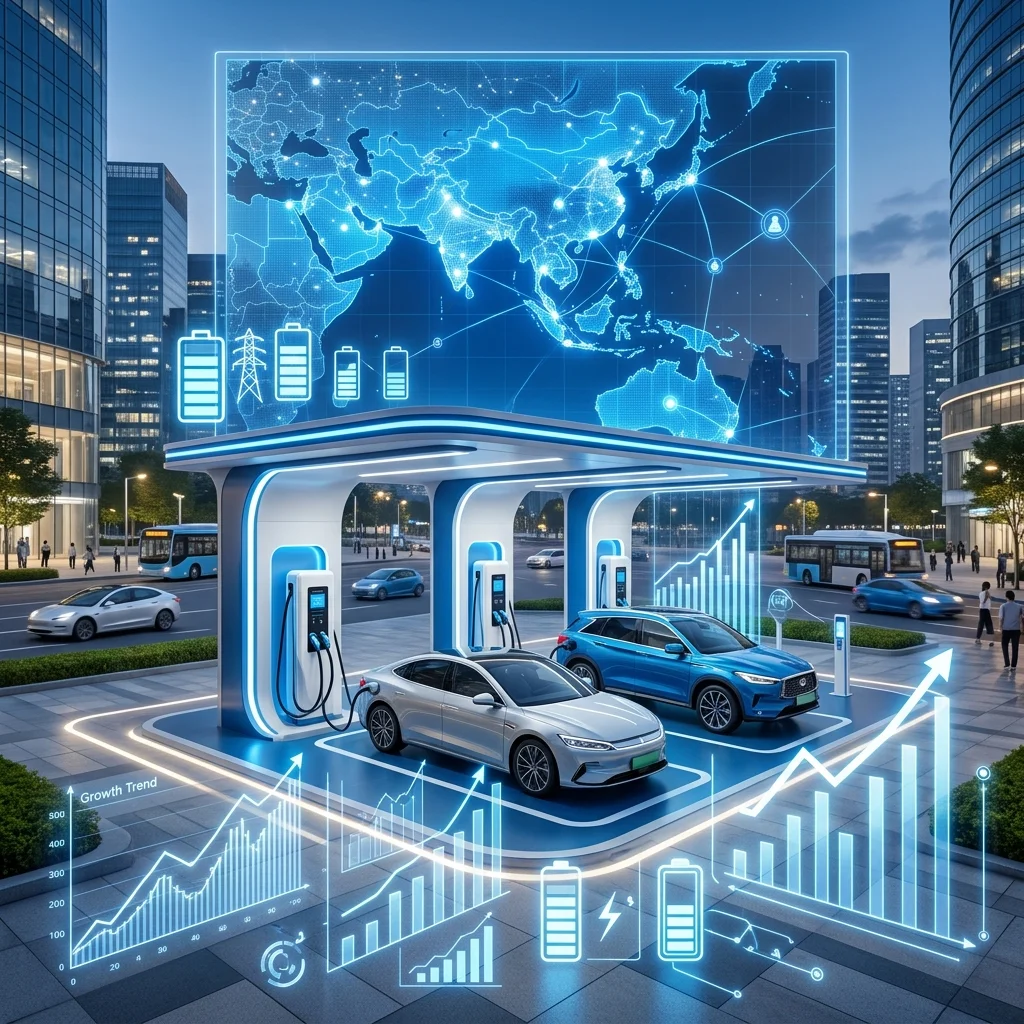
The Trillion-Dollar Transition: Inside the Electric Mobility Boom of 2025–2034
The global electric mobility market is no longer a niche experiment. In 2025, it stands at $768.56 billion, and by 2034, it is projected to reach $5.73 trillion—a compound annual growth rate (CAGR) of 24.68%. That trajectory signals more than exponential adoption; it marks a structural shift in battery chemistry, a recalibration of policy incentives, and a reordering of regional power dynamics.
Three deep insights define this transition. First, solid-state batteries are emerging as a potential supply chain earthquake, threatening to upend the incumbent lithium-ion infrastructure. Second, Asia Pacific’s stranglehold on the market—61.58% of global share—is a strategic moat built on manufacturing scale, battery innovation, and two-wheeler electrification. Third, the hidden friction lies not in demand but in the ability to scale next-generation technologies without disrupting current production lines. This article dissects each layer with hard data, corporate timelines, and the economic logic that will separate winners from laggards.
[IMAGE: World map with glowing EV adoption hotspots, overlayed with CAGR arrows.]
---
Market Size & Regional Dominance: Asia Pacific’s 61.58% Share Under the Microscope
Why does Asia Pacific command more than three-fifths of the global electric mobility market? The answer is threefold: China’s manufacturing scale, Japan’s battery innovation, and India’s two-wheeler electrification wave.
China alone accounts for over 40% of global EV sales in 2025, driven by a vertically integrated supply chain for lithium-ion batteries, government subsidies that have been carefully phased into purchase tax exemptions, and a domestic consumer base that now expects electric options. BYD, CATL, and NIO have turned battery production into a national advantage. Japan, meanwhile, has bet on next-generation chemistry. Toyota’s solid-state battery roadmap—targeting market introduction by 2026—represents a potential leapfrog in energy density and charging speed. India’s contribution comes largely from electric two-wheelers: low-voltage (48V) scooters and motorcycles that serve price-sensitive commuters and benefit from the Faster Adoption and Manufacturing of Electric Vehicles (FAME) scheme.
When you segment the market by product type, a clear pattern emerges. Cars dominate value, but motorcycles, scooters, and bikes drive volume. In emerging markets, the 48–72V segment for two-wheelers accounts for a staggering share of unit sales. Even in developed economies, e-bikes and mopeds have seen a post-pandemic surge as micro-mobility solutions gain traction. Voltage class analysis reveals that high-voltage platforms (400V–800V) are reserved for premium passenger EVs and commercial fleets, while mid-voltage (100–400V) powers most passenger cars. The low-voltage segment (below 100V) is the unsung hero of volume in Asia and parts of Africa.
Meanwhile, Europe and the United States are playing catch-up. The European Union’s 2035 ban on new internal combustion engines, combined with the bloc’s stringent CO₂ emission targets, has forced automakers to accelerate EV launches. The US Inflation Reduction Act (IRA) provided a $7,500 consumer tax credit and domestic manufacturing incentives, but the infrastructure buildout lags. Ford’s 2021 decision to phase out fossil-fuel vehicle sales in Europe by 2030 was a harbinger—a legacy automaker signaling that the internal combustion era has an expiry date. The US is still reliant on imported battery cells, and the raw material supply chain for lithium, cobalt, and nickel is only now being reshored through projects like the Thacker Pass lithium mine in Nevada.
The takeaway: Asia Pacific’s lead is not a temporary head start. It is embedded in decades of supply chain investment, cost-competitive labor, and government industrial policy. The rest of the world will need more than tax credits to close the gap.
[IMAGE: Pie chart of regional market shares (2025) with Asia Pacific highlighted, plus small icons for each vehicle type (car, motorcycle, scooter, bike).]
---
The Battery Revolution: Solid-State vs. Lithium-Ion – A Supply Chain Earthquake
The real battle in electric mobility is not between Tesla and BYD; it is between two generations of battery chemistry. Lithium-ion has driven the current market, with costs falling from over $1,100 per kWh in 2010 to roughly $140 per kWh in 2024. That decline has already lowered EV prices, making them competitive with internal combustion vehicles in many segments. But the physics of lithium-ion is approaching its practical ceiling. Solid-state batteries promise a step-change: 2 to 10 times the energy density, enabling a range of over 1,000 kilometers on a single charge, and a charging time of just 10 minutes.
Toyota, long a skeptic of pure battery EVs, has bet big on solid-state. The company announced plans to introduce a solid-state battery in a production vehicle by 2026, using a sulfide-based electrolyte developed in-house. BMW, meanwhile, has partnered with Solid Power, a Colorado-based startup that produces solid-state cells with a sulfide electrolyte and a silicon anode. Solid Power’s partnership pipeline also includes Ford and Volvo, signaling a cross-industry consensus that solid-state is not a future fantasy but a near-term reality.
Yet the transition to solid-state is a supply chain earthquake. The incumbent lithium-ion battery industry relies on a complex network of cobalt and nickel mines in the Democratic Republic of Congo and Indonesia, graphite processing in China, and gigafactories scattered across the globe. Solid-state batteries use different materials: solid electrolytes (sulfides, oxides, or polymers) and often a lithium metal anode, which eliminates the need for graphite and reduces the dependency on cobalt and nickel. When the chemistry shifts, the entire upstream value chain could be disrupted. Miners of cobalt and nickel face stranded assets; gigafactories optimized for lithium-ion slurry coating will require retrofitting or replacement; and companies like Panasonic and LG may lose their first-mover advantage if they cannot pivot quickly.
The deep insight here is that incumbent lithium-ion players face a fork in the road. They can either invest in dual production lines—maintaining legacy lithium-ion capacity while building solid-state lines—or they can risk having billions of dollars in capital equipment become obsolete within a decade. The data on lithium-ion cost decline shows a steady trajectory, but solid-state could re-accelerate cost declines if scaled efficiently. However, if solid-state scale lags behind projections, the market could bifurcate into a two-tier system: solid-state powering premium long-range vehicles, while lithium-ion remains the workhorse for budget models and two-wheelers.
So who wins? Companies with vertical integration in solid-state materials and manufacturing processes—like Solid Power, which holds exclusive licenses to patented electrolyte materials and has a clear roadmap with automaker partners. Meanwhile, traditional battery giants that are slow to adopt risk being left behind. Toyota’s advantage is its decades of solid-state R&D and its ability to manufacture in-house. BMW’s advantage is its early partnership with Solid Power, combined with its own cell manufacturing joint ventures. The real question is whether the supply chain can scale from pilot lines (10 MWh per year) to mass production (100 GWh per year) without the yield problems that have plagued lithium-ion manufacturing for years.
[IMAGE: Comparison diagram: Title: solid-state battery vs. lithium-ion Left side: Lithium-ion cell with small cloud icons for cobalt, nickel, graphite. Right side: Solid-state cell with large lightning bolt (more energy), red cross over cobalt, nickel, graphite icons. Bottom text: "1,000 km range, 10-min charge" vs "500 km range, 30-min charge". Use clean tech illustration style.]
---
Policy Drivers, Raw Material Wars, and the Hidden Friction of Scale
Government incentives have been the catalyst for the electric mobility market’s growth, but they are also the wildcard. China’s New Energy Vehicle (NEV) subsidy program has evolved into a purchase tax exemption that will last until 2027. Europe’s most aggressive policy is the 2035 ICE ban, but individual countries like France and Germany have implemented income-linked bonuses and CO₂-based registration taxes. In the US, the IRA’s domestic sourcing requirements are reshaping supply chains: batteries must have a certain percentage of critical minerals extracted or processed in countries with free-trade agreements to qualify for the full tax credit.
The post-pandemic recovery has also played a role. Supply chain disruptions in 2020–2022 pushed EV delivery timelines to over a year, but by 2024, lithium prices had stabilized, and gigafactory output was ramping. The real friction now is not demand but production capacity for next-generation batteries. Scaling solid-state technology from a laboratory bench to a production line that can deliver 10 million cells per year without defects is a manufacturing challenge that dwarfs any chemistry breakthrough.
The raw material war is already underway. China controls over 60% of global lithium refining and nearly 90% of graphite processing. As solid-state eliminates graphite, it reduces China’s leverage, but the new dependency becomes lithium metal—and lithium metal manufacturing is still nascent. Companies like Albemarle and SQM are racing to expand lithium extraction, but environmental permitting and geopolitical tensions (especially in Latin America) create bottlenecks. Meanwhile, the need for nickel and cobalt may decline, but the demand for rare earths in electric motors will continue to grow.
Ford’s 2021 fossil-fuel phase-out in Europe was not just a press release; it forced the company to reshape its entire supplier network. Legacy automakers that have relied on the same engine suppliers for decades now need to build relationships with battery material traders, cell manufacturers, and charging infrastructure companies. This reshuffling of the supply chain creates both risk and opportunity. Companies that lock in long-term offtake agreements for solid-state materials—or invest in recycling technologies to recover lithium from spent batteries—will have a strategic advantage.
[IMAGE: Infographic showing a supply chain map: from mining (lithium/nickel/cobalt) to refining (China domination), to gigafactories, to OEMs. Arrows showing disruption path of solid-state eliminating graphite and cobalt steps. Color code: red for legacy lithium-ion, blue for solid-state.]
---
Conclusion: The Fork in the Road
The electric mobility market is not simply growing—it is transforming. By 2034, the $5.73 trillion valuation will be built on a foundation of new battery chemistries, rebalanced regional power, and supply chains that look nothing like today’s. Asia Pacific’s 61.58% share may erode slightly as Europe and the US build domestic capacity, but the lead is structural. Solid-state batteries will not arrive overnight, but when they do, the disruption will be felt from the mines of the Democratic Republic of Congo to the assembly lines of Tesla.
The hidden economic logic of this market is that the winners will be those who can manage the transition without tearing down the infrastructure that already works. Dual production lines, strategic partnerships with solid-state startups, and aggressive raw material sourcing will separate leaders from laggards. For legacy automakers like Ford, the decision to phase out fossil fuels in 2021 was a bet on a future that is now arriving faster than projected. The question is whether the supply chain can keep pace with the ambition.