The Electric Vehicle Market in 2025–2026: Global Surge, U.S. Hesitation, and the Dawn of the Used EV Era
Global EV sales hit 20.7 million units in 2025, a 20% year-over-year increase, with China crossing the 50% adoption threshold. The U.S., meanwhile, lagged at 9–10% share, even as its year-over-year volume grew at low teens. The deeper story is a market shift from early adoption to a second phase defined by slowing brand dominance (Tesla’s share fell to mid-40%), price compression, and a rapidly maturing used EV market. This article explores the structural divergence between markets, the rise of BYD, and how the flood of three- to five-year-old EVs is reshaping supply chains, residual values, and consumer confidence.
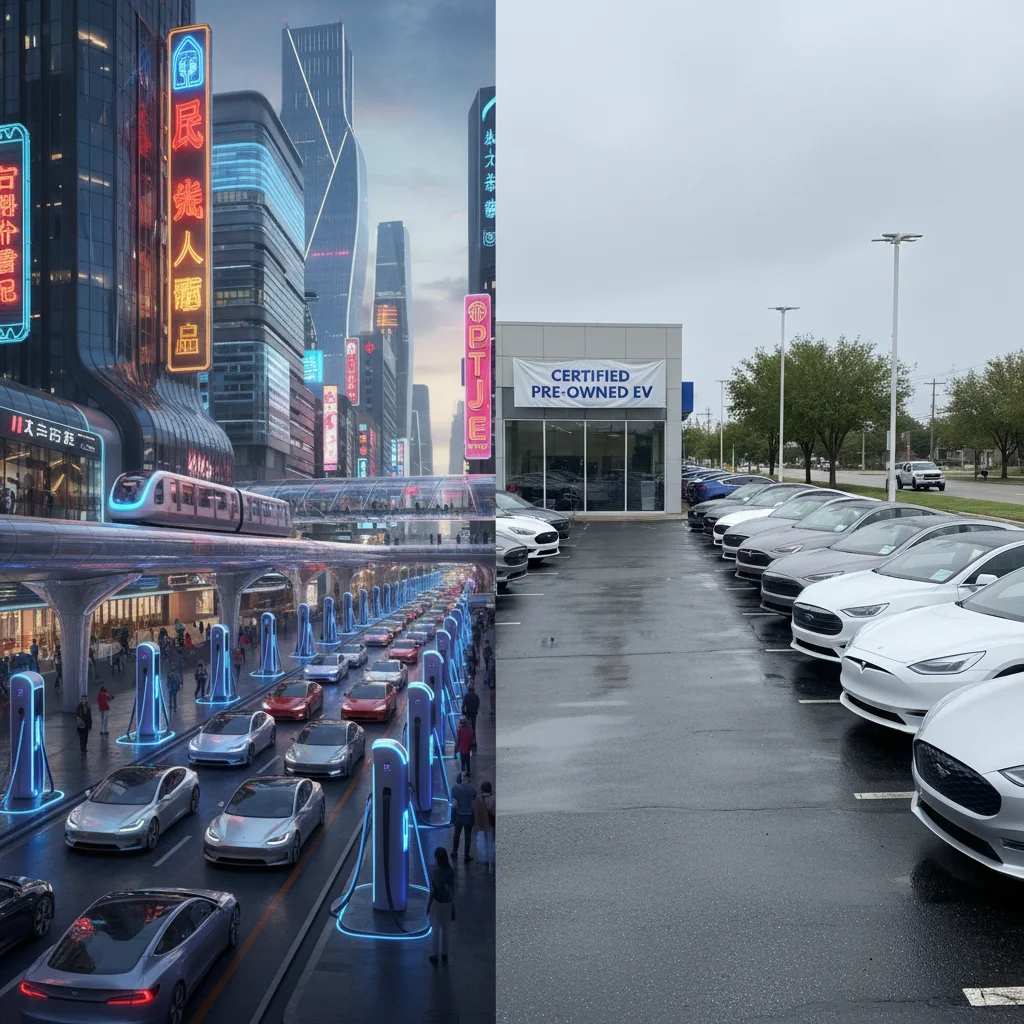
The Electric Vehicle Market in 2025–2026: Global Surge, U.S. Hesitation, and the Dawn of the Used EV Era
**By Senior Technical/Financial Audit Journalist**
---
Introduction: The 20 Million Milestone and the Hidden Divide
Global electric vehicle sales exceeded 20 million units for the first time in calendar year 2025, reaching approximately 20.7 million units—a 20% year-over-year increase from 2024's 17.5 million units (Source 1: [Primary Data]). December 2025 alone set a single-month record of 2.1 million units sold globally, confirming that aggregate demand remains structurally robust.
However, this headline masks a stark regional bifurcation. China crossed the 50% adoption threshold for new car sales, while the United States remained mired in single digits at 9–10% share. The market is no longer debating whether EVs will grow, but rather *where and how fast* that growth is reshaping competitive dynamics, pricing structures, and the secondary market.
The underreported structural shift is the maturation of the used EV market. Three- to five-year-old vehicles are now entering the used car ecosystem in volume, creating a new set of pressures on OEM margins, residual values, and consumer adoption psychology that will define the next phase of the transition.
---
Global Snapshot: China Leads, Europe Consolidates, the U.S. Edges Forward
Global EV sales in 2025 of 20.7 million units represented a 20% increase from 2024's 17.5 million units, maintaining a growth trajectory that first crossed the 20% share of global light-vehicle sales in 2024 (Source 1: [Primary Data]). The December 2025 record of 2.1 million monthly sales underscores that demand acceleration is not decelerating at the aggregate level.
The regional breakdown reveals the structural divergence:
- **China**: 50–51% of new car sales were EVs in 2025. This represents a structural tipping point—the internal combustion engine (ICE) has become the minority powertrain in the world's largest automotive market. Policy support, domestic manufacturing scale, and consumer acceptance have created a self-reinforcing cycle.
- **Europe (EU+UK)**: 28–30% EV share reflects steady, policy-driven growth. The region benefits from binding CO2 emission targets and expanding charging infrastructure, though growth rates have moderated from earlier peaks.
- **United States**: 9–10% EV share, with a low-teens volume increase versus 2024's approximately 1.3 million registrations (Source 1: [Primary Data]). The U.S. market grew again, but from a lower base and with significant monthly volatility.
The U.S. share trajectory—7% in 2023, 8–9% in 2024, 9–10% in 2025—indicates linear rather than exponential adoption (Source 2: [Timeline Data]). This contrasts sharply with China's S-curve acceleration and suggests structural barriers—including infrastructure gaps, price sensitivity, and political uncertainty—that are not present in other major markets.
---
The BYD vs. Tesla Shift: Brand Hegemony Ends in the U.S.
The most significant competitive development of 2025 was BYD surpassing Tesla in annual global EV deliveries, selling well over 2 million units globally (Source 1: [Primary Data]). This is not merely a volume milestone—it represents the end of the "pioneer premium" era and the beginning of commodity pricing dynamics.
In the U.S. market, Tesla's share declined to the mid-40% range in 2025, down from approximately 65% in 2022 (Source 2: [Timeline Data]). This decline is not a sign of Tesla's failure but of market maturation. GM, Ford, and Hyundai–Kia have each brought competitive products to market, expanding the addressable segment beyond Tesla's historical dominance.
This brand share erosion signals three structural changes:
1. **Price compression**: As more OEMs offer EVs within similar price bands, the ability to command premium pricing diminishes. The "early adopter tax" that enabled Tesla's high margins is dissipating. 2. **Segment diversification**: The market is moving from a single-product story (Model 3/Y) to a multi-segment landscape spanning trucks, SUVs, and affordable compacts. 3. **Brand loyalty erosion**: Used EV data shows discounts versus new EV prices, and cross-shopping behavior is increasing. Early adopters who bought Tesla for brand cachet are not necessarily repeating that choice.
---
The Underreported Story: Used EVs Enter the Mainstream
The most consequential structural shift for 2026–2027 is the volume influx of three- to five-year-old EVs into the used car market. These vehicles originate from two primary sources: early lease returns from 2021–2022 and trade-ins from consumers upgrading to newer EV models.
This supply surge is creating steep discounts relative to new EV prices (Source 1: [Primary Data]). While this reduces barriers for entry-level buyers—addressing the affordability constraint that has limited U.S. adoption—it simultaneously creates depreciation risk for early owners and margin pressure for OEMs financing lease residuals.
The dual effect is:
- **Positive**: Used EVs at $15,000–$25,000 price points expand the addressable market beyond affluent early adopters. Lower total cost of ownership becomes a rational purchasing argument.
- **Negative**: Rapid depreciation damages consumer confidence. If a $50,000 EV loses 40–50% of its value in three years, potential buyers question total cost of ownership relative to ICE vehicles. OEMs may need to increase lease subsidies or offer residual value guarantees.
This is the classic "chicken-and-egg" problem of technology adoption: volume growth in new sales creates used supply, which enables broader adoption, but only if residual values stabilize enough to maintain consumer trust.
---
Market Implications: The Structural Pressure Points
The data points to three interconnected dynamics that will define the EV market through 2026.
**First**, the U.S. adoption rate remains structurally constrained. At 9–10% share with low-teens volume growth, the U.S. is not following China's S-curve. The reasons are multifaceted: charging infrastructure density remains uneven, political support for EV incentives is uncertain, and consumer price sensitivity is higher due to the absence of sub-$30,000 mass-market EVs in volume. Early 2026 monthly and quarterly data shows continued year-over-year growth, but selectively, with some months underperforming expectations (Source 2: [Timeline Data]).
**Second**, the competitive matrix is shifting from "Tesla versus everyone else" to "multipolar competition." BYD's global leadership, combined with legacy OEM gains in the U.S., means no single manufacturer commands pricing power. This is structurally healthy for consumers but margin-destructive for manufacturers. The industry is entering a consolidation phase where scale and cost efficiency will determine survival.
**Third**, the used EV market will increasingly dictate new EV pricing. As three- to five-year-old vehicles become abundant, the spread between new and used prices will compress. OEMs that cannot justify premium pricing through differentiation—whether in battery technology, software, or service—will face pressure to reduce MSRPs or increase incentives.
---
Neutral Market Predictions for 2026
Based on the current trajectory, the following outcomes are probabilistically weighted:
1. **Global EV sales will exceed 24 million units in 2026**, representing approximately 15–20% growth, as China's adoption reaches 55–60% and Europe maintains 30–32% share. U.S. share will reach 11–13%, driven primarily by new model launches and price reductions rather than infrastructure improvements.
2. **Used EV supply will increase 40–60% year-over-year** as the 2022–2023 new sales cohort enters the secondary market. Price discounts versus new EVs will widen further, potentially reaching 45–55% for three-year-old vehicles, before stabilizing in late 2026.
3. **OEM margin compression will accelerate**. The combination of price competition, investment requirements for next-generation platforms, and warranty costs on early EVs will pressure profitability. Consolidation among smaller EV startups and joint ventures between legacy OEMs and battery manufacturers is probable.
4. **Tesla's U.S. market share will stabilize in the 35–40% range** as it maintains volume but cedes share to new entrants. BYD will continue to dominate global volume but faces tariffs and political barriers to significant U.S. market penetration.
The EV market has entered its second phase—defined not by pioneer enthusiasm but by structural competition, pricing realism, and the normalization of used EV transactions. The question is no longer whether adoption will continue, but how the industry manages the transition from growth to maturity without destroying margins or consumer confidence in the process.