Global EV Sales Surge to 20 Million in 2025: China Leads, U.S. Lags, and BYD Overtakes Tesla
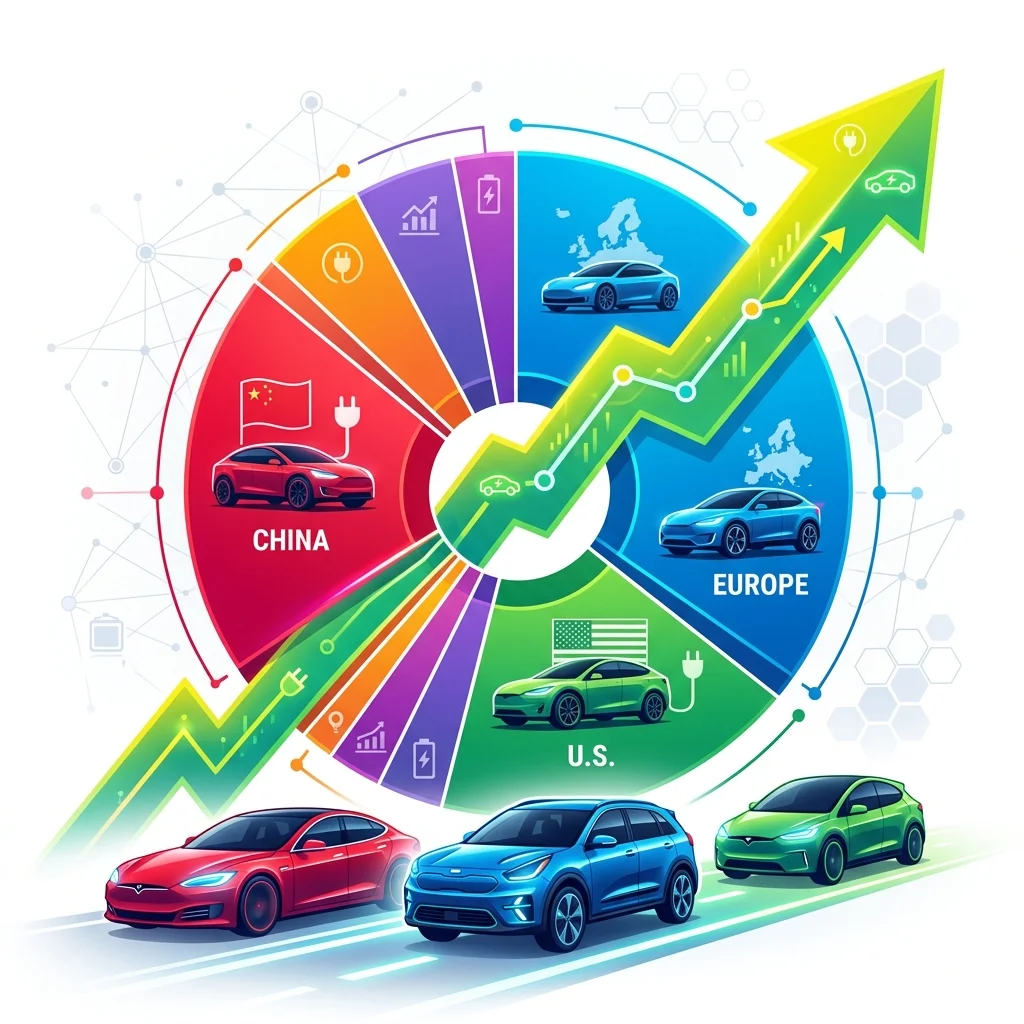
Global electric vehicle sales reached approximately 20.7 million units in 2025, a 20% increase from 2024, with EVs now accounting for over 20% of all light-vehicle sales worldwide. China continues to dominate, with over 50% of new car sales being electric, while Europe climbs to 28–30% and the U.S. remains stuck at 9–10%. BYD surpassed Tesla as the global EV volume leader, selling well over 2 million units, while Tesla's U.S. market share dropped to the mid-40% range. The record December 2025 sales of 2.1 million units underscore a robust but uneven market. This article dives into the regional dynamics, competitive shifts, and what the 2026 outlook means for automakers, policymakers, and supply chains.
Global EV Sales Surge to 20 Million in 2025: China Leads, U.S. Lags, and BYD Overtakes Tesla
Introduction: The 20 Million Milestone
Global electric vehicle (EV) sales reached approximately 20.7 million units in 2025, a roughly 20% increase from the 17.5 million units sold in 2024 (Source 1: Raw Data – Global EV sales). December 2025 set a monthly record of 2.1 million sales, underscoring significant year-end momentum. As of 2025, EVs represented over 20% of all light-vehicle sales worldwide, up from 17% in 2023. This article examines the regional disparities, the competitive realignment between BYD and Tesla, and the structural forces shaping the 2026 outlook.
Global Overview: Growth Accelerates, But Unevenly
The expansion of the global EV market is heavily skewed by region. China remains the engine: its EV share of new car sales has held at approximately 50% in both 2024 and 2025, translating to over 10 million units annually (Source 1: Raw Data – China 2024/2025 EV share). Europe (EU+UK) improved from an estimated 23–25% in 2024 to 28–30% in 2025, driven by stricter CO₂ targets and expanding charging infrastructure. The United States lags far behind, with an EV share of only 9–10% in 2025, up from 8–9% in 2024 and 7% in 2023 (Source 1: Raw Data – U.S. EV share). The core divergence stems from scale and cost advantages in China versus hesitant consumer adoption and structural barriers in the U.S.
China’s Dominance: BYD Takes the Crown
BYD sold well over 2 million EVs globally in 2025, surpassing Tesla to become the world’s top EV brand by volume (Source 1: Raw Data – BYD sales). China’s domestic market alone accounts for half of global EV sales, fueled by aggressive pricing, government subsidies, and a dense network of local suppliers. BYD’s vertical integration—controlling battery production, chip design, and vehicle assembly—gives it a cost edge that legacy automakers struggle to match. Tesla’s volume in China faced headwinds from local competitors such as BYD, NIO, and XPeng, while its U.S. market share declined to the mid-40% range in 2025, down from earlier years (Source 1: Raw Data – Tesla U.S. share). The shift in leadership reflects not just pricing but also a broader product mix: BYD offers a wider range of affordable models, whereas Tesla remains concentrated on higher-priced segments.
Europe’s Steady Rise: Policy-Driven Progress
Europe’s EV share jumped from approximately 23% in 2024 to 28–30% in 2025, aided by expanding model availability and corporate fleet mandates (Source 1: Raw Data – Europe EV share). Countries like Norway (over 80% EV share) lead, while Eastern Europe still lags, creating a mixed regional picture. The European Union’s 2035 combustion-engine phase-out continues to shape automaker strategies, with Volkswagen, Stellantis, and Hyundai–Kia ramping up production. However, challenges persist: rising electricity costs and inconsistent national incentives temper growth rates. The region remains heavily policy-dependent; any weakening of regulatory timelines could slow adoption.
U.S. Market: Stalled at 10% – Structural Barriers and Tesla’s Decline
U.S. EV sales hit approximately 1.3 million new registrations in 2024, growing at low-teens percentage year-over-year in 2025, but with a notably weak fourth quarter (Source 1: Raw Data – U.S. EV sales and growth). The market share has plateaued at 9–10%, far below China and Europe. Tesla’s U.S. EV market share dropped to the mid-40% range in 2025, as legacy automakers—GM, Ford, Hyundai–Kia—introduced competitive models (Source 1: Raw Data – Tesla U.S. share). Structural barriers include limited charging infrastructure in rural areas, higher upfront costs relative to gasoline vehicles despite federal incentives, and inconsistent state-level policies. The low-teens growth rate indicates a maturing early-adopter market, with mainstream consumers remaining cautious. Without more aggressive federal mandates or a step-change in affordability, the U.S. is likely to remain an outlier.
Looking Ahead: 2026 Outlook and the Uneven Road to 30% Global EV Share
Early 2026 monthly data shows the U.S. market still growing year-over-year but selectively, with the pace insufficient to close the gap with China or Europe (Source 1: Raw Data – Early 2026 U.S. data). Global EV sales are projected to reach 24–26 million units in 2026, pushing the EV share of light-vehicle sales toward 25–27%. China will likely maintain its 50%+ share, while Europe’s share could rise to 32–34% if the 2025 trend continues. The U.S. is expected to remain below 15% without major policy shifts or a rapid decline in battery costs. The competitive landscape will see BYD solidifying its volume lead, while Tesla focuses on profitability and autonomous driving technology. Legacy automakers face a critical window: those that accelerate EV production and cost reduction will gain share; those that hesitate risk being marginalized. Supply chains will need to adapt to regionalize battery production, as tariff and subsidy regimes increasingly favor local content. The market is entering a phase of consolidation, where scale and vertical integration—not just brand heritage—determine success.