Global EV Sales Hit 20 Million in 2025: IEA Outlook Reveals Shifting Dynamics and What It Means for the Future of Mobility
Based on the IEA Global EV Outlook 2026, global electric car sales exceeded 20 million in 2025, capturing 25% of new car sales. Battery electric vehicles (BEVs) regained share after a two-year decline, while China remained the dominant market despite slowing growth. Europe rebounded sharply, but the U.S. stagnated below 10%. This article goes beyond the headlines to uncover the hidden economic logic: the recalibration of supply chains, policy-driven demand shocks, and the emergence of ‘third-market’ accelerators. It explores what these trends mean for battery mineral demand, manufacturing overcapacity, and the pace of electrification in emerging economies.
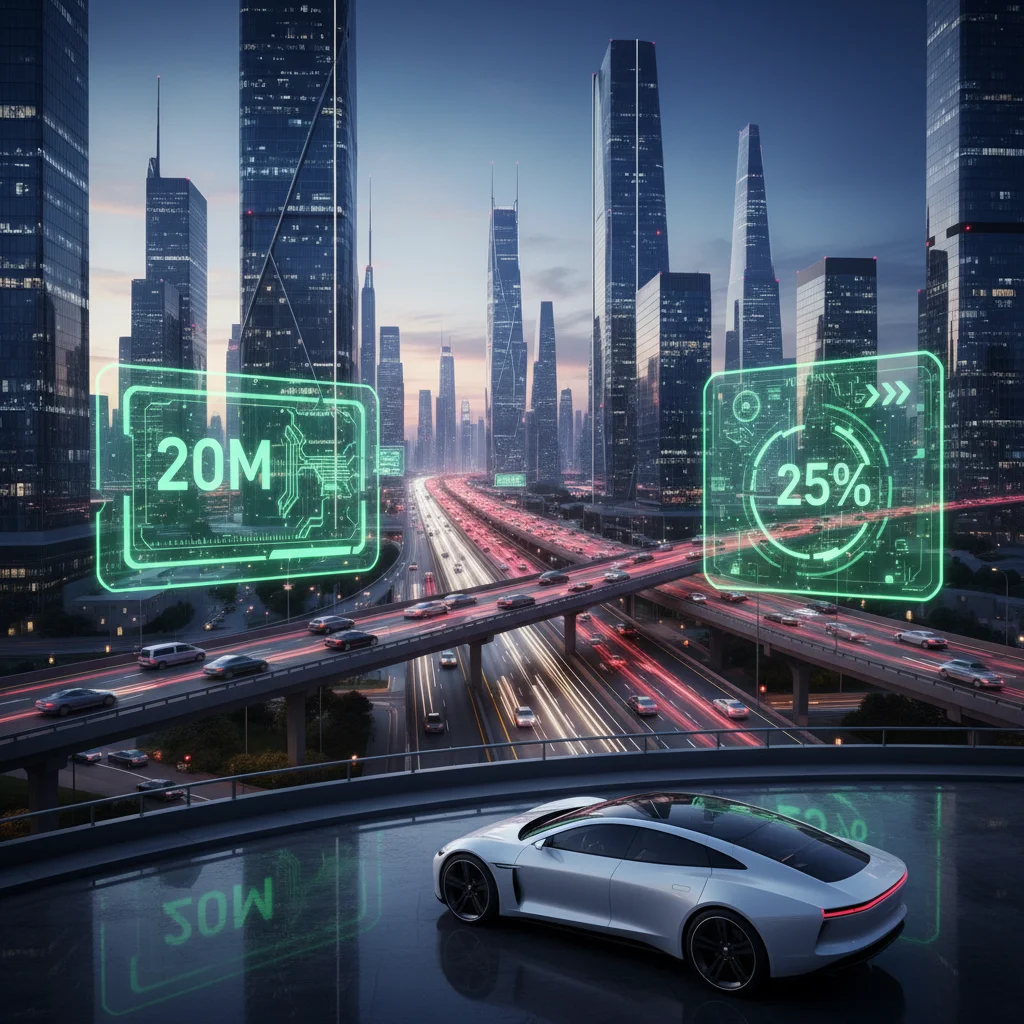
Global EV Sales Hit 20 Million in 2025: IEA Outlook Reveals Shifting Dynamics and What It Means for the Future of Mobility
Introduction: The 20 Million Milestone – A Moment of Deceleration or Inflection?
Global electric car sales topped 20 million in 2025, according to the IEA Global EV Outlook 2026, marking a 20% year-on-year increase and the fifth consecutive annual rise of roughly 3.5 million units. One in every four new cars sold worldwide was electric, a penetration rate that would have seemed improbable just five years ago. Yet beneath the headline numbers lies a more nuanced story: growth is slowing from the breakneck pace of 2020–2024, when annual sales increases routinely exceeded 40%. The central tension now facing the industry is volume versus velocity — absolute market size continues to expand, but the rate of expansion is decelerating, signaling a transition from hyper-growth to maturation.
As the IEA states, “Electric car sales topped 20 million globally in 2025,” an achievement that underscores the irreversible shift toward electrification. However, the composition of that growth reveals shifting dynamics that carry profound implications for supply chains, battery mineral demand, manufacturing capacity, and the pace of adoption in emerging economies. This article unpacks the hidden economic logic behind the numbers: how policy-driven demand shocks, recalibrated supply chains, and the rise of “third-market” accelerators are reshaping the electric mobility trends landscape.
[IMAGE: A global map with country-level EV sales heatmap, showing China in deep red, Europe in orange, US in yellow, and others in light green.]
The BEV Comeback: Why Pure Electric Cars Are Regaining Ground Over PHEVs and EREVs
Battery electric vehicles (BEVs) made up 65% of total global EV sales in 2025, reversing a two-year decline in market share that had seen plug-in hybrids (PHEVs) and extended-range electric vehicles (EREVs) gain ground. The recovery is notable: in 2024, BEVs accounted for only 62% of sales, as consumers in some markets turned to hybrids to address range anxiety and higher upfront costs. By 2025, the pendulum swung back. EREVs, which peaked at 7.5% of the EV market in 2024, slipped below 7%, signaling a peak for niche powertrains that combine a small internal combustion engine with a battery.
What drove this reversal? Three factors stand out. First, battery costs continued their downward trajectory, falling another 12% year-on-year to below $100 per kWh at the pack level, narrowing the price gap between BEVs and PHEVs. Second, fast-charging infrastructure expanded rapidly — the global stock of public DC fast chargers grew by 35% in 2025, with China alone adding over 600,000 units. Third, consumer preferences shifted back toward simpler, all-electric drivetrains as the promise of zero tailpipe emissions and lower total cost of ownership became more tangible. Data from EV Volumes and Marklines confirm the trend: BEV share increased to 65% in 2025, while PHEVs plateaued and EREVs retreated.
This BEV market share recovery is not merely a statistical blip. It reflects a structural shift in the economics of battery electric vehicles — lower battery prices and expanding charging networks are eroding the rationale for complex hybrids. For automakers, the implication is clear: double down on pure electric platforms, or risk being left behind in a market where simplicity and scale win.
[IMAGE: Bar chart comparing BEV vs. PHEV/EREV share from 2020 to 2025, with an annotation highlighting the reversal in 2025.]
China’s Uneven Dominance: Slowdown, Subsidy Shock, and the Rise of ‘Zero-Mileage’ Cars
China sold over 13 million EVs in 2025, maintaining its position as the world’s largest EV market by a wide margin. The country achieved a ~55% sales share — meaning more than half of all new cars sold in China were electric — but growth slowed to under 20% for the first time since 2020. This deceleration is partly a natural consequence of high penetration, but it also reflects policy-induced volatility.
The trade-in scheme, which offered CNY 20,000 (approximately $2,800) for consumers replacing older vehicles with new EVs, drove 11.5 million applications during the year. However, a temporary halt in July 2025 caused a sharp 10% monthly sales dip, revealing just how dependent the market remains on government incentives. The policy pause, intended to recalibrate subsidy budgets, sent a jolt through supply chains and dealerships, and sales only recovered after the scheme was reinstated in August with tighter eligibility criteria.
A more worrying distortion is the emergence of “zero-mileage” cars — vehicles purchased purely for arbitrage rather than transportation. Nearly 4% of new EV sales in China in 2025 are estimated to be zero-mileage cars, bought to capture subsidies or tax benefits and then immediately resold or scrapped for parts. This practice inflates demand figures and creates a phantom market that complicates real-world adoption assessments. The IEA notes that China’s EV stock at end-2025 reached approximately 44 million units, displacing an estimated 1.2 million barrels of oil per day — a critical metric for energy transition models. But if a portion of that stock never sees the road, the actual displacement effect may be lower than reported.
The China EV market slowdown is not a sign of weakness but of maturation — and of the challenges that come with scale. Supply chain implications are already visible: battery manufacturers in China, which produce over 70% of the world’s lithium-ion batteries, face overcapacity as domestic demand growth softens, forcing them to seek export markets aggressively.
[IMAGE: Line graph of China monthly EV sales share over 2025, with a shaded region for the July policy halt dip.]
Europe’s Rebound: From Stagnation to 30% Growth – Drivers and Durability
After two years of stagnation, European EV sales surged 30% in 2025 to 4.2 million units, pushing the EV share of new car sales to 28%. The rebound was led by the European Union, where stricter CO2 fleet targets came into force, effectively mandating a higher share of zero-emission vehicles. Germany, which had seen a slump after the abrupt end of its purchase subsidies in late 2023, posted a 22% increase, driven largely by corporate fleet registrations and improved charging infrastructure. France and the UK also saw strong gains, with France’s social leasing program for low-income households adding 100,000 new EV registrations.
What makes this rebound durable? Unlike previous spikes driven solely by subsidies, the 2025 growth is underpinned by a broader structural shift. The EU’s 2025 CO2 target of 95 g/km for new car fleets (already tightened from previous levels) is forcing automakers to push EVs even as PHEV sales decline. Meanwhile, battery costs in Europe are falling faster than expected, thanks to the ramp-up of local gigafactories — the region’s annual battery production capacity reached 180 GWh in 2025, up from 110 GWh in 2024. Fuel prices, which remained elevated at ~€1.80 per liter for gasoline, further tipped the total cost of ownership calculus in favor of EVs.
Yet challenges remain. The EU market is still heavily dependent on a handful of member states; Southern and Eastern Europe lag far behind, with EV shares below 10% in markets like Italy, Spain, and Poland. Infrastructure density also varies wildly — the Netherlands has one public charger per 2 EVs, while Greece has one per 50. And with the EU’s 2035 ban on new internal combustion engine sales looming, the pace of adoption in the lagging economies will be critical. The Europe EV rebound is real, but its durability hinges on closing the access gap between core and periphery.
[IMAGE: Line chart of monthly EV registrations in key European markets over 2025, with an overlay showing CO2 target thresholds.]