Beyond Electric Vehicles: The Nine Megatrends Reshaping Sustainable Mobility
The sustainable mobility landscape is fragmenting under the pressure of urbanization, regulatory pushes, and tech breakthroughs. While electric vehicles capture headlines, a deeper shift is underway: nine interconnected megatrends—from space-based technologies to AI disruption—are redefining how cities compete for space and how infrastructure is funded. This article explores the hidden economic logic behind these trends, reveals why European Union Recovery Fund investments are just one piece of a larger puzzle, and outlines actionable investment opportunities for stakeholders navigating the multi-modal, data-driven future of transport.
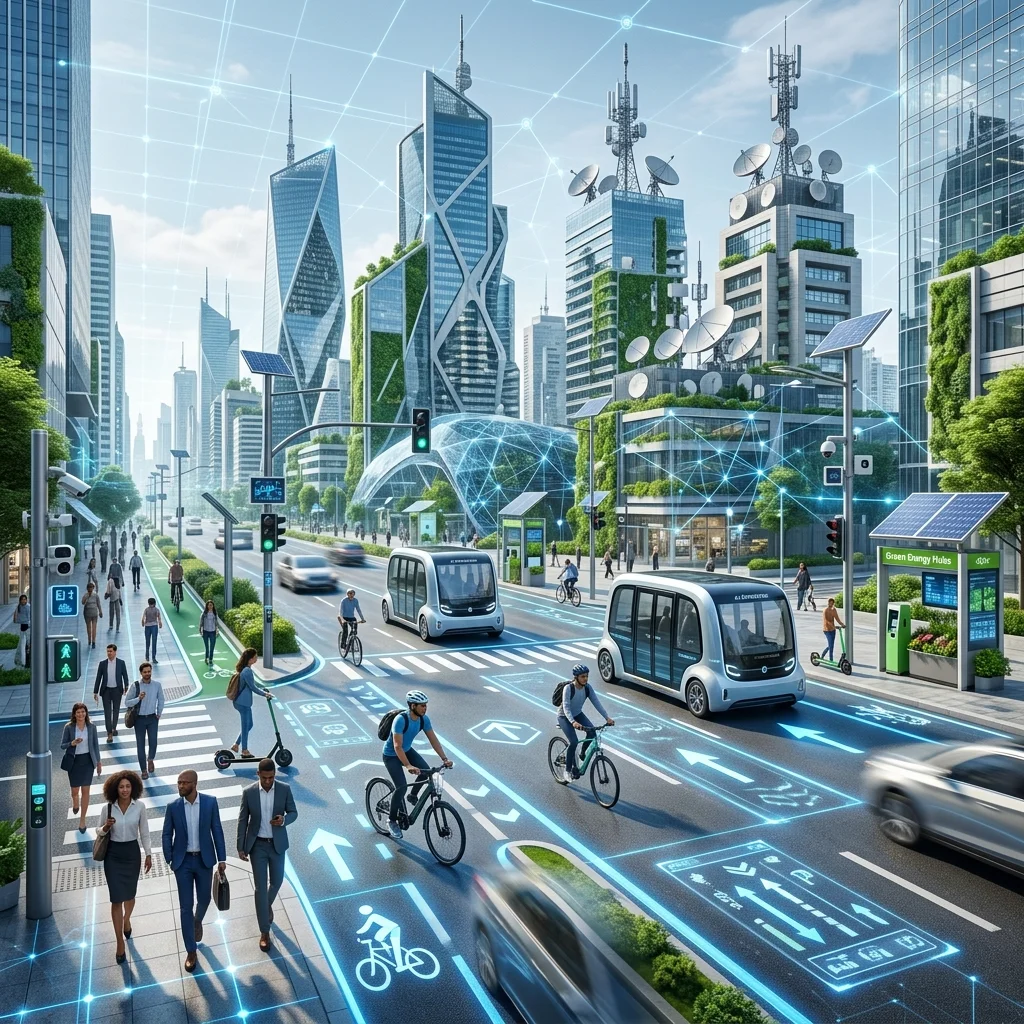
Beyond Electric Vehicles: The Nine Megatrends Reshaping Sustainable Mobility
Introduction: The Fragmented Mobility Ecosystem and Its Hidden Logic
The traditional mobility model—one internal combustion vehicle per driver—is structurally disintegrating under the combined pressure of rapid urbanization, stringent emission mandates, and technological discontinuity. Global urban populations now exceed 4.4 billion, with cities absorbing 1.5 million new residents weekly, creating congestion costs estimated at $300 billion annually in the United States alone (Source: INRIX 2023 Congestion Report). Simultaneously, the European Union's "Fit for 55" package mandates a 55% reduction in CO2 emissions from cars by 2030, forcing fundamental fleet restructuring.
Electric vehicles (EVs) dominate media narratives, supported by substantial public funding—the European Union's Recovery Fund allocated approximately $20 billion specifically to boost EV sales (Source: European Commission Recovery and Resilience Facility Data). However, this headline investment obscures a deeper structural fragmentation. The mobility ecosystem is being reshaped by digitally focused entrants—ride-hailing aggregators, micromobility startups, and logistics platforms—that operate on fundamentally different economic models than legacy automakers and infrastructure operators.
In collaboration with Mundys, a global mobility infrastructure operator managing airports, toll roads, and parking assets across 14 countries, nine interconnected megatrends have been identified that provide a unified analytical framework for understanding where capital, innovation, and regulatory pressure are truly converging. These trends reveal the hidden economic logic: the future of sustainable mobility is not about replacing one propulsion technology with another, but about reengineering the relationship between vehicles, space, energy, and data.
Trend 1–3: The Battle for Urban Space and Smart Infrastructure
Competition for Urban Space
Cities face a zero-sum competition for a finite resource: street space. The average passenger vehicle remains parked 95% of the time, yet consumes up to 200 square feet of urban land per parking spot (Source: Donald Shoup, "The High Cost of Free Parking"). This inefficiency is becoming economically untenable. Municipalities including Paris, Barcelona, and Oslo have initiated systematic parking space removal, converting 30-50% of on-street parking to bike lanes, pedestrian zones, and micro-mobility hubs.
The economic logic is clear: each parking spot generates approximately $1,200 annually in municipal revenue, while the same space converted to a bike-share docking station can generate $4,800 in direct fees and adjacent retail spillover effects (Source: NYC Department of Transportation Economic Benefits Analysis). This reallocation creates new revenue streams for infrastructure operators like Mundys, which are repositioning from parking asset managers to multimodal mobility hub operators.
Smart Infrastructure Investment
The deployment of IoT sensors, adaptive traffic signals, and real-time data analytics is transforming infrastructure from passive concrete to active network nodes. Barcelona's smart traffic management system, integrating 7,000 sensors across 400 intersections, reduced average commute times by 21% and congestion-related emissions by 17% between 2018 and 2023 (Source: Barcelona Urban Ecology Agency). The global smart transportation market is projected to grow from $95 billion in 2023 to $212 billion by 2030, with infrastructure operators capturing approximately 35% of this value chain (Source: McKinsey Global Infrastructure Practice).
This investment is not optional. As connected vehicles generate 4,000 GB of data daily per vehicle, infrastructure must evolve to process, monetize, and secure these data flows. The infrastructure operators that install the physical sensor networks will own the data layer—a recurring revenue stream independent of vehicle ownership cycles.
Sustainability Regulation as Market Catalyst
Regulatory frameworks, particularly in Europe, are creating enforceable timelines for fleet transformation. The EU Recovery Fund, which disburses €723 billion in grants and loans, conditions 37% of expenditures on climate objectives, with transport electrification infrastructure as a primary allocation target. Low-emission zones now operate in 320 European cities, with 170 more scheduled by 2026, creating "regulatory exclusion zones" for non-compliant vehicles (Source: European Commission Urban Mobility Observatory).
The critical insight for investors: regulation is not merely a compliance burden but a market-shaping force that redistributes competitive advantage. Incumbents with legacy fleets face stranded asset risk; agile newcomers with electric fleets and digital operating models gain regulatory access pricing advantages. The window for strategic repositioning closes as regulatory lock-in effects amplify first-mover advantages.
Trend 4–6: Digital Services, Defense-to-Civilian Transfer, and Sustainable Energy
Digital Services and Mobility-as-a-Service (MaaS)
MaaS platforms are aggregating fragmented transportation options—public transit, ride-hailing, bike-share, scooter rental, car-sharing—into single subscription interfaces. Helsinki's Whim platform, operational since 2017, demonstrates that MaaS subscribers reduce private car usage by 25% and increase multimodal trip frequency by 40% (Source: MaaS Global Operational Data). The platform economics favor early movers who achieve data network effects: each additional user increases platform predictive accuracy, which improves route optimization, which attracts more users.
The financial structure is shifting from transaction-based pricing to subscription models, which generate 3-4x higher customer lifetime value (Source: BCG Mobility Platform Analysis). Mundys and similar infrastructure operators are uniquely positioned to serve as MaaS platform anchors, controlling critical physical access points—airports, parking garages, toll plazas—that generate high-frequency, high-value trip data.
Defense-to-Civilian Technology Transfer
Military-developed technologies are migrating to civilian mobility applications at accelerating velocity. Radar systems originally engineered for missile guidance now power autonomous vehicle object detection. Satellite navigation, specifically the European Galileo system's high-accuracy service, enables lane-level positioning for autonomous logistics. Battery chemistry breakthroughs funded by defense research are reducing EV pack costs by 18-22% annually (Source: US Department of Defense Energy Innovation Board).
The commercialization pathway follows a pattern: defense agencies fund fundamental R&D (typically 7-10 years), then civilian spin-offs adapt the technology for volume manufacturing. The current transfer wave, driven by 5G-enabled autonomous systems, will generate approximately $85 billion in civilian mobility value by 2028 (Source: NATO Science & Technology Organization Commercialization Analysis). Investors tracking defense R&D budgets can anticipate civilian applications 3-5 years in advance.
Sustainable Energy Integration
Vehicle-to-grid (V2G) technology transforms EVs from energy consumers to distributed storage assets. A single EV with bidirectional charging can supply 10-15 kWh to the grid during peak demand, valued at $1,200-$2,000 annually per vehicle in energy arbitrage (Source: Fraunhofer Institute V2G Economics Study). At fleet scale, 10,000 V2G-capable vehicles can provide 100-150 MWh of grid buffer capacity, equivalent to a $30-50 million battery storage installation.
Decentralized solar charging nodes are critical for scaling EVs beyond wealthy early adopters. Africa's solar-charging microgrid market, for instance, is projected to reach $2.3 billion by 2027, serving 12 million e-motorcycles and three-wheelers that would otherwise lack grid access (Source: International Energy Agency Africa Energy Outlook). This distributed model reduces transmission infrastructure costs by 40-60% compared to centralized charging networks.
Trend 7–9: Connected Vehicles, Space-Based Tech, and AI Disruption
Connected Vehicles and 5G Integration
Cellular Vehicle-to-Everything (C-V2X) communication enables real-time data exchange between vehicles, infrastructure, and cloud platforms. 5G networks reduce latency to under 10 milliseconds, making platooning—where vehicles travel in closely spaced convoys—commercially viable. Platooning reduces aerodynamic drag by 10-15%, cutting fuel or energy consumption proportionally, and enables 300% road capacity utilization improvement on dedicated lanes (Source: US Department of Transportation Connected Vehicle Pilot Program).
For fleet operators, connectivity enables predictive maintenance: sensor data analysis reduces unplanned downtime by 30-40% and extends vehicle lifespan by 15-20% (Source: Frost & Sullivan Connected Fleet Analytics). Insurance telematics, where premiums are based on actual driving behavior rather than demographic proxies, reduces fleet insurance costs by 20-35%. The cumulative total cost of ownership (TCO) reduction for connected fleets reaches $0.12-0.18 per mile—a decisive competitive advantage in margin-sensitive logistics markets.
Space-Based Technologies
Low-earth orbit (LEO) satellite constellations, exemplified by Starlink's 6,000+ operational satellites, are eliminating connectivity dead zones that have historically prevented real-time freight tracking and autonomous vehicle operation in rural corridors. Cross-border freight routes in Central and Eastern Europe, where terrestrial 5G coverage gaps exceed 40%, are now accessible to connected logistics operators (Source: European Global Navigation Satellite Systems Agency).
Space-based technologies extend beyond connectivity. Synthetic aperture radar (SAR) satellites monitor road surface conditions, bridge structural integrity, and construction progress with centimeter-level precision, enabling infrastructure operators to shift from reactive maintenance to predictive asset management. The global satellite-enabled transportation market is projected to reach $18.5 billion by 2028, with 60% of growth concentrated in logistics and infrastructure monitoring applications (Source: Euroconsult Space-Based Services Report).
AI Disruption and Regulatory Bottlenecks
Machine learning algorithms are optimizing mobility systems across three dimensions: route planning (reducing empty miles by 20-30% in logistics), demand forecasting (improving vehicle availability matching by 35-45% in ride-hailing), and battery lifespan management (extending EV battery life by 25-35% through optimized charging cycles). The applied AI in transportation market is forecast to reach $11.5 billion by 2027, with fleet management and autonomous systems capturing 55% of value (Source: MarketsandMarkets AI in Transportation Analysis).
However, AI regulation represents the next binding constraint. The European Union's AI Act, effective 2025, classifies transportation AI systems as "high-risk," requiring certification, transparency documentation, and human oversight mechanisms. Compliance costs are estimated at $2-5 million per AI system, creating a regulatory barrier that favors well-capitalized incumbents and may delay autonomous vehicle deployment by 12-18 months. Infrastructure operators must invest in AI governance frameworks concurrently with technology implementation to avoid operational disruption.
Investment Implications and Forward-Looking Assessment
The nine megatrends converge on a central economic reality: sustainable mobility is transitioning from a vehicle-centric to a platform-centric model, where infrastructure data, energy integration, and digital services generate higher margins than vehicle manufacturing or operation.
Investment opportunities segment into four categories:
**Multimodal Platform Infrastructure**: Operators controlling physical access points (parking, tolling, airports) who integrate digital services, V2G charging, and MaaS subscriptions will capture platform economics. Mundys' portfolio of 200+ parking facilities across European urban centers positions it to serve as physical anchor for this model. Projected revenue per asset: 25-35% from traditional parking, 40-50% from energy services, and 20-30% from digital subscriptions by 2030.
**Expanded Service Provisioning**: Fleet-as-a-Service providers offering integrated vehicles, insurance, maintenance, and charging under single contracts see 18-22% annual growth rates, versus 2-4% for traditional vehicle sales (Source: Fleet Europe Market Analysis).
**Public-Private Partnership Structures**: As municipal budgets face pressure from post-pandemic fiscal constraints, PPPs for smart infrastructure investment—where private operators finance installation in exchange for data monetization rights—are becoming the dominant procurement model. The European PPP market for transport infrastructure reached €15.2 billion in 2023, with smart technology components representing 38% of contract value (Source: European Investment Bank PPP Database).
**Systemic Policy Investment**: Investors must incorporate regulatory scenario analysis into due diligence. Regions with clear EV mandates, low-emission zone expansion schedules, and AI regulation frameworks (EU, parts of China, California) offer lower policy risk than markets with ambiguous regulatory trajectories (Southeast Asia, Latin America).
The mobility ecosystem in 2030 will bear limited resemblance to its 2020 configuration. The nine megatrends are not autonomous forces but interlocking dynamics: space competition drives infrastructure investment, which enables digital services, which generate data, which powers AI optimization, which reduces energy costs, which accelerates electrification. Infrastructure operators who understand these linkages will own the economic center of gravity in the sustainable mobility transition. Those who treat each trend in isolation will remain peripheral participants, competing on decreasing margins in an increasingly integrated value chain.