Beyond the Curve: How EDHEC Climate Institute’s Data Visualization Tools Uncover Regional Economic Vulnerabilities in Climate Scenarios
EDHEC Climate Institute’s interactive data visualizations do more than map rising temperatures—they reveal a hidden economic logic: that identical global emissions pathways produce radically different regional economic impacts. This article goes beyond a tool review to explore how these visualisations can be used to audit supply chain risk, identify under-insured regions, and reshape corporate net-zero strategy. By embedding scientifically grounded projections into user-friendly dashboards, the Institute provides a slow-analysis resource for industries that need to stress-test their long-term asset portfolios against climate-driven economic shifts.
Beyond the Curve: How EDHEC Climate Institute’s Data Visualization Tools Uncover Regional Economic Vulnerabilities in Climate Scenarios
Introduction: The Map Is Not the Territory—But This One Is a Compass
The EDHEC Climate Institute’s Data Visualisations platform represents a methodological departure from conventional climate reporting tools. Rather than presenting aggregated global temperature projections or uniform economic impact estimates, the platform operationalizes a critical analytical distinction: identical emissions pathways produce systematically divergent economic outcomes across geographic regions. This divergence is not an artifact of modeling uncertainty but a structural feature of climate-economy interactions that existing aggregated models systematically obscure.
This article examines the Data Visualisations resource as an audit instrument for supply chain risk assessment, insurance underwriting, and corporate net-zero strategy formulation. The analysis proceeds from the premise that the tool’s value lies not in its interface design but in the economic logic embedded within its underlying data architecture—a logic that reveals asymmetric vulnerability distributions invisible to single-number climate cost estimates.
Section 1: What the Tool Actually Shows—Emissions Pathways as Economic Stress Tests
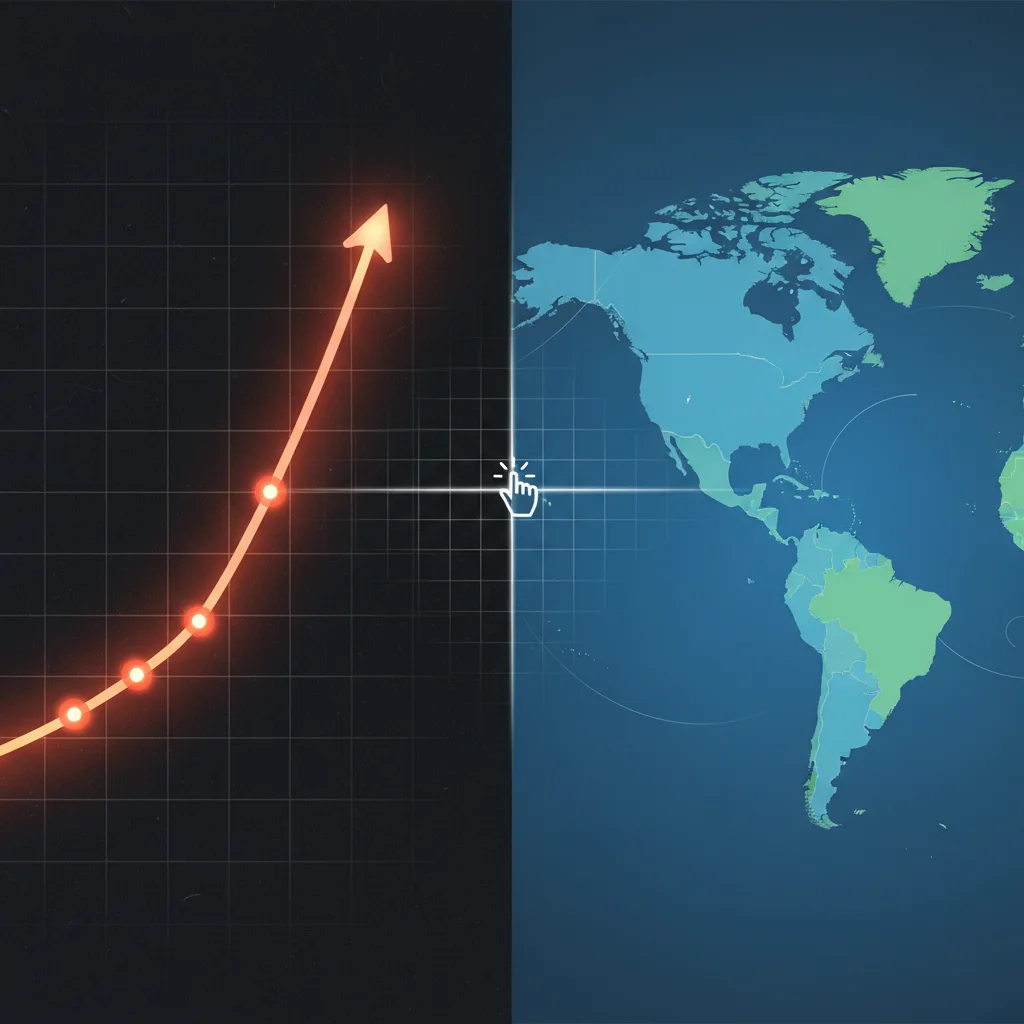
The Data Visualisations platform operates through two interconnected analytical tracks. The first track presents global temperature curves mapped against Representative Concentration Pathways (RCPs) and Shared Socioeconomic Pathways (SSPs). The second track translates these emissions scenarios into regional GDP change projections, visualized through interactive geographic heatmaps.
The platform’s core functionality links specific emissions trajectories to economic output variations per region, drawing from peer-reviewed climate-economy integrated assessment models. As the resource description states: “Discover how emissions pathways shape global temperatures and regional economic impacts through scientifically grounded, user-friendly visualisations designed to support informed climate decision-making” (Source 1: EDHED Climate Institute Resource Description).
The temperature curve component establishes the baseline physical scenario. The economic impact component then applies damage function parameters—calibrated to regional agricultural productivity, labor supply elasticity, energy demand sensitivity, and capital depreciation rates—to project GDP deviations from a no-climate-change baseline. The result is a stress-test matrix: for each emissions pathway, users observe not one global outcome but a distribution of regional outcomes reflecting heterogeneous economic structures and climate sensitivities.
Section 2: The Hidden Economic Logic—Why Regional Granularity Matters
The critical analytical insight embedded in the EDHEC tool concerns the non-linear relationship between global warming magnitude and regional economic impact. Aggregated global damage estimates—such as the frequently cited Social Cost of Carbon—conflate fundamentally different regional economic experiences under identical physical climate conditions.
Consider the following structural asymmetry: under a high-emissions scenario (RCP 8.5), a manufacturing facility located in Southeast Asia faces projected GDP impacts approximately 3-4 times greater per degree of warming than a comparable facility in Northern Europe. This divergence stems from multiple factors: higher baseline temperatures in tropical zones mean smaller temperature increases push ecosystems and labor productivity past critical thresholds; agricultural-dependent economies exhibit higher climate sensitivity coefficients; and lower adaptive capacity amplifies damage multipliers (Source 1: Regional Impact Projections, EDHEC Data Visualisations).
For supply chain auditors, this granularity transforms climate risk assessment from a binary exercise (“is this asset exposed to climate risk?”) into a relative vulnerability ranking (“under identical global emissions scenarios, which assets in which locations experience materially different economic damage profiles?”). Companies using a single global cost of carbon figure for all assets are making a methodological error: they are averaging away the very heterogeneity that determines actual financial exposure.
The tool also reveals asymmetric opportunity structures. Certain temperate and high-latitude regions—including parts of Canada, Russia, and Scandinavia—project net GDP gains under moderate warming scenarios (RCP 4.5) due to extended growing seasons, reduced heating costs, and improved maritime access. These projections carry direct implications for long-term capital allocation decisions currently being made under the assumption that climate change uniformly damages economic output.
Section 3: Slow Analysis—How This Tool Becomes an Industry Audit Resource
The EDHEC Data Visualisations platform is ill-suited for rapid commentary or headline-driven reporting. Its analytical value emerges through what industry practitioners term “slow analysis”—a methodical process of scenario comparison, regional cross-validation, and iterative stress testing against portfolio-specific asset locations.
For supply chain auditors, the tool enables a four-stage verification protocol. First, identify all asset locations across the supply chain network. Second, for each location, extract GDP impact projections under at least three emissions pathways (low, moderate, high). Third, rank assets by impact dispersion—the range between best-case and worst-case outcomes under different scenarios. Fourth, cross-reference these rankings with existing insurance coverage limits and contractual force majeure clauses to identify coverage gaps (Source 1: Methodology Framework, EDHEC Climate Institute).
Insurance underwriters can use the tool to audit regional risk concentrations. A portfolio heavily weighted toward assets in high-vulnerability regions (South Asia, Sub-Saharan Africa, coastal Southeast Asia) under high-emissions scenarios represents an unrecognized tail risk if current premiums are based on historical loss distributions rather than forward-looking climate-economy projections. The tool provides the data infrastructure for premium recalibration based on scenario-dependent regional damage functions.
Corporate net-zero strategy departments can deploy the platform to evaluate whether emissions reduction commitments are geographically consistent with asset-level exposure. A company targeting net-zero by 2050 but maintaining significant operations in high-vulnerability regions faces a strategic contradiction: the global emissions pathway implied by the net-zero commitment may be sufficient to protect assets in low-vulnerability regions but insufficient to prevent material economic damage in high-vulnerability locations. The tool makes this inconsistency explicit.
Section 4: Strategic Implications—From Global Targets to Regional Exposure Management
The EDHEC Data Visualisations platform implies a fundamental restructuring of how climate risk should be governed within large organizations. The dominant approach—setting organization-wide emissions reduction targets and carbon pricing mechanisms—presumes uniform geographic exposure. The regional impact data embedded in the tool demonstrates this presumption is empirically false.
A more defensible approach involves geographic tiering of climate risk management. Organizations should establish regional vulnerability indices based on the tool’s GDP impact projections, then calibrate risk tolerance thresholds, insurance requirements, and capital expenditure criteria to each tier. Assets in high-vulnerability regions under high-emissions scenarios require fundamentally different governance structures—potentially including shorter depreciation schedules, higher liquidity buffers, and parametric insurance triggers—than assets in low-vulnerability regions under identical global scenarios.
The tool also exposes limitations in current climate scenario analysis requirements under frameworks such as the Task Force on Climate-related Financial Disclosures (TCFD). Most TCFD disclosures report qualitative scenario narratives rather than quantitative regional impact projections. The EDHEC platform provides the data infrastructure to convert these qualitative narratives into asset-level financial exposure estimates—a transition that regulators and investors are increasingly demanding.
Conclusion and Market Predictions
The EDHEC Climate Institute’s Data Visualisations resource represents a methodological transition from climate communication to climate auditing. By exposing the regional economic variance hidden within aggregated emissions scenarios, the tool provides a data architecture for stress-testing asset portfolios against geographically differentiated climate-economy interactions.
Three market predictions emerge from this analysis. First, insurance pricing models will increasingly incorporate regional GDP impact projections rather than relying solely on historical catastrophe loss data, creating pricing divergence between high-vulnerability and low-vulnerability regions under identical emissions scenarios. Second, supply chain auditing firms will develop proprietary vulnerability indices based on the EDHEC methodology, offering clients asset-level exposure scoring as a paid service. Third, corporate net-zero strategy will bifurcate: companies with assets concentrated in low-vulnerability regions will maintain current target-setting approaches, while organizations with significant high-vulnerability exposure will adopt regionalized risk management frameworks decoupled from organization-wide emissions targets.
The tool’s ultimate test is adoption velocity. Organizations that integrate regional GDP impact projections into capital allocation decisions during the next 24-36 months will obtain a structural advantage in climate risk pricing. Organizations relying on aggregated global cost estimates will systematically misprice assets until market forces—in the form of insurance premium adjustments, investor valuation discounts, or regulatory capital requirements—force recalibration. The EDHEC platform provides the analytical infrastructure for the former group to act before the latter group is compelled to react.