The Great Offshore Wind Divide: Global Boom Meets American Bust
While the global offshore wind industry is accelerating, with China, Europe, and Asia-Pacific rapidly expanding capacity and setting ambitious targets, the United States market is experiencing a severe contraction. In 2023 alone, over 12 gigawatts of US projects were canceled or renegotiated as developers like Ørsted faced billions in losses. This article explores the core economic and policy fissures creating this stark divergence. It analyzes how inflation, supply chain costs, and rigid regulatory frameworks are crippling US ambitions, even as the federal government pushes forward with new lease sales and a long-term 110-gigawatt roadmap. The analysis reveals a critical moment for the US energy transition, where global momentum clashes with local market realities.
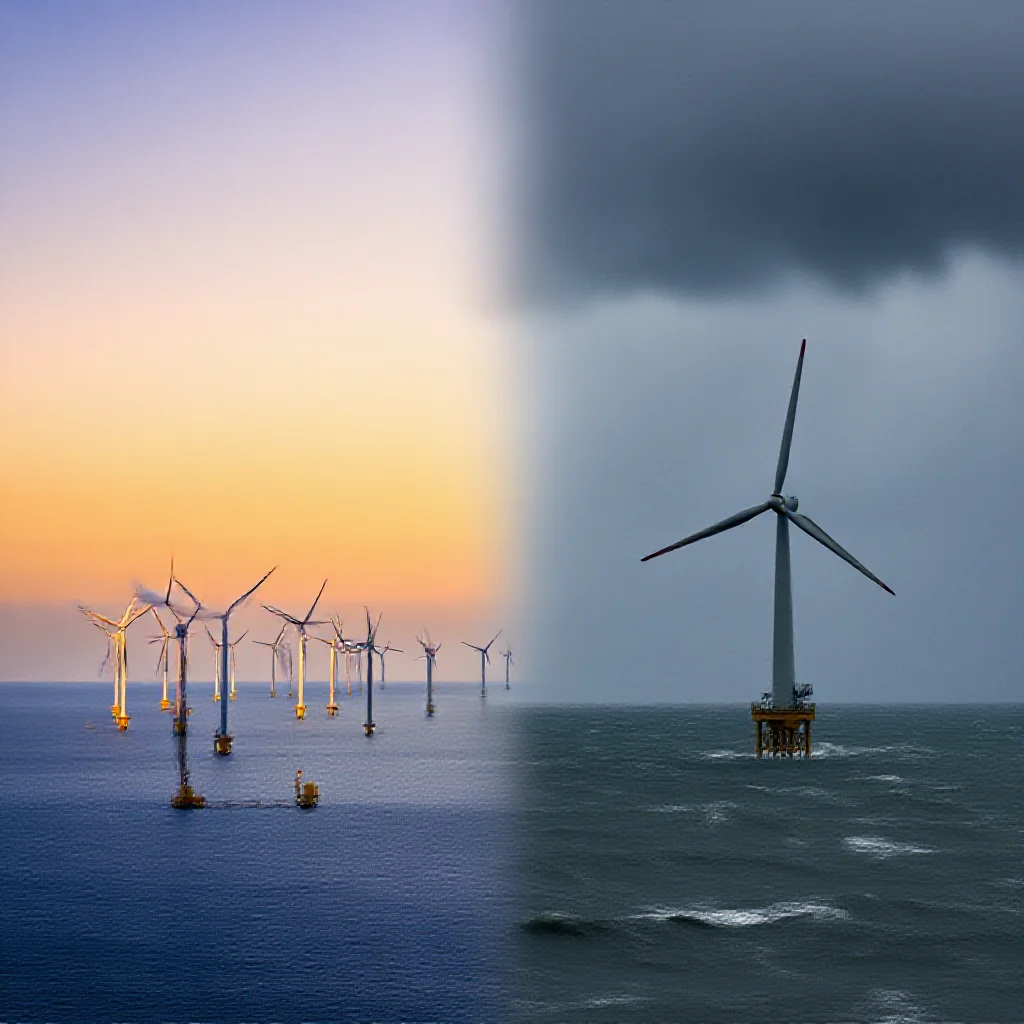
The Great Offshore Wind Divide: Global Boom Meets American Bust
Introduction: A Tale of Two Markets The global offshore wind industry reached a significant milestone in 2023, adding 11 gigawatts (GW) of new capacity to the world’s electrical grids (Source 1: [Primary Data]). This growth was led by China, which installed 6.3 GW, alongside substantial commitments from the United Kingdom (3.7 GW contracted), Taiwan (5.5 GW approved), and Germany (8.8 GW planned for tender in 2024) (Source 2: [Primary Data]). Concurrently, Japan enacted legislation to accelerate its own offshore wind development. This expansion stands in stark contrast to developments in the United States. Within the same year, over 12 GW of planned U.S. offshore wind capacity entered cancellation or contract renegotiation, representing a severe market contraction (Source 3: [Primary Data]). This divergence presents a central analytical question: why is a nation with vast offshore wind potential experiencing systemic failure while global deployment accelerates?
The Global Acceleration Track: Policy Certainty Fuels Expansion The momentum in Europe and Asia-Pacific is not serendipitous but is engineered through a target-driven policy model. Governments establish long-term capacity goals and implement regulatory frameworks to achieve them. The UK’s contract awards and Germany’s scheduled tenders provide a predictable pipeline for investment. Taiwan’s approval process and Japan’s new promotional law serve a similar function: de-risking projects for developers and financiers. This policy certainty is the critical catalyst for building the necessary industrial ecosystem, including manufacturing, port infrastructure, and specialized installation vessels.
China’s role is dual-faceted. It is the dominant market, accounting for over half of the global capacity installed in 2023 (Source 4: [Derived from Primary Data]). It also functions as the global manufacturing engine for turbine components, exerting significant influence on global supply chain dynamics and costs. The established markets operate on a foundational principle: long-term government commitments absorb a portion of macro-level risk, enabling private capital to finance and build projects at scale.
The American Quagmire: The Perfect Storm of Cost and Contract The U.S. market disruption is characterized by specific, high-profile project failures. Danish developer Ørsted canceled its Ocean Wind 1 and 2 projects off New Jersey, recording a $4 billion impairment charge (Source 5: [Primary Data]). Avangrid paid $64 million to terminate its power purchase agreement (PPA) for the Commonwealth Wind project in Massachusetts (Source 6: [Primary Data]). Furthermore, New York state regulators denied petitions from developers of four projects seeking adjustments to existing offtake contracts (Source 7: [Primary Data]).
The core failure mechanism is identifiable. Projects were secured years in advance through fixed-price PPAs with state utilities. These contracts locked in revenue streams before the macroeconomic shocks of post-pandemic inflation, which drastically increased costs for critical materials like steel, specialized installation vessels, and financing. The regulatory response, particularly in the Northeast, was rigidity. State authorities refused to adjust contracts, effectively transferring 100% of the unforeseen macroeconomic risk onto the developers. This rendered the projects unfinanceable, as projected costs irrevocably exceeded locked-in revenues.
Deep Audit: Beyond Headlines, a Systemic Supply Chain Failure The project cancellations are symptomatic of a more profound, systemic deficiency: the absence of a dedicated domestic offshore wind supply chain and installation fleet. The U.S. market relies on a congested global supply chain, competing for limited specialized installation vessels and components from European and Asian factories. This results in escalated costs, scheduling uncertainty, and logistical complexity.
In contrast, Europe’s established industry is supported by a network of purpose-built ports, cable factories, and a fleet of installation and service vessels. The U.S. Department of Energy’s roadmap, which outlines a path to 110 GW of offshore wind by 2050, is contingent upon the simultaneous creation of this industrial base (Source 8: [Primary Data]). Without coordinated, massive public and private investment in ports, manufacturing, and maritime logistics, the numerical target remains a theoretical exercise. The federal government’s activity, including the first Gulf of Mexico lease sale and plans for up to four additional sales by 2025, addresses only the initial site acquisition phase, not the subsequent industrial build-out required for construction (Source 9: [Primary Data]).