The Great Rebalancing: How Political Headwinds and Technology Tailwinds Reshaped Global Renewable Energy Investment in 1H 2025
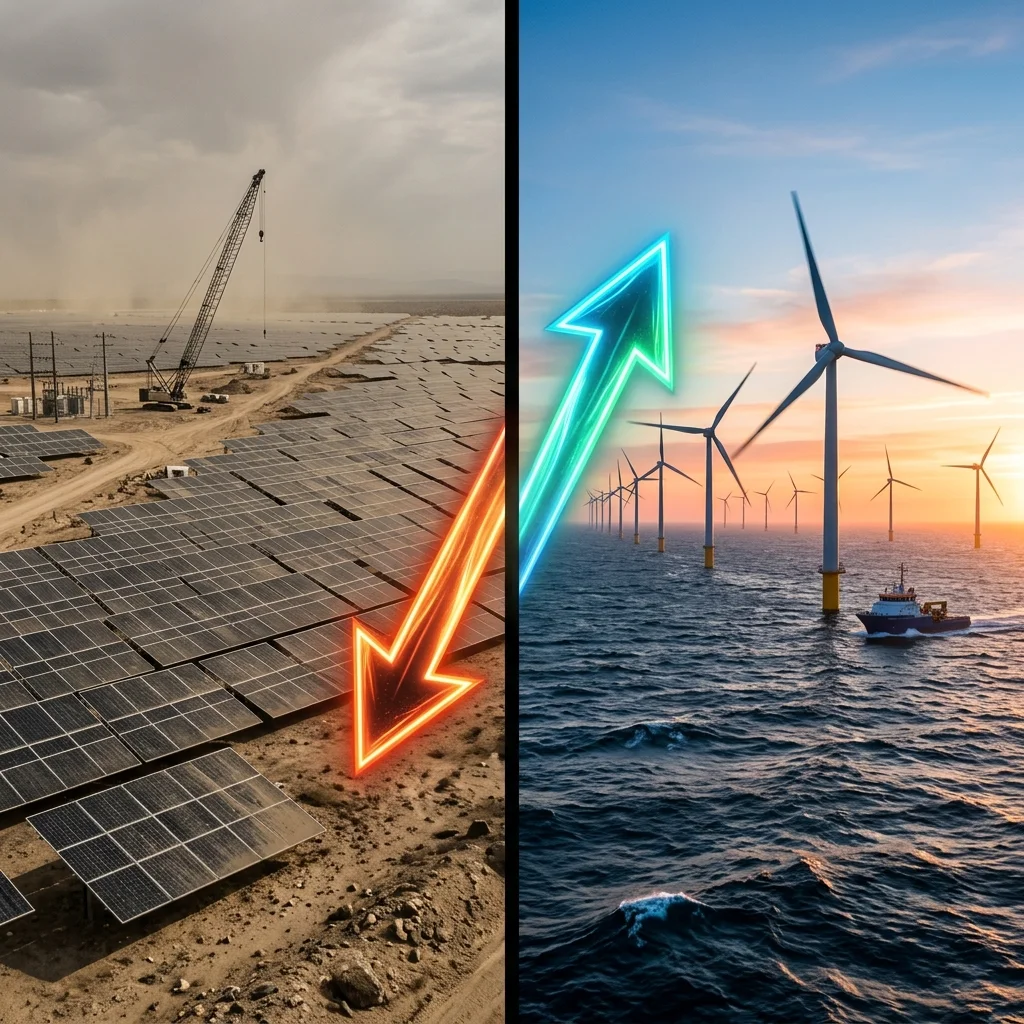
Global renewable energy investment hit a record $386 billion in the first half of 2025, up 10% year-on-year, according to BloombergNEF. But beneath the headline growth, a dramatic geographic, technological, and structural rebalancing is underway—one that challenges the conventional story of unstoppable solar dominance. While the US saw a stunning 36% crash in investment (partly due to policy uncertainty) and utility-scale solar asset finance fell 13%, offshore wind exploded, exceeding its entire 2024 total in just six months. Meanwhile, the EU-27 surged 63% as supportive revenue mechanisms took hold, and China’s small-scale solar nearly doubled. This article digs into the market logic behind these shifts, asking: is the world moving from a one-size-fits-all renewables model toward a multi-speed, risk-adjusted portfolio approach?
The Great Rebalancing: How Political Headwinds and Technology Tailwinds Reshaped Global Renewable Energy Investment in 1H 2025
**By a Senior Technical/Financial Audit Journalist**
---
The $386 Billion Paradox: Record Investment, Deepening Structural Fragmentation
Global renewable energy investment reached a record $386 billion in the first half of 2025, representing a 10% year-on-year increase (Source 1: BloombergNEF, 2H 2025 Renewable Energy Investment Tracker, August 26, 2025). This headline figure signals continued capital commitment to the energy transition. However, the composition beneath this aggregate growth reveals a market undergoing profound structural realignment.
The most striking divergence concerns asset finance for utility-scale solar and onshore wind. This category fell 13% compared to 1H 2024, declining to its lowest share of total renewable investment since 2006 (Source 1: BloombergNEF). Utility-scale solar photovoltaic investment alone dropped 19% year-on-year. The paradox is therefore explicit: total capital flows are at an all-time high, but the traditional workhorses of renewable deployment—large-scale solar farms and wind installations—are experiencing relative capital withdrawal.
Meredith Annex, Head of Clean Power at BloombergNEF, provided the interpretive framework: "Renewable energy investors and developers are rethinking capital allocation and putting their money where project returns are strongest" (Source 1: BloombergNEF). This statement functions as the analytical key to understanding the market logic driving the 1H 2025 results. Investors are not exiting renewables; they are re-routing capital away from segments perceived as commoditized, margin-compressed, or policy-exposed, toward assets offering superior risk-adjusted returns.
The declining share of utility-scale solar and wind asset finance represents a structural shift, not a cyclical dip. Since 2006, these technologies formed the backbone of renewable energy deployment. Their relative retreat suggests that the industry has entered a phase where capital allocation decisions are increasingly differentiated by technology type, geography, and revenue mechanism design.
---
Offshore Wind’s Breakout Year: Why $39 Billion in Six Months Changes the Calculus
Offshore wind attracted $39 billion in new investment during 1H 2025, surpassing the full-year 2024 total of $31 billion (Source 1: BloombergNEF). This 26% outperformance of the previous annual record within six months constitutes a breakout moment for the technology class.
The underlying logic is rooted in asset profile preferences. Offshore wind projects require extended development lead times and substantial upfront capital expenditure, but they secure long-term revenue certainty through contracts for difference (CfDs) or equivalent mechanisms. In an environment where utility-scale solar margins have compressed due to panel oversupply and declining capture prices, institutional capital—pension funds, infrastructure equity, and insurance companies—has rotated toward assets offering contracted, inflation-protected cash flows over 20- to 30-year horizons.
The EU-27 investment surge of 63% between 2H 2024 and 1H 2025 provides the enabling context (Source 1: BloombergNEF). Markets with supportive revenue mechanisms have directly channeled capital into offshore wind. The European Union's REPowerEU framework, combined with national CfD auctions in the United Kingdom, Germany, the Netherlands, and Denmark, created a pipeline of bankable projects. These mechanisms effectively de-risk offshore wind by guaranteeing minimum revenue floors, thereby aligning project returns with institutional investor return requirements.
China’s market dynamics further illustrate this structural shift. Utility-scale solar installations in mainland China fell 28% in 1H 2025, even as small-scale solar investment nearly doubled year-on-year (Source 1: BloombergNEF). The divergence indicates a market pivot away from large centralized infrastructure toward distributed generation. Small-scale solar offers faster deployment cycles, lower capital concentration risk, and direct consumer engagement—characteristics that appeal to different capital sources than those funding gigawatt-scale offshore wind farms.
Offshore wind’s breakout is not merely a growth story; it signals a reclassification of risk preferences. The asset class has transitioned from experimental technology to core infrastructure, attracting capital that previously favored gas-fired power or transmission assets. This repositioning carries implications for portfolio construction across the entire energy investment spectrum.
---
The US Setback and the EU Catch-Up: Policy Risk vs. Regulatory Certainty
The most dramatic geographic divergence in 1H 2025 occurred between the United States and the European Union. US new renewable energy investment fell by $20.5 billion, a 36% decline from 2H 2024 levels (Source 1: BloombergNEF). In contrast, EU-27 investment increased by nearly $30 billion, a 63% rise over the same period (Source 1: BloombergNEF).
This bifurcation demands causal analysis. The US decline coincides with implementation uncertainty surrounding the Inflation Reduction Act (IRA). While the IRA created expansive tax credit frameworks for renewable energy, the practical application of guidance on prevailing wage requirements, apprenticeship standards, and domestic content bonuses introduced regulatory complexity. Transmission interconnection queues expanded to multi-year delays, directly impeding utility-scale solar project financial close. Political signals regarding potential modification or repeal of IRA provisions—including debates in the 2024 election cycle—further eroded investor confidence in long-term policy stability.
Meredith Annex addressed this directly: "Markets with supportive revenue mechanisms have maintained momentum on renewable energy investment" (Source 1: BloombergNEF). The EU-27, through its CfD frameworks and national auction systems, provided the regulatory certainty that the US lacked. European developers could model project returns with confidence in revenue floors; US developers faced uncertainty about tax credit applicability, interconnection timelines, and future policy direction.
The US decline is concentrated in utility-scale solar, where asset finance fell most sharply. This is consistent with the technology-specific analysis: large-scale solar projects are highly sensitive to policy signals because their economics depend on tax equity structures and power purchase agreement (PPA) pricing. When policy visibility deteriorates, developers delay final investment decisions, capital remains on the sidelines, and project pipelines slow.
Southeast Asia, by contrast, recorded a 7% investment increase from 2H 2024 (Source 1: BloombergNEF), demonstrating that growth is not exclusive to Europe but occurs in markets with stable regulatory frameworks and growing electricity demand.
Mainland China maintained its dominant position with a 44% share of global new investment in 1H 2025 (Source 1: BloombergNEF). This concentration carries implications for supply chain resilience and technology pricing, as Chinese manufacturing capacity continues to set global benchmarks for solar modules, wind turbines, and battery storage.
---
Technology Portfolio Rebalancing: Distributed Generation, Long-Duration Assets, and the Future of Utility-Scale
Three structural trends define the rebalancing underway:
**First, the rise of distributed generation.** Small-scale solar investment in China nearly doubled year-on-year (Source 1: BloombergNEF), and similar patterns emerge across Europe and parts of Asia. Rooftop solar, commercial installations, and community solar projects offer lower capital commitment per project, faster deployment, and direct exposure to retail electricity prices. These characteristics attract different capital sources—retail investors, green banks, and municipal utilities—than those financing utility-scale assets.
**Second, the ascendancy of long-duration, contracted assets.** Offshore wind’s $39 billion in 1H 2025 demonstrates institutional preference for megaprojects with guaranteed revenue streams. This trend suggests that capital will increasingly flow to technologies offering contracted returns rather than merchant exposure. Floating offshore wind, tidal energy, and long-duration energy storage may benefit from similar capital rotation as they develop CfD mechanisms.
**Third, the marginalization of unsubsidized, merchant-exposed utility-scale solar.** The 19% decline in utility-scale solar investment (Source 1: BloombergNEF) reflects market saturation in regions with high solar penetration, where midday electricity prices have collapsed. Without storage integration or fixed-price contracts, utility-scale solar projects face diminishing economic viability. This segment will likely require structural innovation—hybridization with storage, corporate PPAs with floor prices, or capacity payment mechanisms—to regain investor confidence.
The global market is transitioning from a one-size-fits-all model, where any renewable technology attracted capital based on declining costs, to a multi-speed, risk-adjusted portfolio approach. Capital allocation now differentiates between technology types, geographies, revenue mechanisms, and project scales.
---
Market Predictions: Toward a Differentiated Capital Allocation Regime
The data from 1H 2025 supports several projections for the remainder of 2025 and into 2026:
**Offshore wind will sustain momentum.** The pipeline of awarded CfDs in Europe, combined with policy support in the US (if IRA implementation clarifies) and Asia-Pacific markets (Japan, South Korea, Vietnam), suggests full-year 2025 offshore wind investment could exceed $70 billion. Continued institutional capital rotation into long-duration infrastructure assets supports this trajectory.
**Utility-scale solar will recover selectively.** Markets with effective revenue mechanisms—CfDs in Europe, feed-in tariffs in Southeast Asia, and corporate PPA markets in the US (if policy stabilizes)—will see capital return. Merchant-exposed solar in regions with high penetration and negative pricing events will remain challenged.
**The US will require policy resolution.** If IRA implementation guidance achieves clarity and transmission reform advances, a rebound in 2026 is plausible. Continued uncertainty will depress investment further, potentially accelerating manufacturing and project relocation to Europe and Asia.
**China’s distributed generation surge will reshape global solar markets.** Small-scale solar deployment at near-doubling growth rates will increase demand for residential and commercial inverters, battery systems, and smart energy management platforms, altering supply chain dynamics beyond the utility-scale segment.
**Technology convergence will accelerate.** Hybrid projects combining solar, wind, storage, and green hydrogen production will gain share as investors seek diversified revenue streams within single project structures. These projects offer risk mitigation through technology and market diversification.
---
The great rebalancing of 1H 2025 reveals a renewable energy investment landscape that is simultaneously record-breaking and fragmenting. Capital is abundant, but its deployment is increasingly discriminating. Markets with policy certainty, revenue mechanisms, and infrastructure readiness attract investment; those without, do not. Technology preferences are shifting from scale to stability, from volume to value.
The $386 billion record is not the story. The story lies in where that money went, where it did not, and what those choices reveal about the future structure of global renewable energy finance.