Climate Technology Trends in 2024: AI, Storage, Carbon Capture, and the Economics of Decarbonization
This article examines climate technology trends in 2024 and beyond through the lens of market adoption, supply-chain constraints, and policy pressure. It covers AI-driven climate optimization, battery innovation, renewable energy scaling, green hydrogen, perovskite solar cells, larger offshore wind turbines, and carbon capture technologies. The core argument is that climate tech is no longer only a science story: it is an industrial restructuring story shaped by regulation, economics, and technology transfer. Verification points are embedded early for publication context and later for company/product claims such as Vaayu’s AI systems and its Carbonfact connection.
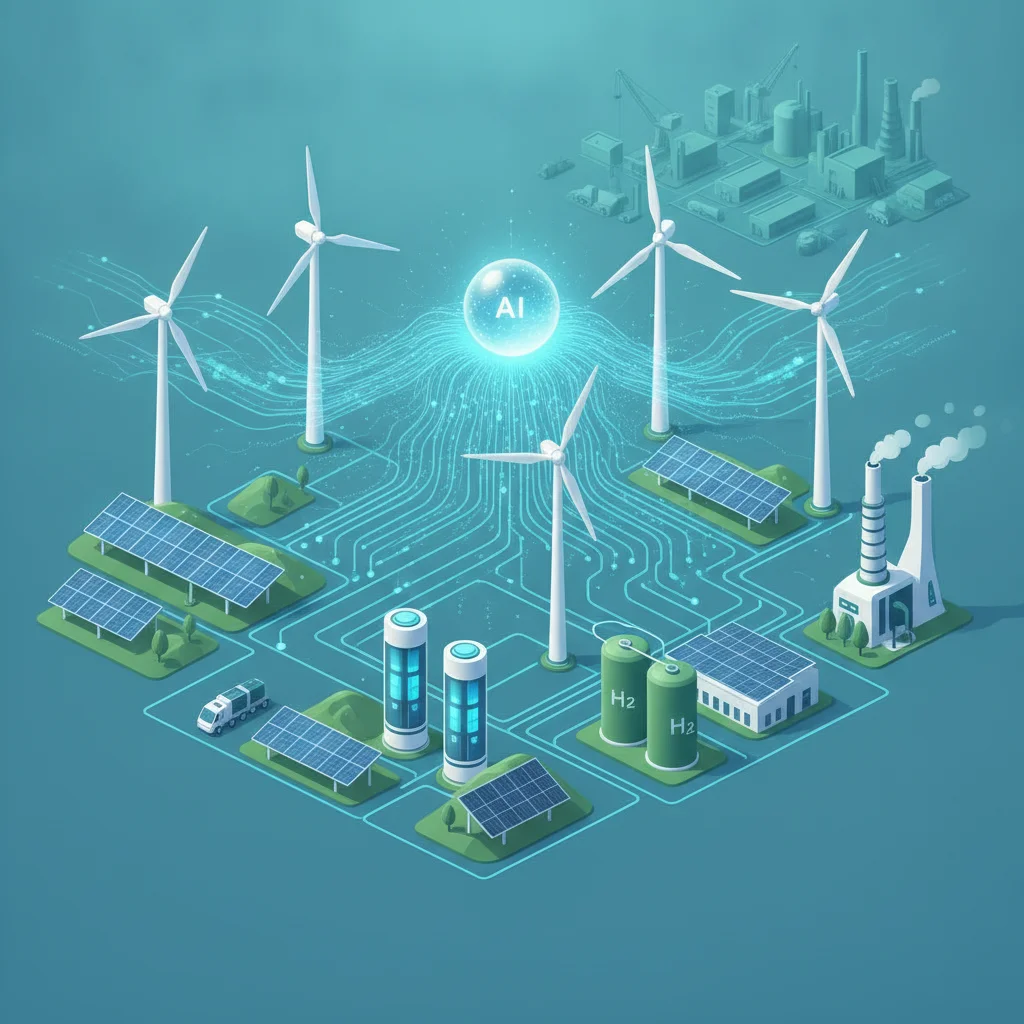
Climate Technology Trends in 2024: AI, Storage, Carbon Capture, and the Economics of Decarbonization
[IMAGE: A modern editorial illustration of a clean energy ecosystem, with AI data streams flowing into wind turbines, solar panels, battery storage units, green hydrogen tanks, and carbon capture facilities, plus subtle industrial supply-chain elements in the background.]
Climate technology in 2024 is no longer best understood as a standalone innovation story. It is increasingly an industrial economics story shaped by regulation, financing, supply chains, and the pace at which new tools can move from pilots into large-scale operations. The most important climate technology trends are not just about what can be invented, but about what can be deployed at cost, at speed, and across complex sectors such as power, manufacturing, transport, and logistics.
That shift matters because decarbonization has entered a phase where adoption gaps are as important as technical breakthroughs. A promising battery chemistry, a more efficient solar cell, or a better carbon capture process is only part of the equation. The other part is whether the technology can survive procurement cycles, grid constraints, policy changes, and manufacturing bottlenecks.
Climate tech as an industrial economics story
The real axis of climate technology trends is the interaction of three forces: lower-cost hardware, policy support, and scalable software. When those three align, adoption accelerates. When one is missing, deployment slows even if the underlying science is sound.
This is why climate tech now looks less like a pure R&D category and more like a restructuring of industrial systems. Utilities need to balance intermittent renewable energy. Manufacturers need to cut process emissions without undermining margins. Logistics firms need to measure and reduce emissions across fragmented supply chains. Each of these problems has a technical component, but each also has a cost and operational component.
[IMAGE: A clean infographic-style scene showing regulation, economics, and technology arrows converging toward a decarbonized industrial hub.]
In that sense, the most important question is not whether a technology works in the lab. It is whether it can cross the adoption gap. Can it be financed? Can it be installed at scale? Can it be measured? Can it be integrated into existing industrial workflows? Those questions define the market in 2024 and beyond.
Fast context, slow analysis
This article is best read as slow analysis, because the trends it covers are durable rather than fleeting. It evaluates supply-chain constraints, policy pressure, and technology-transfer barriers that will remain relevant beyond a single news cycle. Still, a fast verification layer is useful at the start: the reference article was published on May 22, 2024, written by Jen Latimer, and reviewed by Namrata Sandhu.
That matters because climate technology coverage often mixes immediate developments with structural trends. The timing is important, but the deeper value comes from identifying what will still matter in 2025 and beyond. The trends below are not just snapshots. They are signals of how decarbonization is becoming industrialized.
[IMAGE: A split-screen concept showing a calendar and news ticker on one side, and a long-term industrial roadmap on the other.]
AI is becoming climate infrastructure
Artificial intelligence is increasingly embedded in climate operations, not just used as an analysis layer. In practice, AI is being used for weather pattern prediction, grid optimization, waste management, and emissions tracking. That expansion reflects a basic reality: climate systems are full of uncertainty, and uncertainty is expensive.
Power grids need to manage variability from solar and wind. Logistics networks need to anticipate demand and reduce wasted miles. Manufacturers need more accurate emissions data to meet reporting rules and internal targets. AI helps in each case by improving forecasting, automating routine decisions, and reducing the cost of measurement.
This is where AI climate tech becomes strategically important. The value is not simply that AI is “smart.” It is that AI can reduce friction in systems where timing, accuracy, and coordination matter. In climate markets, those systems are everywhere.
Companies building software in this area are increasingly positioning AI as operational infrastructure. Instead of treating emissions tracking as a reporting exercise, they are linking it to purchasing, product design, and process improvement. The result is a shift from static carbon accounting toward active climate optimization.
Verification checkpoint: Vaayu, Kria, and climate software consolidation
One example often cited in this category is Vaayu, a climate software company that uses AI to support emissions calculations, code improvement, automation, and impact modeling. Its system, Kria, is described as part of that workflow, supported by a database used for operational analysis and climate impact measurement.
[IMAGE: A documentation-style screen with software architecture diagrams, emissions data tables, and workflow nodes connecting product data to carbon calculations.]
A factual checkpoint is important here: Vaayu’s data science team was recognized by Fast Company’s Most Innovative Companies 2024 in the Data Science category. That recognition helps illustrate how climate software is increasingly tied to advanced data systems rather than only environmental branding.
Another meaningful update is that Vaayu is now part of Carbonfact. This signals a broader pattern in climate software: consolidation. As measurement, reporting, and product-level emissions workflows mature, companies are combining capabilities to serve enterprise buyers that want fewer vendors and more integrated platforms.
The implication is larger than one company. Climate software is moving toward a model in which AI, data infrastructure, and sustainability reporting converge. That makes the sector more durable, but also more competitive.
Battery storage: the quiet enabler of renewable energy
Battery storage remains one of the most consequential climate technology trends because it solves a practical problem: renewables are variable, but electricity demand is not. As solar and wind scale, storage becomes essential for balancing supply and demand across minutes, hours, and increasingly longer time frames.
The storage market is being shaped by several forces at once. Lithium-ion systems remain central, but the industry is also pushing into new chemistries, better thermal management, improved recycling, and alternative designs aimed at lowering cost and reducing dependence on constrained materials.
The core economic question is simple: can storage be delivered cheaply enough to reduce curtailment, stabilize grids, and support electrification? In many markets, the answer is increasingly yes, but not uniformly. Supply-chain concentration, mineral sourcing, and manufacturing capacity still influence deployment speed.
[IMAGE: A battery storage facility beside a solar farm, with layered data overlays showing charge cycles, grid balancing, and price signals.]
Storage also matters because it expands the range of viable decarbonization strategies. It helps utilities integrate more renewable energy. It supports industrial electrification. It can reduce the need for fossil-based peaker plants. In climate economics, storage is often the difference between a theoretical pathway and a workable one.
Renewable energy scaling is now a systems problem
Renewable energy is no longer only about generation capacity. It is about permitting, transmission, interconnection, land use, supply chains, and financing. Solar and wind continue to scale, but the pace of deployment is increasingly determined by infrastructure and regulatory realities.
This is why the focus has shifted from simply installing more capacity to building systems that can absorb it. Transmission lines are needed to move electricity from resource-rich regions to demand centers. Grid upgrades are needed to handle fluctuating output. Permitting reform can be as important as panel efficiency.
Large-scale renewable deployment is therefore an industrial coordination challenge. The technologies themselves are mature enough to be competitive in many markets, but the supporting ecosystem often is not. That mismatch creates delays and raises costs.
The broader lesson is that decarbonization is not linear. A country can add gigawatts of renewable capacity while still facing bottlenecks in transmission, storage, and distribution. Climate technology trends in 2024 reflect that tension: generation is growing faster than the systems built to support it.
Green hydrogen: promising, but still constrained by economics
Green hydrogen remains a major climate technology category, but it is also one of the clearest examples of the gap between ambition and cost. Produced using renewable electricity, green hydrogen has potential in sectors that are difficult to electrify directly, including heavy industry, shipping, and some chemical processes.
Yet the economics remain challenging. Hydrogen production is energy-intensive. It depends on low-cost clean power, electrolyzers, infrastructure, and end-user demand. If any one of those components is missing, the business case weakens.
That does not make the sector irrelevant. It means the market is still moving through a classic scaling phase. Governments are supporting pilot projects and industrial clusters. Companies are testing use cases where hydrogen can substitute for fossil fuels. But broad adoption will depend on whether costs fall and supply chains mature.
For now, green hydrogen should be viewed less as an immediate mass-market solution and more as a strategic option for hard-to-abate sectors. Its relevance in climate technology trends comes from its role in industrial decarbonization, not from near-term ubiquity.
Perovskite solar cells and the race for higher efficiency
Perovskite solar cells remain one of the most closely watched innovations in renewable energy because they offer the possibility of higher efficiency and lower production cost than some conventional designs. They are especially interesting as part of tandem cell structures, where perovskites are paired with silicon to improve performance.
But the challenge is durability. Laboratory results can be impressive, yet commercial deployment requires long-term stability, manufacturing consistency, and protection against degradation. That gap between performance and reliability is a recurring theme in climate tech.
If perovskites can clear the durability hurdle, they could reshape solar economics by improving power output per square meter and reducing cost per watt. If not, they may remain an important but limited technology. Either way, they are a useful example of how climate innovation now depends on both materials science and industrialization.
[IMAGE: A close-up editorial image of tandem solar cells with layered crystal structures and a faint factory background.]
Offshore wind: bigger turbines, bigger stakes
Offshore wind is entering a new phase defined by larger turbines, deeper water installations, and more complex project economics. Bigger turbines can capture more energy per unit, which improves project efficiency. But they also require more sophisticated manufacturing, transport, installation, and maintenance systems.
This is where supply-chain constraints become visible. Specialized vessels, port infrastructure, and component manufacturing all influence whether offshore wind projects can proceed on time and on budget. When those constraints tighten, costs rise and schedules slip.
Despite those challenges, offshore wind remains strategically important because of its scale potential. Coastal regions with strong wind resources can generate large amounts of electricity close to population centers. That makes offshore wind a critical piece of the renewable energy scaling puzzle.
The economics of offshore wind now depend not only on turbine performance, but on industrial coordination. The larger the machines become, the more the project resembles a logistics and infrastructure exercise.
Carbon capture: from concept to deployment pathway
Carbon capture continues to draw attention because it addresses emissions that are difficult to eliminate through electrification alone. That includes cement, steel, chemicals, and other industrial processes. It also plays a potential role in carbon removal pathways, depending on the technology and storage method involved.
The central debate is not whether carbon capture can work in principle. It can. The real question is where it makes economic and operational sense. High-cost capture systems may be justified in sectors with unavoidable process emissions, but they are less compelling where cheaper alternatives exist.
Policy pressure is a major driver here. As governments tighten emissions rules, industrial firms face growing incentives to evaluate capture and storage options. At the same time, investors and regulators are demanding clearer proof of durability, measurement, and long-term storage integrity.
Carbon capture is therefore part of the larger decarbonization economics story. It is not a universal solution, but it may be a necessary one in targeted sectors. Its role will likely be defined by the cost of compliance, the availability of infrastructure, and the pace of industrial policy.
[IMAGE: A carbon capture facility with pipelines, storage tanks, and monitored emissions plumes, rendered in a realistic editorial style.]
Climate technology is becoming an implementation race
The common thread across AI, storage, renewables, hydrogen, perovskites, offshore wind, and carbon capture is that climate technology is now an implementation race. The frontier is no longer defined only by scientific novelty. It is defined by deployment capability.
That means the most valuable companies and projects will often be the ones that reduce friction. AI tools that improve emissions measurement. Battery systems that smooth grid volatility. Software platforms that connect product data to carbon accounting. Manufacturing innovations that lower cost while improving durability. Infrastructure that lets clean electricity flow where it is needed.
This is also why technology transfer matters so much. A breakthrough in one market does not automatically scale to another. Local regulations, industrial structures, financing conditions, and labor constraints all shape outcomes. Climate technology trends in 2024 reflect that reality more clearly than ever.
The biggest lesson is that decarbonization is becoming an industrial restructuring project. Science remains essential, but success increasingly depends on economics, policy, and integration. In that sense, climate tech is not just about invention. It is about building systems that can be adopted, maintained, and scaled.
What to watch next
Looking ahead, the most important signals will likely include:
- whether AI climate tech moves deeper into operational decision-making
- whether battery storage costs continue to fall across different grid applications
- whether renewable energy scaling is matched by transmission and permitting reform
- whether green hydrogen finds durable demand in hard-to-abate sectors
- whether perovskite solar cells can transition from promising research to reliable manufacturing
- whether offshore wind supply chains stabilize enough to support larger turbines
- whether carbon capture gains enough policy and industrial support to move beyond niche deployment
These are not isolated trends. They are interconnected parts of a larger transition in which climate tech becomes inseparable from industrial strategy.
For 2024, that is the most important conclusion: the climate technology market is no longer just about what is technically possible. It is about what can be built, financed, verified, and deployed at scale.