Beyond the Range Anxiety: The eRV2 on Route 66 and the Real Economics of Electric RV Travel
A planned all-electric RV journey from Chicago to Santa Monica in a 2024 Winnebago eRV2 is more than a road trip; it's a real-world stress test for a nascent industry. This analysis moves beyond simple range anxiety to examine the underlying economic and infrastructural calculus of electric RV travel. By dissecting the author's preparation—including home charger installation, meticulous route planning with PlugShare and ABRP, and energy consumption calculations of 1.1 miles/kWh—we uncover the operational realities, hidden costs, and strategic planning required. This case study reveals whether current technology and infrastructure can support the dream of emission-free, long-haul recreational travel, and what it means for the future market.
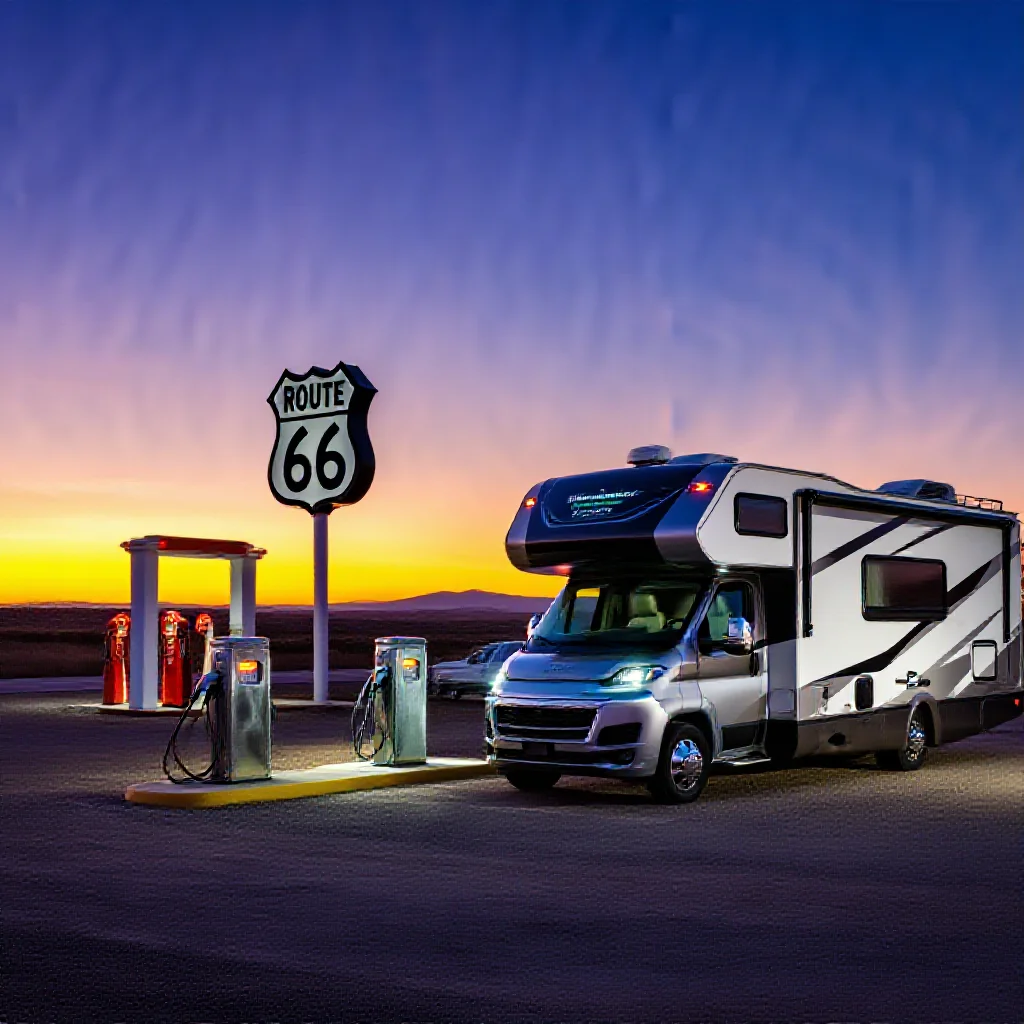
Beyond the Range Anxiety: The eRV2 on Route 66 and the Real Economics of Electric RV Travel
Introduction: The Route 66 EV Pilgrimage as a Market Litmus Test
A planned journey from Chicago to Santa Monica in a 2024 Winnebago eRV2 represents a significant operational trial for the electric recreational vehicle sector (Source 1: [Primary Data]). This undertaking transcends a personal adventure, functioning as a pioneering case study on the viability of long-haul, zero-emission recreational travel. The core analytical question is whether current electric RV technology constitutes a viable product for mainstream consumers or remains a proof-of-concept limited to early adopters. The choice of Route 66, America's most iconic highway, provides a symbolic and practical testbed, challenging nascent technology against a backdrop of historic automotive freedom.

The Hardware Reality: Decoding the Winnebago eRV2's Spec Sheet
The operational parameters of the test vehicle define the constraints of the experiment. The Winnebago eRV2 is built on a 42 kWh usable battery pack and carries a gross vehicle weight rating (GVWR) of 9,000 pounds (Source 1: [Primary Data]). This power-to-weight ratio is the primary determinant of range. With a calculated energy consumption rate of approximately 1.1 miles per kWh, the theoretical range per full charge is roughly 46 miles (Source 1: [Primary Data]). This consumption metric, when contrasted with a passenger electric vehicle's typical 3-4 mi/kWh, establishes a distinct performance baseline. The analysis indicates that electric RV travel is not an extension of passenger EV logic but a new category defined by high energy demand per mile. The utility baseline shifts from absolute distance to strategic energy management.

The Invisible Infrastructure: The Pre-Trip Investment and Planning Burden
The preparatory phase reveals significant hidden costs and infrastructural dependencies. The installation of a 48-amp home charger represents a non-trivial upfront investment, encompassing hardware and potential electrical panel upgrades (Source 1: [Primary Data]). This requirement acts as a financial and logistical barrier to entry, preceding any travel. Furthermore, the journey's feasibility is contingent upon meticulous planning using third-party applications like PlugShare and A Better Routeplanner (ABRP) (Source 1: [Primary Data]). This app-dependent planning model reveals a lack of seamless, integrated public infrastructure capable of intuitively supporting large-format EVs. Mapping a viable charging corridor along Route 66 requires identifying stations not only with compatible connectors but also with physical layouts that can accommodate a vehicle of this size, highlighting potential geographic and capability gaps in the current network.

The Operational Calculus: Energy Management as the New Campground Reservation
The trip execution shifts the narrative from generalized "range anxiety" to precise "energy budgeting." Each leg of the journey, such as the initial segment from Chicago to Springfield, Illinois, must be pre-calculated as a function of available kWh versus required kWh (Source 1: [Primary Data]). Trip planning evolves into a constant calculation of energy reserves, overshadowing traditional considerations. The time-cost of charging becomes a critical economic variable. Given the battery capacity and typical DC fast-charging rates, a significant portion of a multi-day itinerary will be spent stationary. The economic value of this lost travel or leisure time must be factored into the total cost of the journey. Secondary cost structures also emerge, including the potential for premium pricing per kWh for large-battery vehicles at public stations and the necessity of booking campgrounds with high-power electrical hookups, which may command higher fees.
Conclusion: Viability, Scalability, and the Future Market Trajectory
The Route 66 case study demonstrates that technically feasible does not equate to broadly viable. The 2024 Winnebago eRV2, as a first-generation product, serves a specific market segment: the technically adept early adopter willing to exchange planning burden for the benefit of emission-free travel. The current economic calculus includes high upfront costs, significant time investment in charging, and a reliance on a still-maturing public infrastructure. For the electric RV market to scale, several trends must converge: substantial improvements in battery energy density, a rapid expansion of high-power charging networks designed for large vehicles, and a reduction in both vehicle and home-infrastructure costs. The success of this and similar real-world tests will provide critical data to manufacturers and infrastructure developers, informing the next generation of products that may eventually achieve mainstream recreational utility.