Beyond Survival: How Fossil Fuels Built Our World and Why Renewables Must Redefine It
This analysis moves beyond the climate debate to examine energy through a psychological lens. It posits that fossil fuels historically acted as humanity's tool for fulfilling basic physiological and safety needs—the foundation of Maslow's hierarchy—by powering industrialization, agriculture, and global security. Now, the energy transition represents a societal shift up the pyramid. Renewable energy is not merely a substitute; it is positioned to meet higher-level needs for esteem (energy sovereignty, ethical consumption) and self-actualization (sustainable legacy, harmonizing with the environment). The article explores the profound implications of this shift for economic logic, geopolitical power structures, and the very definition of 'progress' in the 21st century.
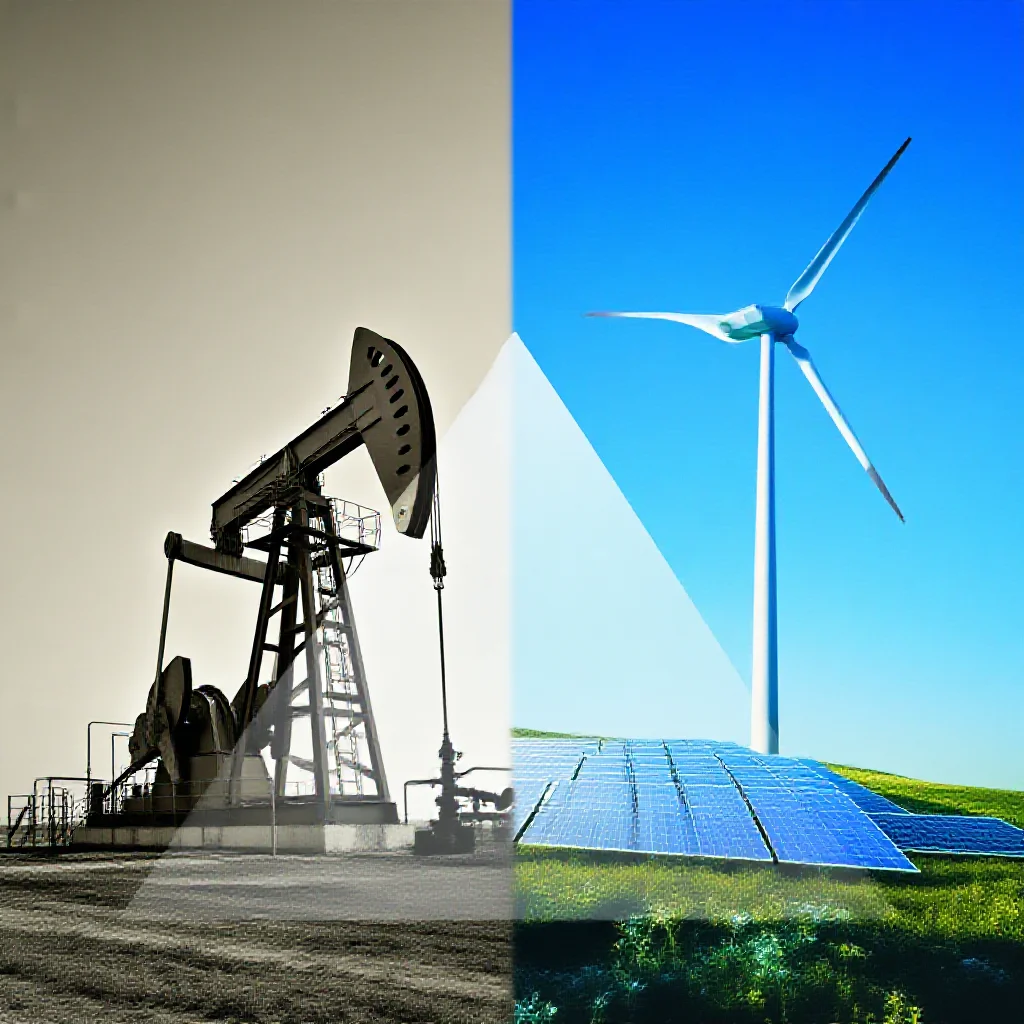
Beyond Survival: How Fossil Fuels Built Our World and Why Renewables Must Redefine It
**Published:** April 8, 2026
Introduction: Reframing the Energy Debate with Psychology
The dominant discourse on energy transition is frequently confined to a binary framework of cost competitiveness and carbon accounting. This analysis proposes an alternative lens: the application of Abraham Maslow's psychological hierarchy of needs to humanity's relationship with energy. The theory, which posits that human motivation progresses from basic physiological requirements to higher psychological aspirations, provides a structural metaphor for societal development. The central thesis is that energy sources have not merely powered economies but have evolved in direct correlation with collective human needs. Fossil fuels served as the foundational tool for addressing base-level survival and security. The current shift to renewable energy represents a societal ascent to fulfilling needs for esteem and self-actualization.

The Foundational Fuel: Fossil Fuels as Humanity's Physiological Base
Coal, oil, and natural gas functioned as the primary catalysts for meeting humanity's most fundamental physiological needs. The Haber-Bosch process, powered by fossil fuels, fixed atmospheric nitrogen into ammonia, enabling synthetic fertilizer production and a dramatic increase in global food supply. Mechanized agriculture, construction, heating, and large-scale water distribution systems were all predicated on dense, on-demand fossil energy. This energy density directly supported a surge in global population and economic output, with a strong historical correlation observed between fossil fuel consumption and GDP growth (Source 1: [World Bank historical data & IPCC assessments]).
The provision of "safety needs" was equally dependent. National security frameworks, from naval fleets to aerial power, were built around petroleum. Economic stability and predictable infrastructure—the bedrock of 20th-century development—relied on the controllable, dispatchable nature of fossil-fueled power grids and the global trade networks they enabled. This period established a paradigm where safety and progress were synonymous with access to concentrated hydrocarbons.

The Hidden Economic Logic: A Pyramid Built on Extraction
The economic model that emerged mirrored a "scarcity mindset" appropriate for foundational needs. It was intrinsically extractive, based on locating, controlling, and depleting finite geologically concentrated resources. This logic shaped global geopolitics, with power structures and supply chains organized around the control of oil fields, shipping chokepoints, and pipeline routes. The resulting system was linear—take, make, dispose—and optimized for delivering abundance from a point source.
This model created underlying systemic fragilities. Long, complex supply chains were vulnerable to disruption. Economic and political power became centralized in entities controlling the resource base. The externalized costs of this system, including environmental degradation, were consistent with a developmental phase focused on immediate security and growth over long-term equilibrium.

Ascending the Pyramid: Renewables as Tools for Esteem and Self-Actualization
Renewable energy sources, particularly solar and wind, are not direct substitutes within the old paradigm but enablers of a new one aligned with higher-level needs. They address "esteem needs" through mechanisms of energy sovereignty—the ability for communities, businesses, and nations to generate power locally—and through the social status increasingly associated with ethical, low-carbon consumption. Mastery over sophisticated, distributed energy technologies provides a form of collective esteem distinct from passive consumption.
The transition further engages the level of "self-actualization." It represents a societal attempt to align energy use with environmental values, to leave a sustainable legacy, and to achieve a state of systemic harmony where economic activity operates within ecological boundaries. The decentralized, participatory nature of renewable generation contrasts fundamentally with the centralized, hierarchical model of fossil fuels, enabling a more networked and resilient structure.

The Inevitable Friction: Redefining Progress in the 21st Century
This psychological shift generates profound friction. The economic logic must evolve from extraction to creation—valuing efficiency, circularity, and system integration over sheer volumetric throughput. Geopolitical power, historically tied to fossil resource geography, will reorient around technology supply chains, grid infrastructure, and intellectual property. The very definition of "progress" is being redefined from one of material accumulation powered by combustion to one of qualitative improvement and stability powered by regeneration.
The infrastructure and market design challenges are significant. They require moving from a system built for base-load scarcity to one managing intermittent abundance. This is not merely a technical shift but a cognitive one, demanding new frameworks for valuation, risk assessment, and security.
Conclusion: A Neutral Forecast of Systemic Evolution
The logical deduction from this framework leads to specific, neutral predictions. Energy markets will increasingly bifurcate: a commodity-based market for residual fossil fuels and essential feedstocks, and a technology-and-service-based market for integrated renewable systems. Geopolitical tensions will pivot from control of resources to control of critical minerals and grid dominance. Corporate and national strategies that interpret the transition solely as a fuel substitution will face systemic risks. Those that approach it as a re-architecture of economic and social logic, aligned with an evolved set of human needs, are positioned to define the next era. The energy transition, therefore, is less about replacing one source with another and more about the maturation of a societal system.