Beyond the Plug: How LA''s New Solar-Powered EV Chargers Signal a Shift in Grid Economics and Urban Energy Strategy
The April 2026 launch of 40 new EV chargers with integrated solar generation in Los Angeles is more than a simple infrastructure expansion. This analysis explores the project as a strategic pivot in urban energy management, moving beyond carbon reduction to address grid stability and economic resilience. We examine the hidden logic behind co-locating generation and consumption, the potential long-term impact on utility demand charges and local energy markets, and what this deployment reveals about the future convergence of transportation and distributed energy resources. This marks a critical step towards transforming EVs from a grid burden into a grid asset, reshaping the underlying economics of urban electrification.
Beyond the Plug: How LA's New Solar-Powered EV Chargers Signal a Shift in Grid Economics and Urban Energy Strategy

Introduction: The LA Launch – More Than Just 40 New Plugs
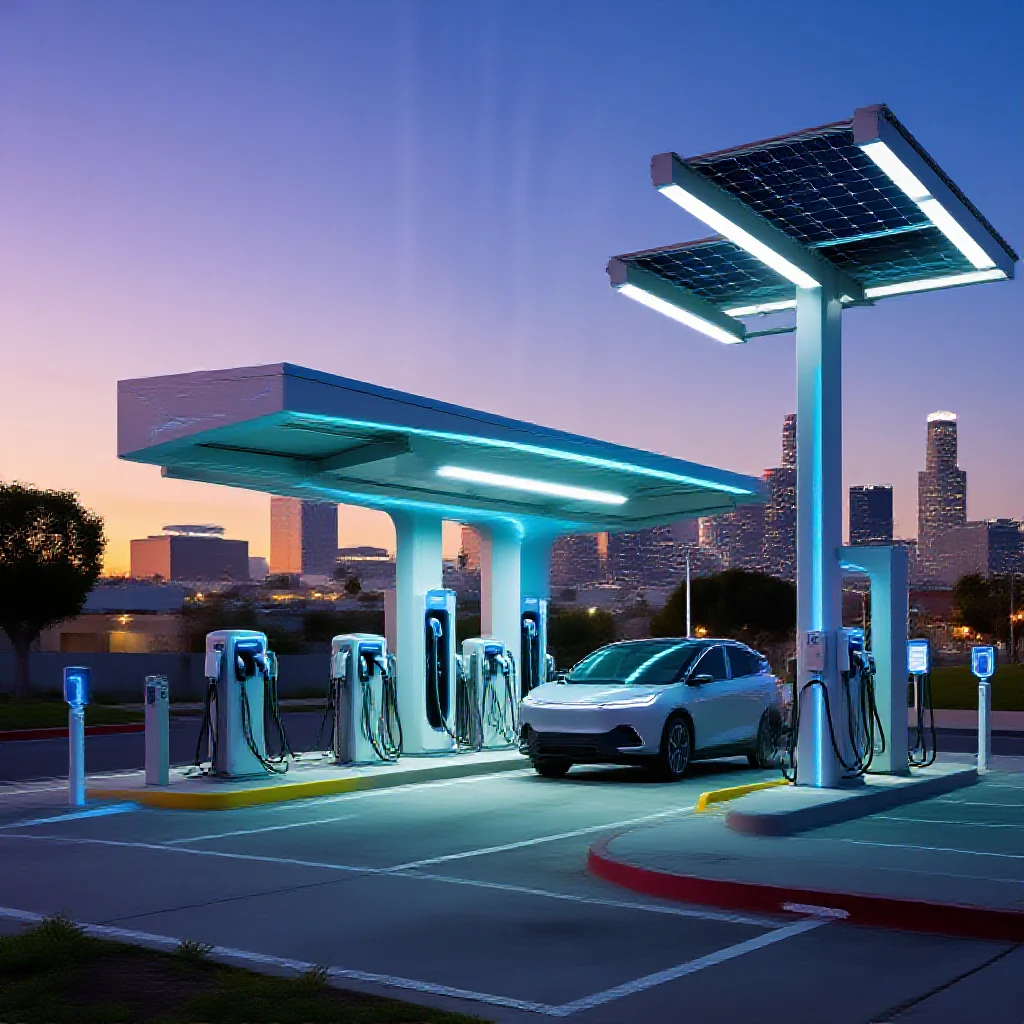
On April 9, 2026, a new electric vehicle charging site became operational in the Los Angeles area. The deployment consists of 40 new EV chargers co-located with on-site solar power generation. (Source 1: [Primary Data]) This event aligns with the city's established climate and mobility goals. The project's significance, however, extends beyond the incremental addition of charging ports. It functions as a practical test case for a nascent energy paradigm. The strategic integration of generation and consumption at the point of use represents a calculated move to preempt future grid strain and unlock more sustainable economic models for the essential infrastructure of electrified transportation.

The Hidden Economic Logic: Decoupling from Grid Demand Charges
The environmental benefit of solar-powered charging is apparent. A deeper analysis reveals a core driver rooted in financial mitigation. For commercial operators of Direct Current Fast Charging (DCFC) stations, a dominant cost component is not energy consumption, but peak demand charges levied by utilities. These charges are based on the highest rate of electricity drawn from the grid within a billing period, often triggered by multiple vehicles charging simultaneously.
The integration of on-site solar generation directly offsets these peak draws. During daylight hours, particularly those coinciding with high charging activity, solar output can reduce the site's maximum grid import. This directly lowers the demand charge, a critical factor for profitability. Studies from the National Renewable Energy Laboratory (NREL) have identified demand charges as a primary barrier to the financial viability of public DCFC networks. (Source 2: [Secondary Analysis, NREL]) The LA project model demonstrates a pathway to make the scaling of high-power charging infrastructure financially sustainable, decoupling operational costs from volatile peak grid tariffs.
From Burden to Asset: EVs and the Future of Distributed Grid Services
This deployment is a foundational step in a longer-term transition: redefining electric vehicles from a perceived grid burden to a potential grid asset. The co-location of generation and consumption establishes the physical and operational template for more advanced integration. The logical progression is toward Vehicle-to-Grid (V2G) and Vehicle-to-Building (V2B) systems, where EV batteries can discharge power back to the local grid or a building during periods of high demand or outage.
The vision entails using aggregated EV batteries—both in vehicles and in complementary stationary storage paired with solar—to provide local grid support services. This includes frequency regulation, peak shaving, and enhanced resilience. Pilot programs by Southern California Edison have explored using EVs for grid stability, while research institutions like UCLA have modeled the aggregate capacity of the regional EV fleet as a distributed energy resource. (Source 3: [Secondary Analysis, Industry Pilots & Academic Research]) This trend is already influencing supply chain priorities, placing greater emphasis on battery cycle life, durability, and the bidirectional capability of both battery management systems and charging hardware.
The Policy Architecture: Incentives, Zoning, and the Path to Scale
The viability of the LA project is not solely a function of technology. It is enabled by a specific policy architecture. California's legislative backdrop, including SB 100 mandating 100% clean electricity, creates a conducive environment. Local ordinances and funding mechanisms from entities like the California Air Resources Board (CARB) and the Los Angeles Department of Water and Power (LADWP) provide critical financial and regulatory support for such integrated projects. (Source 4: [Secondary Analysis, Policy Documentation])
A critical question for the industry is the replicability of this model outside California. The analysis identifies key barriers: zoning regulations that may not accommodate combined solar canopy and charging installations, complex utility interconnection processes for distributed generation, and the absence of comparable state-level incentives in other regions. The LA deployment serves as a blueprint, but its widespread adoption depends on the evolution of local codes, standardization of interconnection, and the recognition of distributed energy benefits by utility rate structures across different jurisdictions.
Conclusion: Blueprint for a Self-Healing Urban Energy Network
The launch of 40 solar-integrated EV chargers in Los Angeles is a discrete event with systemic implications. It demonstrates a shift in strategy from solving singular problems—charging availability or renewable generation—to designing integrated nodes within a more resilient urban energy network. The primary insight is economic: mitigating demand charges is essential for the scalable deployment of fast-charging infrastructure.
The secondary insight is operational: this model is a precursor to a future where transportation and energy systems converge. EVs, coupled with localized generation, are poised to become active participants in grid management. Market predictions indicate increased investment in bidirectional charging technology and energy management software platforms. The industry trend will move toward standardized solutions that bundle solar, storage, and charging, sold not merely as infrastructure but as grid-service assets. This project marks a tangible step toward an urban energy model that is more distributed, economically rational, and inherently resilient.