From Mali to the Midwest: The Geologic Hydrogen Rush and Its Unresolved Commercial Equation
The discovery of a naturally occurring, high-purity hydrogen well in Mali has ignited a global search for geologic hydrogen, challenging the paradigm that hydrogen must be manufactured. Recent USGS estimates suggest vast global reserves, and significant U.S. government funding is now fueling exploration. However, this article argues that the nascent industry faces a critical disconnect: while exploration is accelerating, the path to cost-effective, scalable production remains fraught with unproven extraction technologies, undefined reservoir behavior, and a lack of commercial infrastructure. The real story is not the resource''s existence, but the immense technical and economic gulf between discovery and a viable commodity market.
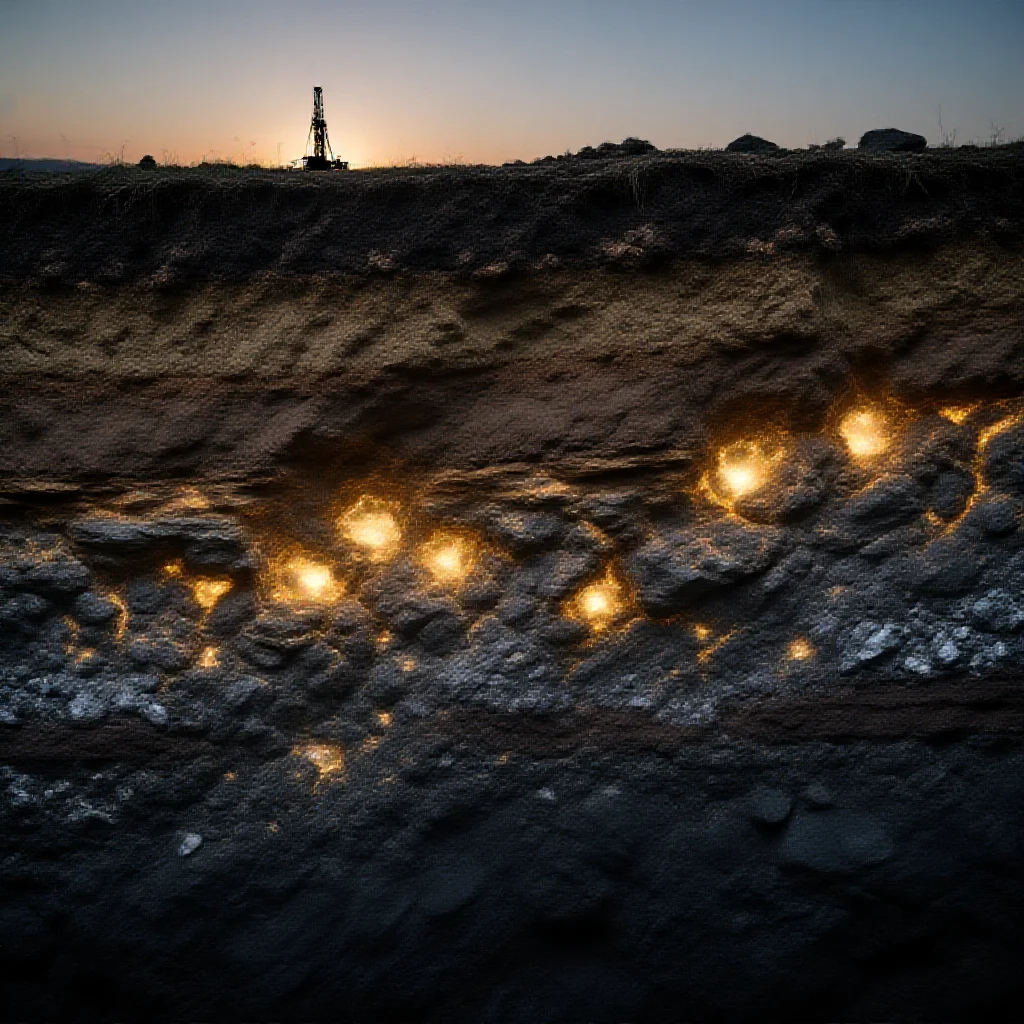
From Mali to the Midwest: The Geologic Hydrogen Rush and Its Unresolved Commercial Equation
The Mali Proof Point: A Decade of Purity Disrupts Energy Assumptions
The foundational case study for natural, or "white," hydrogen is a single well drilled in 2012 in Bourakébougou, Mali. This well has produced a continuous stream of gas measured at 98% pure hydrogen for over a decade. (Source 1: [Primary Data]) This discovery directly challenged the long-standing industrial paradigm that hydrogen is solely a manufactured product, derived from natural gas (blue hydrogen) or water electrolysis (green hydrogen). The existence of a commercially viable, high-purity reservoir shifted scientific consensus from pervasive skepticism to targeted, evidence-based inquiry. The Mali well serves as an empirical proof point that natural hydrogen systems can exist and persist, providing a tangible template for a new resource category.
Mapping the Potential: USGS Numbers and the American Exploration Front
Quantifying the scale of this resource has become a primary focus. A 2024 study by the U.S. Geological Survey (USGS) estimated a mean of 5.5 trillion metric tons of natural hydrogen could exist in the Earth's subsurface. (Source 2: [Primary Data]) This theoretical resource estimate, while vast, is presented with significant caveats regarding geologic probability and accessibility. Concurrently, strategic public funding is catalyzing exploration. In 2024, the U.S. Department of Energy (DOE) awarded a $20 million grant to a consortium, including the University of Kansas, to explore for natural hydrogen, with a focus on the Midcontinent Rift system. (Source 3: [Primary Data]) This pairing of a monumental resource estimate with directed federal investment marks the transition of geologic hydrogen from a geologic curiosity to a formal exploration target within the national energy strategy.
The Core Commercial Chasm: Why Discovery Does Not Equal Production
The acceleration of exploration activities obscures a fundamental commercial disconnect. The technical pathway from discovery to cost-effective, scalable production remains largely uncharted. Reservoir engineering for native hydrogen presents unique challenges; hydrogen is highly buoyant, reactive, and prone to microbial consumption, unlike more inert methane. The industry must shift from a "manufacturing" mindset, where production is engineered and controlled, to a "mining" mindset, dealing with the inherent unpredictability of natural accumulation. Critical production data—reliable flow rates, predictable decline curves, and evidence of reservoir recharge—are almost entirely absent. Without this data, projecting the economic lifespan and output of a potential hydrogen field is speculative, rendering bankable project finance currently unattainable.
Beyond the Wellhead: The Missing Links in the Value Chain
Commercialization hurdles extend far beyond the reservoir. The existing energy infrastructure is not designed for pure geologic hydrogen. There are no dedicated large-scale gathering systems, pipelines, or storage solutions tailored for this resource. The economic modeling challenge is pronounced: how to price a "mined" commodity against "manufactured" alternatives (blue, green) when there is no established production cost history. Furthermore, a regulatory vacuum exists. No legal or leasing framework in the United States explicitly governs the ownership and extraction rights for native hydrogen, creating uncertainty for investors and landholders. The value chain from wellhead to consumer is a series of unresolved links, each representing a significant risk and cost variable.
Strategic Pathways: Bridging the Gap Between Geoscience and Commerce
The strategic pathway forward relies on systematically converting geologic potential into commercial knowledge. Government funding, such as the DOE grant, serves to de-risk the earliest stages of exploration and subsurface characterization. A plausible near-term model involves treating natural hydrogen deposits as a low-carbon feedstock within existing or planned regional hydrogen hubs, potentially blending it with manufactured hydrogen to improve overall economics and reduce carbon intensity. The long-term outlook positions geologic hydrogen not as an imminent, standalone solution, but as a potential component in a diversified hydrogen economy. Its ultimate role will be determined not by the scale of theoretical resources, but by the iterative resolution of its complex commercial equation—where each solved technical and infrastructural variable brings a hypothetical trillion-ton resource incrementally closer to market reality.