Policy Analysis for Climate Resilience: A Strategic Guide to Designing and Implementing Effective Frameworks
This guide explores how policy analysis can be systematically designed and applied to enhance climate resilience. Drawing on insights from the Grantham Research Institute on Climate Change and the Environment at the London School of Economics, it examines the economic logic behind resilience planning, the dual-track nature of fast versus slow policy analysis, and the often-overlooked supply chain vulnerabilities that climate policies expose. The article provides a step-by-step framework for building robust policy models, integrating stakeholder input, and navigating uncertainty. It also discusses how sustainability policy analysis can bridge short-term political cycles with long-term adaptation needs, offering evidence-based recommendations for policymakers, analysts, and sustainability practitioners.
Policy Analysis for Climate Resilience: A Strategic Guide to Designing and Implementing Effective Frameworks
**Summary:** Climate resilience requires proactive, evidence-based decision-making. Policy analysis provides the structured framework to quantify trade-offs, embed uncertainty, and align short-term political cycles with long-term adaptation needs. Drawing on methodologies from the Grantham Research Institute on Climate Change and the Environment at the London School of Economics, this article examines the economic logic of resilience planning, the dual-track nature of fast versus slow analysis, and the often-overlooked supply chain vulnerabilities in policy models. It offers a step-by-step framework for building robust policy models and discusses the persistent challenges of uncertainty, equity, and time horizons.
---
Introduction: Why Policy Analysis Matters for Climate Resilience
Climate resilience investments face a structural economic paradox: high upfront costs are incurred for benefits that materialize only probabilistically over decades. Policy analysis resolves this tension by quantifying the net present value of avoided losses, the option value of flexible adaptation pathways, and the co-benefits of ecosystem services. A 2023 working paper from the Grantham Research Institute on climate adaptation cost-benefit analysis demonstrated that for every dollar invested in flood defenses, expected losses over a 30-year horizon decline by an average of 4 to 6 dollars, depending on discount rate assumptions (Source: Grantham Research Institute, 2023). Such analysis transforms resilience from an abstract moral imperative into a fiscally defensible allocation of public and private capital.
The Grantham Institute’s framework integrates climate projections, economic models, and social equity indicators—moving beyond gross domestic product to metrics such as “adaptive capacity per capita” and “ecosystem service resilience.” This multidimensional approach is the benchmark against which any serious resilience policy analysis must be measured.
---
Dual-Track Selection: Fast vs. Slow Policy Analysis
Policy analysis for climate resilience operates on two distinct tracks, each with a specific purpose, time horizon, and methodological rigor.
**Fast-track analysis** is triggered by acute climate shocks—a flood event, a heatwave, a wildfire outbreak. Its function is verification: assessing whether existing policies (e.g., emergency response protocols, insurance payout formulas) remain fit for purpose under the realized event. The typical turnaround is days to weeks. The analysis uses historical damage functions, real-time hazard data, and pre-calculated vulnerability maps. Decisions are binary: activate or not activate a policy lever.
**Slow-track analysis** is the subject of this guide. It is a deep, iterative examination of systemic vulnerabilities and structural reforms. Time horizons span one to five years. It employs scenario planning, Monte Carlo simulations, and stakeholder co-creation. The output is not a single policy but a portfolio of adaptation pathways with conditional triggers.
The selection criterion is straightforward: fast analysis for crisis management where decision speed is paramount; slow analysis for systemic vulnerability reduction and long-term infrastructure planning. Governments that conflate the two—using fast tools for slow problems, or vice versa—produce either shallow reforms or delayed responses that compound risk.
---
Designing a Resilience-Centered Policy Analysis Framework
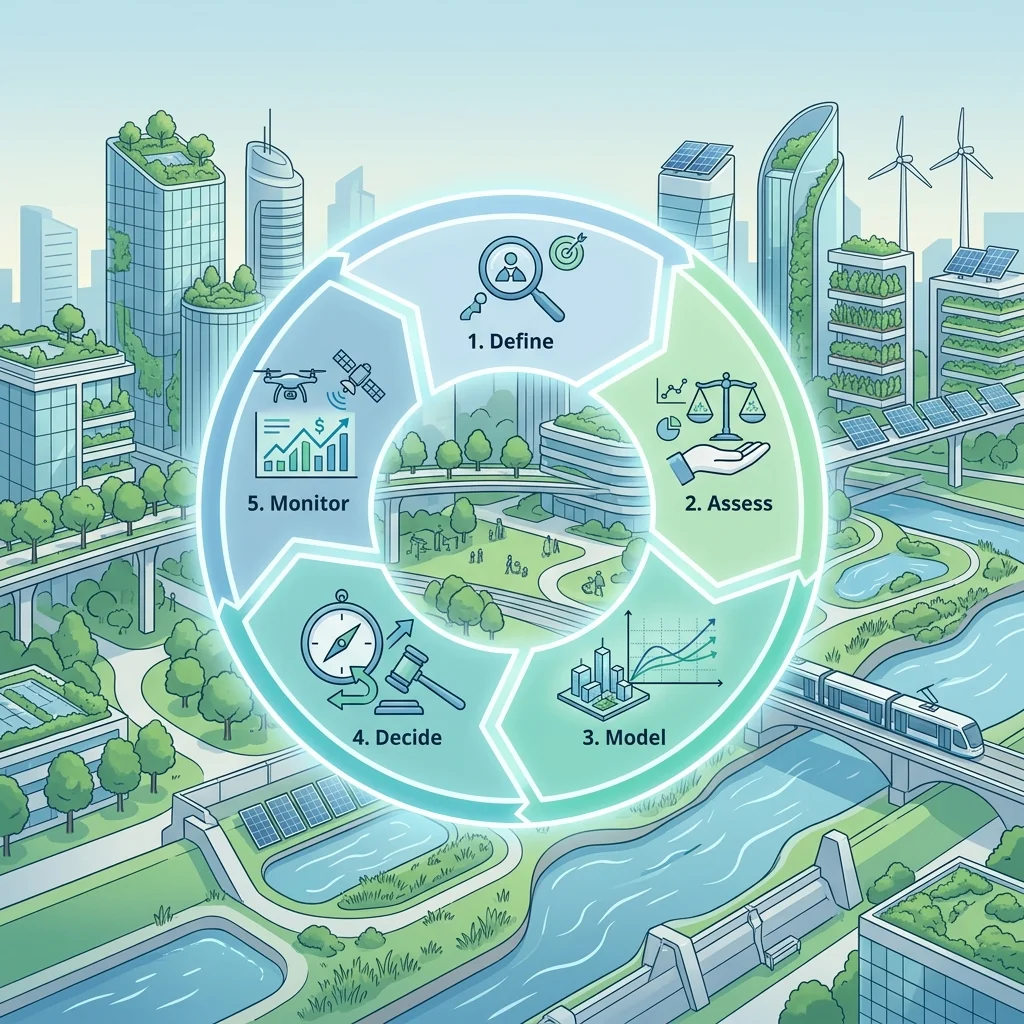
A robust policy analysis framework for climate resilience comprises four interconnected stages:
1. **Problem definition and system boundaries.** This requires delineating the geographic scope (e.g., coastal zone, urban watershed), the hazard vector (e.g., sea-level rise, precipitation extremes), and the assets at risk (physical, economic, social). The Grantham Institute’s 2022 report on London’s climate resilience explicitly bounded the system to the Thames Estuary 2100 Plan area, excluding upstream groundwater effects to maintain analytical tractability (Source: Grantham Research Institute, 2022).
2. **Data collection and model construction.** Climate projections must be downscaled to the decision-relevant scale. Economic models then translate physical changes into output losses, capital depreciation, and fiscal impacts. The critical innovation in Grantham-style analysis is the coupling of climate models with agent-based economic models that capture behavioral responses—such as firms relocating supply chains or households investing in retrofits.
3. **Embedding uncertainty.** Single-point forecasts are useless for climate policy. The standard approach is to generate an ensemble of climate scenarios (e.g., Representative Concentration Pathway 2.6, 4.5, and 8.5) and run Monte Carlo simulations over economic parameters. This yields probability distributions of outcomes, not deterministic forecasts. The Grantham Institute’s ‘resilience metrics’ incorporate a confidence interval for each indicator, ensuring that policymakers see the range of plausible futures.
4. **Stakeholder validation and policy option ranking.** Neither model nor data can substitute for local knowledge. Stakeholder workshops identify overlooked vulnerabilities, calibrate discount rates to community preferences, and reject options that are technically optimal but politically infeasible.
The output is a transparent, revisable policy portfolio with explicit triggers for switching between pathways as new climate data emerges.
---
Deep Entry Point: Supply Chain Vulnerabilities Hidden in Policy Models
Most policy analyses commit a common error: they assess only direct, first-order impacts. A flood damages buildings, so flood defenses are evaluated accordingly. But resilience policy that ignores supply chain cascades systematically underestimates systemic risk.
Consider a carbon tax designed to reduce domestic emissions. A policy analysis limited to direct effects would show lower industrial emissions. A supply-chain-aware analysis, however, would examine where production shifts. The Grantham Institute’s 2024 research on global trade and climate fragility found that carbon pricing in OECD countries increased the share of emissions-intensive imports from regions with weak climate adaptation infrastructure (e.g., South Asian textile hubs vulnerable to monsoon intensification). The net effect: a reduction in domestic emissions but an increase in global supply chain fragility, because a single monsoon disruption now cuts production across multiple geographies.
The implication for policy design: every resilience policy analysis should include a **supply chain stress test**. This involves mapping the top N nodes in the value chain, overlaying climate hazard probabilities, and computing the expected loss of final output under a cascading failure scenario. Policies that pass this stress test are genuinely resilience-enhancing; those that fail create hidden systemic vulnerabilities.
---
Application Challenges: Uncertainty, Equity, and Time Horizons
Three persistent challenges undermine the credibility of even the best-designed policy analysis.
**Uncertainty** cannot be eliminated. The solution is not to demand more precise climate models but to embed adaptive management into policy design. This means sunset clauses in legislation, mandatory review intervals, and pre-agreed adjustment triggers. The Grantham Institute’s “dynamic adaptive policy pathways” framework formalizes this: policies are designed as sequences of branching decisions rather than fixed rules.
**Equity** is often treated as an afterthought. Resilience investments that concentrate benefits in high-value coastal real estate while leaving low-lying informal settlements unprotected are economically efficient under standard cost-benefit analysis but socially destabilizing. Policy analysis must incorporate equity weights or set a floor on minimum protection standards. The 2023 Grantham Institute note on distributive impacts of adaptation finance recommended that benefit-cost ratios be calculated separately for income deciles (Source: Grantham Research Institute, 2023).
**Time horizons** clash with political cycles. A four-year election cycle cannot accommodate the 50-year return period of a coastal defense. The solution is institutional: creating independent statutory bodies—such as the UK’s Climate Change Committee—that operate on legislative mandates independent of electoral calendars. These bodies commission the slow-track analyses and report publicly, creating a political cost for ignoring long-term risk.
---
Conclusion: Bridging Analysis and Action
The gap between policy analysis and policy implementation remains wide. Part of the explanation is analytical failure: analyses that are too opaque, too static, or too narrow gain no traction. The Grantham Research Institute’s work demonstrates that rigorous, transparent, and iterative analysis can achieve policy influence when it is designed as a decision-support tool rather than a forecasting exercise.
Looking forward, three trends will shape the field: first, the integration of machine learning to rapidly update vulnerability assessments as new disaster data becomes available; second, the codification of supply chain stress tests into standard policy analysis templates; third, the growing demand for adaptation audits by institutional investors, who increasingly require climate resilience scores for bond and infrastructure portfolios.
Policy analysis will not eliminate the deep uncertainty of a changing climate. But it provides the only rational basis for allocating scarce resources to reduce vulnerability. The frameworks outlined here, grounded in the methodologies of leading research institutions, offer a replicable architecture for governments and organizations seeking to move from reactive crisis management to systematic resilience building.