Policy Mixes for Sustainability Transitions: A Deep Framework for Analyzing Energy Transition Policy Design
This article examines how policy mixes shape sustainability transitions, using Rogge and Reichardt’s interdisciplinary framework to explain policy design beyond single instruments. The core logic is that technological change, market formation, and institutional coordination must be aligned through a mix of policy elements, policy processes, and policy characteristics. The piece focuses on the German energy transition as a practical test case, showing why renewable power adoption depends not only on incentives, but on timing, coherence, stability, and interaction across policies. Best suited for slow analysis, this topic supports a deep audit of sustainability policy analysis, with emphasis on long-term system change rather than short-term policy headlines.
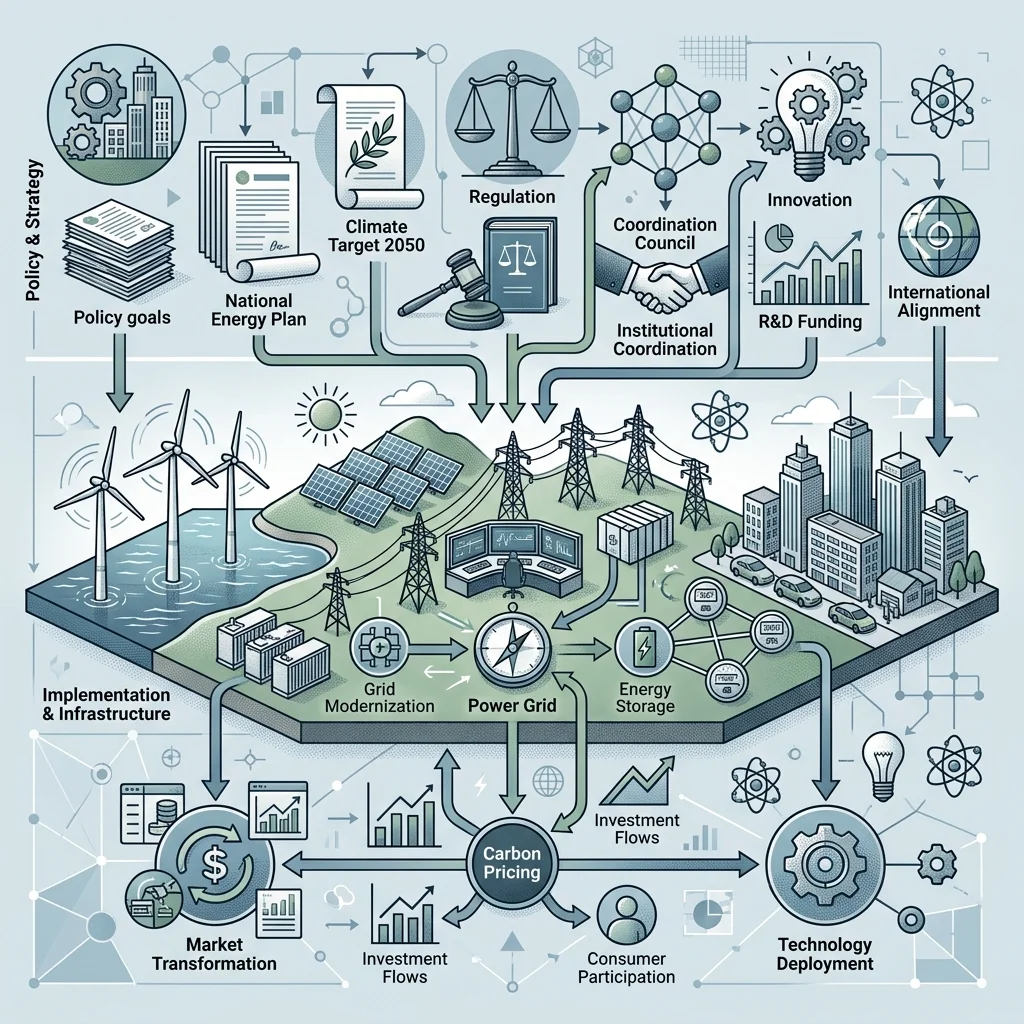
Policy Mixes and Sustainability Transitions: A Framework for Energy Transition Policy Design
*Based on concepts from Rogge and Reichardt’s policy mix framework, and informed by sustainability transitions, innovation studies, and environmental economics.*
Introduction
Energy transition policy is often discussed instrument by instrument: a subsidy for solar panels, a carbon price, a grid upgrade, or a permitting reform. This approach can be useful for describing individual measures, but it does not fully capture how transitions unfold in practice. Sustainability transitions are system changes. They involve technology diffusion, market formation, institutional adjustment, and shifts in expectations over time. In that setting, the design of a **policy mix** becomes a more useful unit of analysis than any single policy tool.
The policy-mix literature argues that outcomes depend not only on whether a policy exists, but on how different policies interact. A feed-in tariff may support renewable power deployment, but its effect can be weakened if grid regulation is slow, permitting rules are inconsistent, or fossil fuel subsidies remain in place. At the same time, a policy mix can also fail if it is too complex, poorly sequenced, or unstable across political cycles. The framework therefore does not assume that more policy is always better. It asks a more specific question: under what conditions do policy elements, policy processes, and policy characteristics align enough to support structural change?
[IMAGE: A layered editorial illustration of an energy transition system showing wind turbines, solar panels, grids, regulatory documents, and institutional nodes connected by arrows]
Why policy mixes matter more than single instruments
Single policy instruments can play an important role, but they rarely operate in isolation. Renewable power deployment depends on a chain of conditions: investment confidence, technological learning, grid access, demand creation, and regulatory coordination. If one part of that chain is missing, the policy effect may be partial or delayed.
This is one reason sustainability policy analysis increasingly uses the concept of policy mixes. A mix can combine:
- price-based instruments, such as carbon taxes or emissions trading;
- support measures, such as subsidies, tax credits, and feed-in tariffs;
- regulation, such as emissions standards or renewable portfolio requirements;
- public investment in infrastructure and research;
- planning and coordination tools, such as permitting reforms or network expansion.
The logic is not that every policy must do everything. Rather, different instruments address different failure modes. A subsidy may lower cost barriers, while a standard creates market demand, and public planning reduces coordination problems. Used together, these can reduce uncertainty and mobilize capital more effectively than a single intervention.
However, policy mixes can also create overlap and confusion. If support schemes are changed too often, firms may delay investment. If regulatory agencies work at cross-purposes, deployment can stall. If policies are poorly targeted, they may lock in inefficiencies or increase public cost without changing the underlying system. In some cases, a single well-designed instrument can be effective, especially where the problem is narrow, the market structure is simple, or institutional capacity is limited. The point is not that policy mixes always outperform single instruments, but that transitions usually involve interdependent barriers that one tool alone cannot address.
The core mechanism: technology diffusion and market formation
At the center of the policy-mix framework is a basic economic observation: technology adoption is shaped by risk, expectations, and learning. Renewable power technologies often face high upfront costs, uncertain returns, and infrastructure constraints. Policy design affects these conditions directly.
A good policy mix can influence:
1. **Cost trajectories** Early support can move technologies down learning curves through scale, repetition, and experience.
2. **Risk allocation** Stable revenue frameworks lower financing costs and make capital deployment more predictable.
3. **Demand formation** Standards, quotas, and procurement policies create markets that may not emerge on their own.
4. **Infrastructure coordination** Grid investment, interconnection rules, and storage policy help align generation with system needs.
5. **Innovation incentives** Research funding and demonstration support can move technologies from laboratory development to commercial use.
This process is often sequential. At the early stage, experimentation matters. Later, scaling becomes more important. Policies that are well suited to one phase may be less effective in another. For example, a grant for pilot projects may help new technologies enter the market, but it may not support large-scale deployment without complementary market rules and infrastructure planning. Likewise, a generous deployment subsidy can accelerate adoption, but if it is introduced before technical standards or grid readiness are in place, it may generate bottlenecks.
[IMAGE: A clean flow graphic linking policy design to innovation, investment, deployment, and market growth]
An interdisciplinary framework
Rogge and Reichardt’s framework is useful because it combines insights from three fields.
Innovation studies Innovation studies focus on technological learning, niche development, and transition pathways. From this perspective, policy is not only about correcting market failures. It also shapes expectations, experimentation, and early-stage adoption. This helps explain why long-term support and policy credibility matter.
Environmental economics Environmental economics emphasizes incentives, externalities, and cost-effectiveness. It asks whether policies internalize environmental damage, how they influence investment, and whether they minimize social cost. This perspective is useful for comparing policy tools, but it can overlook coordination problems and institutional change.
Policy analysis and governance Policy analysis examines design, implementation, administrative capacity, and political feasibility. It draws attention to timing, sequencing, legitimacy, and enforcement. This matters because even a theoretically sound instrument can fail if agencies cannot implement it consistently or if regulations change too often.
The value of the framework lies in combining these perspectives. Each field captures a different source of failure. Innovation studies explains learning dynamics, economics explains incentives, and governance analysis explains why implementation often diverges from design. The limitation is that interdisciplinary frameworks can become broad enough to describe many cases without offering precise predictions. That is why operational criteria are needed.
The three building blocks: elements, processes, and characteristics
The policy-mix framework can be broken into three analytical building blocks.
1. Policy elements Policy elements are the visible parts of the mix: objectives, instruments, targets, and settings. These are the “what” of policy design.
Examples include: - renewable electricity targets; - feed-in tariffs or contracts for difference; - carbon pricing; - grid access rules; - public research funding; - permitting requirements; - fossil fuel subsidy reform.
Analytically, the question is not only whether the elements exist, but whether they are aligned. A transition-oriented mix should avoid contradictory signals. For example, support for renewables may be offset if fossil capacity continues to receive fiscal or regulatory advantages.
2. Policy processes Policy processes concern how the mix is created, revised, and implemented. These are the “how” and “when.”
Key process questions include: - How were the instruments sequenced? - Were they introduced together or in stages? - How often are they revised? - Do ministries and agencies coordinate? - Are feedback mechanisms in place?
This dimension matters because transitions unfold over time. Policies may need adjustment as technologies mature. A static policy mix can become obsolete if it does not adapt to changing cost structures or infrastructure constraints. Yet excessive policy revision can create instability. The challenge is not simply flexibility, but credible adjustment.
3. Policy characteristics Policy characteristics describe the qualities that determine whether the mix can work in practice. These are the “conditions of effectiveness.”
Important characteristics include:
- **Consistency**: Do the measures reinforce each other, or do they pull in different directions?
- **Coherence**: Are policy goals, instruments, and administrative responsibilities logically aligned?
- **Credibility**: Do firms and investors expect the policy to remain in place long enough to matter?
- **Stability**: Is the policy framework durable across electoral cycles and ministerial changes?
- **Flexibility**: Can the mix be revised as technologies and market conditions change?
- **Comprehensiveness**: Does it address both supply and demand, as well as infrastructure and institutions?
- **Timing**: Are policies introduced in the right sequence for the stage of transition?
These characteristics are often more important than headline ambition. A generous but unstable subsidy can be less effective than a more modest but credible framework. Similarly, a comprehensive mix may still underperform if agencies cannot coordinate implementation.
[IMAGE: Three overlapping circles labeled innovation, economics, and governance converging on sustainability transitions]
How to assess a policy mix: a practical diagnostic
A deeper analysis of sustainability policy design should move beyond description and ask diagnostic questions. The following framework can be used to evaluate an energy transition policy mix.
A. Interaction diagnosis - Do policies complement each other, or do they duplicate effort? - Are there incentives that conflict across ministries or regulatory levels? - Does one instrument undermine another, such as subsidies that weaken price signals?
B. Sequencing diagnosis - Is the policy mix designed for the current stage of the technology lifecycle? - Are infrastructure and permitting ready before large-scale deployment incentives begin? - Are innovation measures in place before strict market requirements are imposed?
C. Implementation diagnosis - Which institutions are responsible for each element? - Do agencies have capacity, data, and enforcement authority? - Are monitoring and adjustment mechanisms built into the design?
D. Stability diagnosis - How exposed is the mix to reversal after elections or budget changes? - Are support commitments legally or financially credible? - Can firms reasonably plan multi-year investments?
E. System diagnosis - Does the mix address generation, grids, storage, demand, and industrial supply chains together? - Are fossil-based incumbents still supported through other policy channels? - Are transition costs distributed in a way that sustains political legitimacy?
This kind of diagnosis makes the framework operational. It also shows why policy success cannot be judged by one indicator alone. A policy may increase installed renewable capacity while still failing to reduce system congestion, improve equity, or build durable institutions.
The German energy transition as an empirical test case
Germany’s energy transition, often discussed under the term *Energiewende*, is a useful test case because it shows both the strengths and the limits of policy mixes. Early renewable expansion was supported by stable feed-in tariffs, priority grid access, and a clear investment signal. These measures helped create a market for renewable electricity and supported learning-by-doing.
At the same time, the German case also illustrates policy tension. Expansion of renewable generation did not automatically solve grid bottlenecks, system integration, or permitting delays. In some phases, support levels were revised in ways that created uncertainty. Policy interaction with electricity market reforms and network planning became increasingly important as renewable penetration rose.
The German case suggests that transitions require more than deployment incentives. They require alignment between: - generation support; - grid expansion; - market design; - flexibility resources; - industrial policy; - administrative coordination.
It also shows that success is uneven across time. A policy mix may work well in one phase and become less effective later. Early-stage diffusion can be relatively straightforward when costs are falling and public support is strong. Later-stage integration is often harder because the policy challenge shifts from adoption to system coordination.
Limitations and counterpoints
A balanced assessment should also note where the policy-mix framework has limits.
First, policy mixes can be difficult to analyze empirically. When many instruments act at once, causal attribution becomes uncertain. It may be unclear which element mattered most, or whether the outcome resulted from external market trends rather than policy design.
Second, coordination itself has costs. A larger mix can increase administrative burden, make compliance harder, and create more opportunities for inconsistency. In settings with limited state capacity, a simpler instrument may perform better than a complex package.
Third, policy mixes may generate political trade-offs. Measures that are efficient in theory can face resistance if they impose visible costs on households or firms. This can reduce durability even when the mix is economically coherent.
Fourth, transitions are not only technical and economic. They are also political. Incumbent interests may slow implementation, weaken enforcement, or reshape policy content. The framework can identify these pressures, but it does not automatically resolve them.
Finally, there are cases where a single instrument is appropriate. A narrow pollution problem, a specific technical standard, or a localized infrastructure constraint may not require a broad mix. The analytical task is to match the policy architecture to the problem structure, not to assume that complexity is always an advantage.
Conclusion
The policy-mix approach offers a structured way to study sustainability transitions because it treats energy transition policy as a system of interacting measures rather than a list of isolated interventions. Drawing on Rogge and Reichardt’s framework, the analysis highlights three dimensions: policy elements, policy processes, and policy characteristics. Together, these help explain why renewable power adoption depends on more than incentives alone.
For sustainability policy analysis, the key question is not whether a policy exists, but whether it is coherent, credible, sequenced, and adaptable enough to support long-term system change. The German energy transition shows that alignment across technology, markets, and institutions can accelerate deployment, but it also shows how instability, coordination failures, and policy conflict can limit outcomes. A rigorous framework therefore needs both explanatory breadth and diagnostic precision.
In that sense, policy mixes are not a slogan for “more intervention.” They are a way to analyze how different policy components interact over time, where they fail, and what kind of design is needed to move from experimentation to durable transition.
Source note
This article summarizes concepts associated with the policy-mix literature in sustainability transitions, especially the framework developed by Rogge and Reichardt, and connects them with themes from innovation studies, environmental economics, and policy analysis. It is a transparent synthesis rather than a direct reproduction of any single source.