Renewable Energy Markets in 2025: Investment Boom, Grid Bottlenecks, and the Race to 2030
Renewable energy is no longer a niche transition story—it is a large-scale market reshaping electricity supply, capital flows, and industrial supply chains. Nearly 30% of global electricity now comes from renewables, up from 20% in 2011, while clean energy investment hit $2.1 trillion in 2024. Yet the market is not scaling smoothly: supply chain imbalances, permitting delays, aging grids, and policy uncertainty are becoming the main constraints on growth. This article will examine the hidden economic logic behind the renewables boom, including why solar and wind are winning on cost, where bottlenecks are shifting from generation to infrastructure, and how the race to 2030 may determine whether net-zero goals remain credible.
Renewable Energy Markets in 2025: Investment Surges, Grid Constraints, and the Race to 2030
Renewable energy has moved from a niche policy theme to a major force in the global power market. In many countries, solar, wind, batteries, and related grid assets are now central to planning for new electricity supply. According to the **International Energy Agency (IEA), Renewables 2024**, renewables account for nearly **30% of global electricity generation**, up from about **20% in 2011**. The IEA also projects in its **Renewables 2024** outlook that renewable generation could exceed **17,000 terawatt-hours by 2030** under current policy settings.
That growth matters beyond the power sector. It is changing where capital goes, which industrial suppliers gain pricing power, and which parts of the electricity system face the most pressure. In practice, the market story in 2025 is no longer only about adding more generation capacity. It is also about whether grids, permitting systems, supply chains, and storage resources can keep pace.
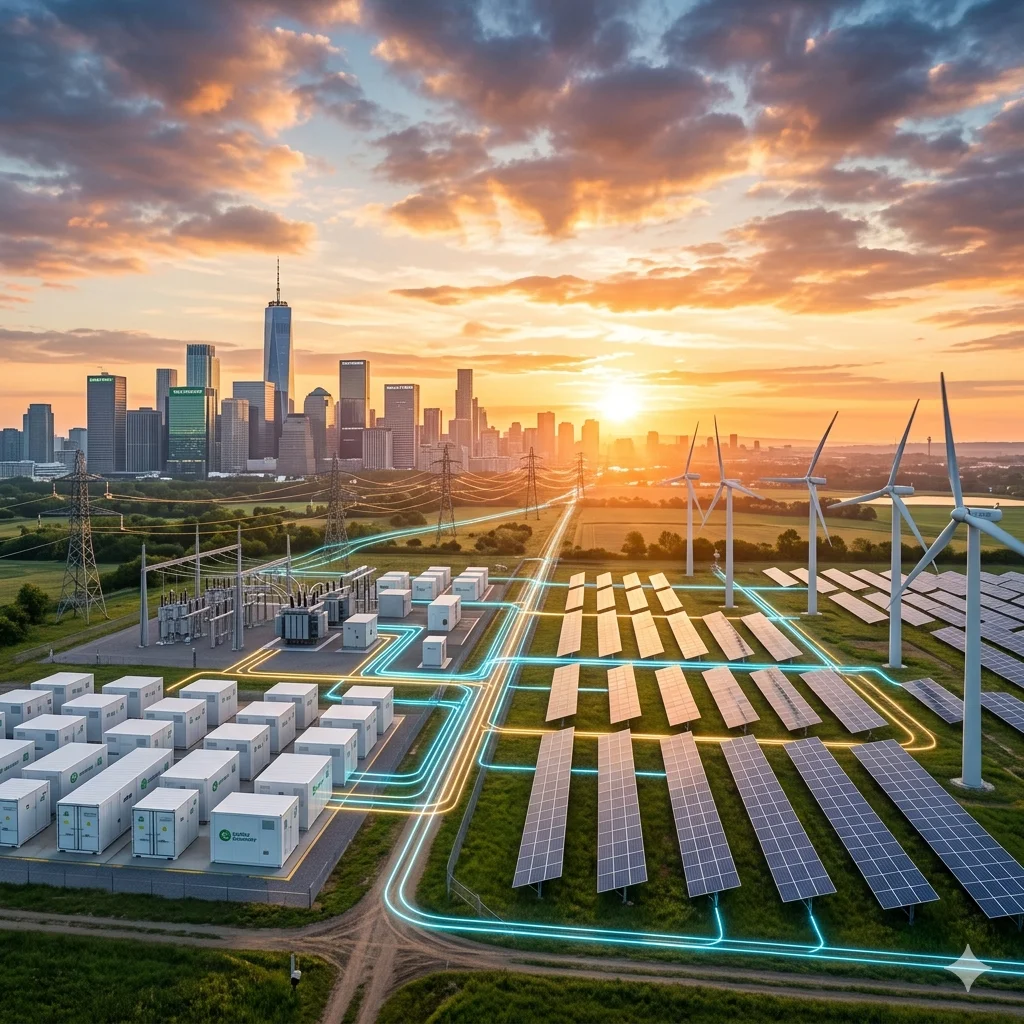
[IMAGE: A wide editorial view of solar farms, wind turbines, battery storage units, and transmission lines connected to a modern power grid at sunrise]
Renewables are becoming a baseline source of power
The most important market shift is that renewables are increasingly treated as part of the default electricity mix rather than a separate transition segment. That change can be seen in deployment data, utility procurement, and long-term capacity planning.
The IEA’s **Renewables 2024** report shows that solar and wind continue to lead new capacity additions in many regions. Their appeal is not only environmental; it is also economic. In a growing number of markets, utility-scale solar and onshore wind are among the lowest-cost options for new electricity generation on an unsubsidized basis, although actual project economics still vary by financing costs, land access, grid connection fees, and local permitting rules.
This creates a broader market implication. The renewables story is now a reallocation story: money is shifting from conventional generation toward generation equipment, grid hardware, storage systems, software, and flexible infrastructure. The scale of the change can be large enough to affect industrial supply chains, commodity demand, and utility balance sheets.
Why this is a slow analysis, not a headline reaction
A quick reading of the market can be misleading. It is easy to focus on annual installation records or investment totals and conclude that the transition is simply accelerating in a straight line. A slower analysis shows a more complicated picture.
First, growth rates do not translate directly into system readiness. A solar project may be economically attractive, but it still requires land, transformers, inverters, interconnection studies, and a grid that can absorb variable output. Delays in any one of those stages can push projects back by months or years.
Second, investment totals can obscure concentration. Large capital flows may be arriving, but they are not always reaching the same geographies or technologies. Some markets are financing utility-scale solar and storage at speed, while others are still constrained by permitting or transmission shortages. A headline investment number therefore says little about whether capital is being deployed efficiently.
Third, policy support can change project timing without changing the underlying need for infrastructure. Tax incentives, auctions, and clean power standards may improve project economics, but they do not automatically solve interconnection queues or transmission congestion. For that reason, any market assessment in 2025 has to separate generation economics from system integration economics.
[IMAGE: Analyst desk with renewable project maps, investment charts, and grid congestion diagrams]
The hidden economic logic: cheap generation creates a bottleneck shift
Solar and wind have become cheaper in many regions over the past decade, and that cost decline helps explain the investment boom. But lower generation costs have also shifted the bottleneck elsewhere. The binding constraint is increasingly the ability to connect, balance, and move power.
Three areas matter most:
- **Grid interconnection:** In many markets, projects wait years for connection approvals and network upgrades.
- **Transmission capacity:** New generation is often built far from urban demand centers, increasing the need for long-distance lines.
- **Flexibility resources:** Batteries, demand response, and dispatchable backup power are becoming more important as variable renewables take a larger share of supply.
This is why the market logic is changing. In earlier phases of the transition, the main challenge was making clean generation cheaper than fossil alternatives. In 2025, the challenge is often whether the surrounding infrastructure can absorb the new supply. That does not mean generation is no longer the focus; it means generation alone is no longer sufficient.
For developers, this changes project strategy. Returns may depend not only on kilowatt-hours sold, but also on access to storage, grid services, and congestion management. For equipment suppliers, it increases demand for transformers, switchgear, power electronics, and digital control systems. For utilities, it raises the importance of integrated planning across generation, wires, and flexibility.
Investment surge: capital is flowing, but unevenly
The financing picture is large, but it is not uniform. According to the **IEA, World Energy Investment 2024**, global clean energy investment reached about **$2.1 trillion in 2024**, compared with roughly **$1.1 trillion for fossil fuel supply**. That gap indicates how strongly capital markets are already pricing the transition, even though the split varies by sector and region.
Within that total, solar and wind remain the largest individual investment categories. In the **IEA’s World Energy Investment 2024** assessment, spending on solar, wind, grids, storage, and electrification continued to rise, with solar alone accounting for a substantial share of new clean power investment. BloombergNEF’s **Energy Transition Investment Trends 2025** also points to continuing growth in capital allocated to clean power, though the composition of that capital differs by country and financing structure.
Corporate activity has also been significant, but classification matters. Some large transactions are straightforward mergers and acquisitions; others involve minority stakes, project portfolios, supply-chain deals, or strategic investments rather than full takeovers. For that reason, any figure on clean-tech M&A should be read carefully and tied to the specific dataset used. Where reported, **BloombergNEF** and related market trackers indicate that strategic buyers, including technology companies, have remained active in clean energy-related assets, but the exact dollar amount depends on whether one counts equity purchases, project acquisitions, or broader strategic transactions.
Policy has also influenced capital flows, though the effects differ by market. In the United States, the **Inflation Reduction Act of 2022** continues to shape project economics through tax credits and manufacturing incentives. In Europe, national support schemes, carbon pricing, and grid expansion plans remain important. In China, industrial policy, grid planning, and domestic manufacturing capacity play a larger role. These frameworks are different in design and implementation, and their effects should be described rather than ranked.
[IMAGE: Capital flow graphic showing clean energy financing, project pipelines, and infrastructure investment]
Grid bottlenecks are now a market variable
If the past decade was defined by falling equipment costs, the next phase may be defined by infrastructure constraints. Grid bottlenecks are no longer a technical side issue; they are part of the pricing and delivery structure of the market.
Aging transmission systems in many countries were not designed for distributed, variable, and geographically dispersed generation. As renewable penetration rises, utilities face new operational needs: voltage management, frequency response, better forecasting, and faster interconnection workflows. In some regions, these requirements are already affecting project economics.
This is also where the policy debate becomes more practical. Support for generation can bring rapid capacity growth, but without transmission buildout and faster permitting, the result may be a larger pipeline of delayed projects rather than a functioning power system. That is why grid modernization, while less visible than solar panels or turbines, is increasingly a core investment category.
For investors, this means grid equipment and software may capture value even when generation margins narrow. For policymakers, it suggests that expansion targets need to be matched with network plans. For utilities, it means that delay risk has become a financial risk.
China, the United States, and Europe are shaping different market models
The renewable energy market is not converging on a single model. Instead, major regions are developing distinct structures.
**China** remains central because of scale and manufacturing depth. It has built a dominant position in solar modules, battery supply chains, inverters, and related industrial inputs. Its advantage lies in **industrial capacity, domestic supply-chain integration, and scale-driven cost reductions**. That does not eliminate risk—trade restrictions, margin pressure, and overcapacity concerns remain relevant—but it does help explain why China continues to influence global pricing.
The **United States** is being shaped by tax incentives, private capital, and growing demand for grid-connected clean power. Here, the main constraint is often not project economics but infrastructure readiness and permitting timelines.
**Europe** has a different profile again. It combines ambitious decarbonization goals with tighter land-use, permitting, and grid coordination challenges. That can slow deployment even when policy support is strong.
These differences matter because they affect which companies and technologies will benefit. A grid equipment supplier may find stronger demand in one region than another. A module manufacturer may face pricing pressure in a market with excess supply. A battery developer may depend on rules for storage compensation and ancillary services. The market is therefore not one story but several overlapping ones.
The race to 2030 will test system credibility
By 2030, the key question may not be whether renewable generation keeps growing. The more important issue is whether the electricity system can absorb that growth without creating persistent congestion, reliability problems, or investment delays.
The IEA’s **Renewables 2024** outlook suggests that global renewable generation is on track to rise sharply by the end of the decade. But forecasts depend on execution. If transmission investment, interconnection reform, and storage deployment do not advance alongside generation, some projects may remain stranded or underutilized.
That would matter for climate targets, but also for market confidence. Developers need clarity on connection timelines. Lenders need visibility on grid access and revenue stability. Industrial buyers need confidence that renewable power can be delivered consistently. The race to 2030 is therefore not only about deployment volume; it is about whether the physical system can support the installed base.
Conclusion
The renewable energy market in 2025 is defined by two forces moving at once. On one hand, capital, policy, and technology continue to support rapid growth in solar, wind, storage, and related infrastructure. On the other hand, grid constraints, supply-chain imbalances, and permitting delays are increasingly shaping which projects proceed and when.
That combination suggests a more mature market than the one that existed a decade ago. The central challenge is no longer simply building more clean generation. It is building the network, flexibility, and industrial capacity needed to make that generation usable at scale.
For investors, utilities, and policymakers, the next five years will likely determine whether renewable energy becomes not just a fast-growing segment of the power mix, but a stable foundation for the broader electricity system.
[IMAGE: Distant skyline powered by renewable generation, with transmission lines and battery storage under a clear sunrise]